A Flutter app costs roughly $5,000 to $60,000 for an MVP, $10,000 to $80,000 for a mid-level app, and $40,000 to $200,000+ for a full platform. These are published market ranges. Your exact number depends on scope, backend depth, and who builds it.
The cost of Flutter app development swings that widely because quotes rarely price the same scope. This guide shows you how to fix that before you sign.
TL;DR
Price range: MVPs start in the low five figures. Full platforms reach six figures. Most of the spread comes from backend, integrations, and team location.
Why quotes differ: One vendor publishes $50k to $60k for a simple Flutter app. Another publishes $5k to $15k. Same label, different scope.
Where Flutter saves money: iOS and Android ship from one codebase. Backend, design, and QA still cost what they cost.
Budget for after launch too: store fees, hosting, API subscriptions, and maintenance.
Before you sign: run every quote through the 10-point checklist below.
Why Can't Anyone Give You a Straight Flutter Price?
Picture this: you send one feature list to three agencies, and the three quotes come back within 10% of each other.
Has that ever happened to you? Me neither. Here is why.
As a certified Flutter technical consultant, I review a lot of Flutter scopes. The most expensive mistake I see is a quote that prices the app but forgets the admin panel. The client notices later, and so does the budget.
That one gap is the pattern behind most confusing quotes. Below are two published ranges that show the problem.
Source | "Simple" Flutter app | "Complex" Flutter app |
|---|---|---|
$50,000 to $60,000 | $80,000 to $200,000+ | |
$5,000 to $15,000 | $40,000 to $120,000 |
Both use the word "simple," but what sits inside that word is completely different.
Flutter App Development Cost at a Glance: Budget Tiers From MVP to Full Platform
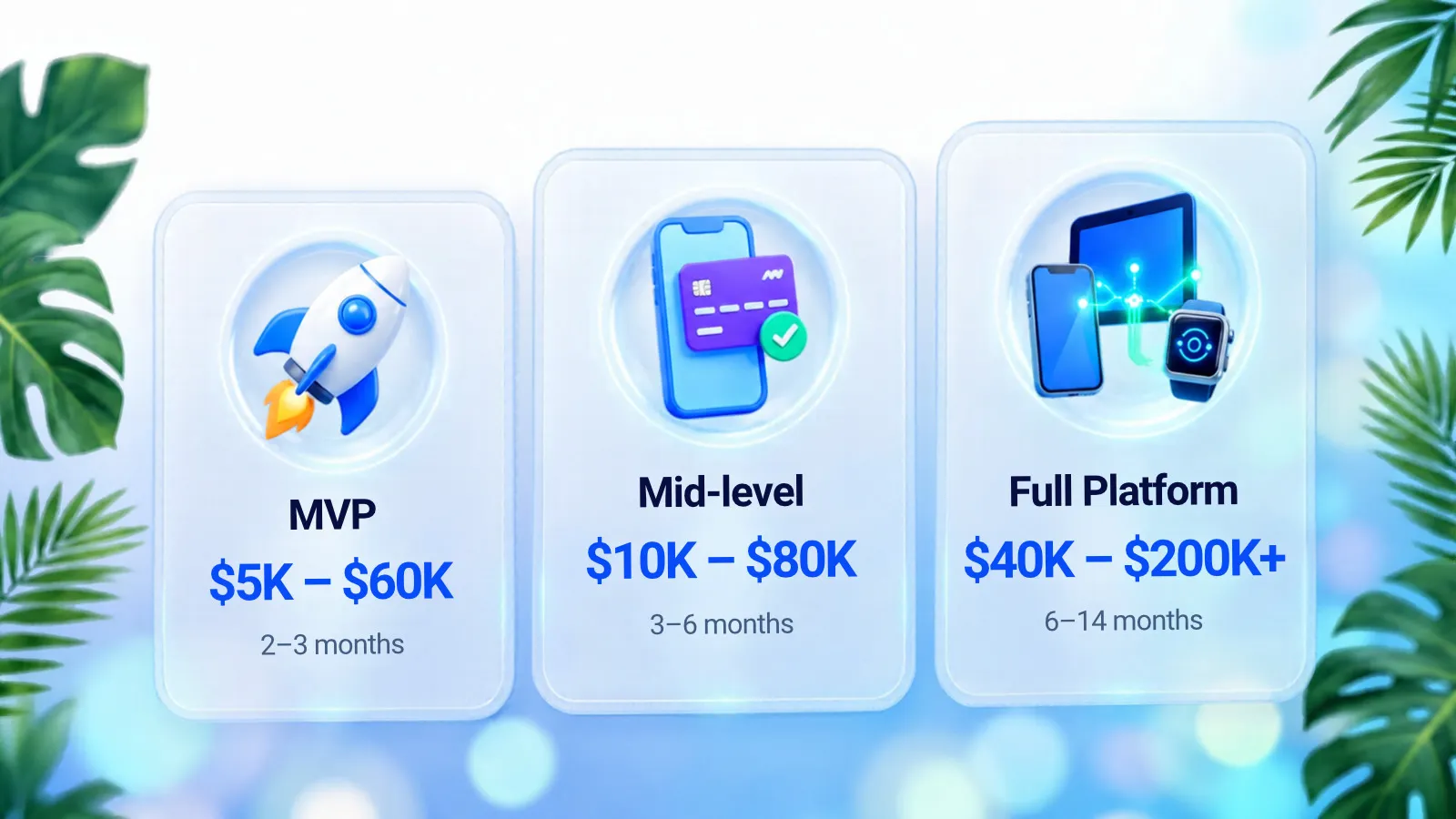
Pick your tier by the scope you need, not by the budget you hope for. The table below maps each tier to what you actually get.
Tier | Typical scope | Timeline | Published budget range | Best for |
|---|---|---|---|---|
MVP | 8 to 15 screens, auth, one core flow, basic backend | 2 to 3 months | $5,000 to $60,000 | Validating an idea with real users |
Mid-level | 20 to 40 screens, payments, push, admin panel, analytics | 3 to 6 months | $10,000 to $80,000 | Launching to paying customers |
Full platform | Multi-role apps, real-time features, web plus mobile, integrations | 6 to 14 months | $40,000 to $200,000+ | Scaling an operation or marketplace |
Where these numbers come from:
Timelines: Appinventiv's guide gives simple apps 2–3 months at $50,000–$60,000, medium 3–6 months at $60,000–$80,000, and highly complex 6–14 months at $80,000–$200,000+.
Lower bounds: ManekTech lists Simple $5k–15k; Medium $10k–50k; Complex $40k–120k.
How to read a range: the low end usually means an offshore team and a lean scope. The high end usually means a US team and a full scope.
MVP Flutter App: What You Get and What Drops Out
An MVP proves one thing works, and everything else waits.
Included: sign-up, one core user journey, simple backend (often Firebase), store release
Drops out: admin dashboard, advanced analytics, custom animations, multi-language support
Timeline: 2 to 3 months
→ One core flow + fast feedback = an MVP worth funding
Mid-Level Flutter App: What You Get and What Drops Out
This tier is where most real businesses launch.
Included: payments, subscriptions, push notifications, admin panel, role-based access
Drops out: offline-first sync, deep third-party integrations, web version
Timeline: 3 to 6 months
Example: a subscription fitness or booking app (see our fitness app development cost guide)
Full Platform Flutter App: What You Get and What Drops Out
A full platform is several apps sharing one backend.
Included: customer app, provider app, admin web, real-time tracking, integrations
Drops out: nothing critical, but the scope needs a paid discovery phase first
Timeline: 6 to 14 months, usually shipped in phases
Example: an on-demand or delivery marketplace (see on-demand app development with dispatch and tracking)
Quick Tier Self-Check: Which One Is Your App?
Answer five yes/no questions. Count your "yes" answers.
Do you need more than one user role (customer, provider, admin)?
Do users pay inside the app?
Do you need real-time features like chat, tracking, or video?
Do you handle health, payment, or identity data?
Do you need a web version alongside mobile?
0 to 1 yes = MVP tier
2 to 3 yes = Mid-level tier
4 to 5 yes = Full platform tier
Why Do Flutter App Quotes Differ So Much?
Quotes differ because each vendor prices a different scope. Here are the five gaps I see most often.

Scope Gaps Between Quotes
The cheapest quote usually prices only the screens.
Quote A: mobile app only
Quote B: mobile app + backend + admin panel
→ Same "app," roughly double the real scope
Team Location and Seniority
Hourly rates vary more by region than by framework. One vendor's rate table lists North America $40–250; Western Europe $35–180; Australia $35–150; South America $25–120; Eastern Europe $25–110; India and Asia $20–80 per hour.
Fixed Price vs Time and Materials
A fixed bid includes a risk buffer. Time and materials doesn't, but your total can drift.
Discovery Done vs Skipped
Teams that skip discovery quote low and reprice later.
Know why? The integration was never scoped.
The Hidden Backend
The backend often costs as much as the app.
APIs, databases, admin tools, and cloud functions are all real work
Ask every vendor: "Is the backend in this number?"
What Factors Affect Flutter App Development Cost?
Six factors drive almost every Flutter budget I review. Complexity and integrations move the number most.
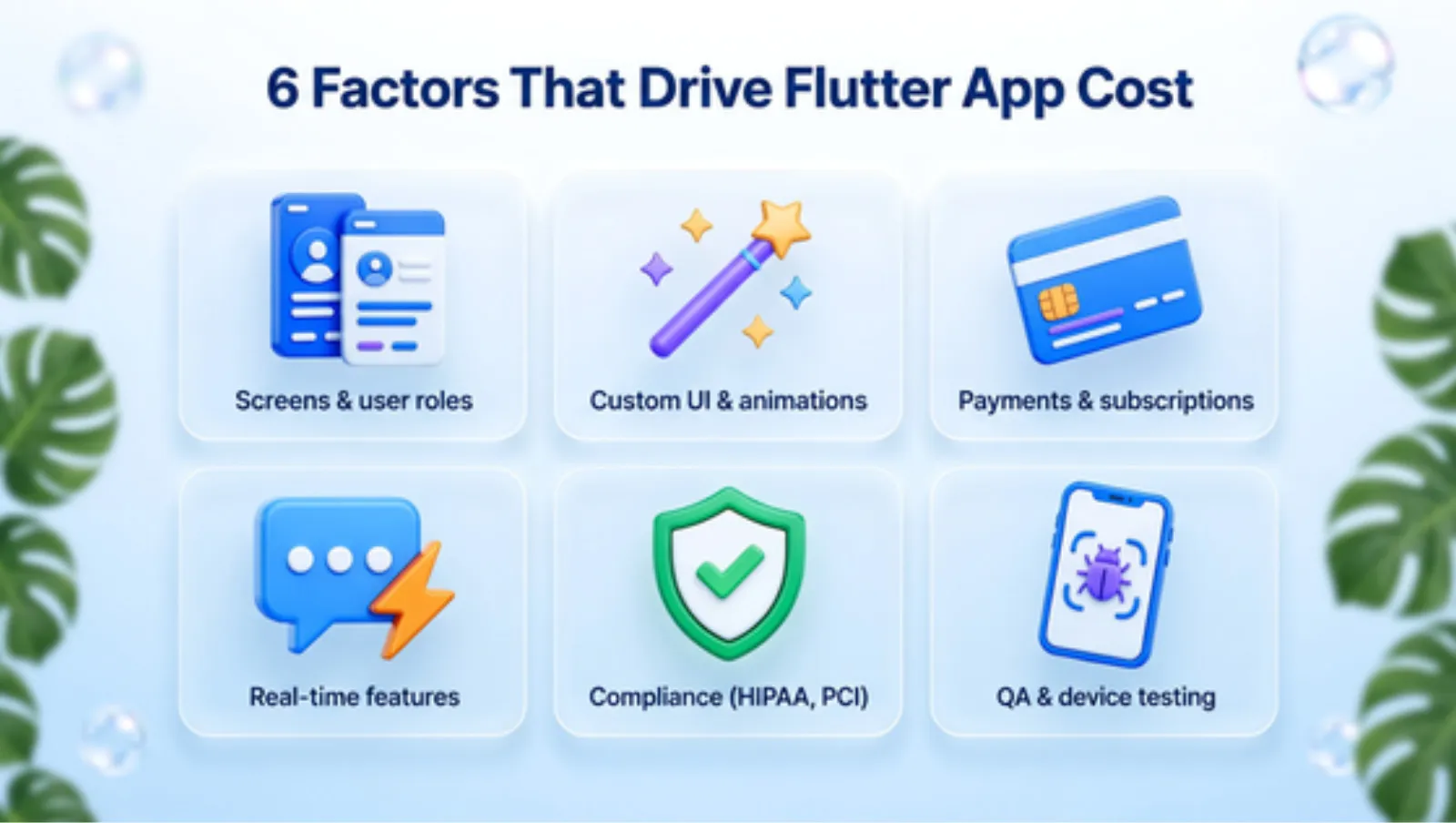
Factor | Effort level | Cost impact |
|---|---|---|
Screens and user roles | Scales with count | High |
Custom UI and animations | Medium to high | Medium |
Payments and subscriptions | Medium | Medium |
Real-time features (chat, tracking, video) | High | High |
Compliance (HIPAA, PCI) | High | High |
QA and device testing | Medium | Medium |
App Complexity and Number of Screens
More roles mean more apps. A rider app, a driver app, and an admin panel are three products, not one.
UI/UX Design and Animations
Custom motion looks great in a pitch deck, but it adds days per screen. It's fun to demo and less fun to invoice, so scope it down where you can.
Design alone adds up fast. One published breakdown puts UI at $5,000–$10,000+ and animations at $1,000–$10,000.
Integrations: Payments, Maps, Chat and Video
Each third-party SDK adds setup, testing, and failure handling.
Subscription apps: RevenueCat cuts the billing logic work
Video calling: see how we shipped Codex Meet on a single Flutter codebase
Compliance for Regulated Apps
Healthcare and fintech apps cost more because of the controls you build, not because of Flutter. We build to HIPAA technical safeguards: encryption, audit logs, and access controls. Our HIPAA compliant app development guide breaks those controls down.
Platforms: iOS, Android, Web and Desktop
One Flutter codebase can target all four. Each extra platform still needs its own testing and release work.
QA and Store Release
Testing on real devices is the step teams cut first and regret most.
Pro tip: Ask every vendor for their QA plan in writing. A missing QA line explains a suspiciously low quote faster than anything else.
Flutter Developer Rates and Pricing Models in 2026
Your team model changes the bill more than your feature list does. Match the model to your risk tolerance.
Freelancer vs Offshore Agency vs US Agency vs In-House
Model | Cost level | Speed | Risk | Best for |
|---|---|---|---|---|
Freelancer | Lowest | Variable | High (single point of failure) | Small fixes, prototypes |
Offshore agency | Low to mid | Fast | Medium | MVPs and mid-level apps |
US agency | High | Fast | Low to medium | Enterprise, regulated builds |
In-house team | Highest long-term | Slow to start | Low once hired | Core product after product-market fit |
For the hiring side, read how to hire Flutter developers. For time zones and quality controls, see our offshore mobile app development guide.
Flutter Dev Pricing Models
Fixed price: clear scope = predictable budget
Time and materials: evolving scope = flexible budget
Dedicated team: long roadmap = monthly retainer
Is Flutter Cheaper Than Native or React Native?
Yes, Flutter is usually cheaper than building two native apps. Against React Native, the cost is close, so team skill decides it.
Approach | Codebases | Team size | Relative cost | Best for |
|---|---|---|---|---|
Flutter | 1 | Smaller | Lower | Most business apps |
React Native | 1 | Smaller | Similar to Flutter | Teams already in JavaScript |
Native (Swift + Kotlin) | 2 | Larger | Highest | Heavy hardware or platform-specific features |
Wait, You Might Be Thinking: "Won't Flutter Cost Me More Later?"
Not if you choose it for the right app type. Flutter struggles mainly with very platform-specific features. For standard business apps, one codebase keeps updates cheaper over time.
For the full framework decision, read Flutter vs React Native vs Native and is Flutter good for business apps.
Flutter vs FlutterFlow: What App Builder Pricing Really Buys You
FlutterFlow is a visual builder that generates Flutter code. It lowers MVP cost, but custom logic still needs developers.
Fast internal tools or MVPs: FlutterFlow development
Complex, long-life products: custom Flutter
Scaling an existing FlutterFlow app: our FlutterFlow app events guide
Is Flutter Still a Safe Investment in 2026?
Yes. Google ships Flutter on a predictable stable schedule, so you won't be building on a stalled framework.
Steady release schedule: For 2026, the Flutter team planned four stable releases, published on the Flutter SDK archive.
Flutter 3.44: launched with Dart 3.12 at Google I/O 2026.
Next release: Flutter 3.50 targets November 2026.
What this means for your budget: add a small line for framework upgrades to your yearly maintenance budget.
Hidden and Ongoing Costs of a Flutter App
Build cost covers only year one. Budget for running costs from day one.

App Store Fees and Commissions
Apple Developer Program: $99 per year
Google Play Console: $25 one-time registration
Both stores take a commission on digital in-app purchases
Hosting, Backend and API Subscriptions
Firebase, maps, SMS, and payment providers bill monthly. Usage-based pricing grows with your users.
Maintenance and Flutter Upgrades
Maintenance is a recurring yearly cost, not a one-off. It covers OS updates, SDK upgrades, and bug fixes. As a planning benchmark, one published guide notes that companies tend to save 15-20% of their total Flutter app development pricing for app maintenance. See our app maintenance services.
3-Year Total Cost of Ownership
Cost line | Year 1 | Year 2 | Year 3 |
|---|---|---|---|
Build | Full build budget | None | None |
Store fees | $99 + $25 | $99 | $99 |
Hosting and APIs | Usage-based | Grows with users | Grows with users |
Maintenance | Light (post-launch fixes) | About 15 to 20% of build | About 15 to 20% of build |
New features | Optional | Usually needed | Usually needed |
How to Reduce Flutter App Development Cost Without Cutting Quality
Cut scope, not quality. These five moves lower cost without creating rework.
Start with a scoped MVP. Launch one core flow first.
Run a paid discovery phase. A short discovery sprint prevents expensive surprises later.
Prioritise with MoSCoW. Sort features into must-have, should-have, could-have, and won't-have.
Reuse proven packages. We maintain open-source Flutter packages for common needs.
Choose the right engagement model. Use fixed price for a clear scope and a dedicated team for a long roadmap.
Pro tip: Write your 'won't-have' list before you request quotes. It is the fastest way to make three vendors price the same app.
Which Budget Path Fits You?
Match your priority to a path:
If speed to market matters most, go with a FlutterFlow or Flutter MVP.
If you are launching to paying users, go with a mid-level custom Flutter build.
If you handle health or payment data, go with a custom Flutter build with compliance scoped in from day one.
If you need technical guidance before you hire, go with a Flutter consultant first.
If you are replacing two native apps, go with a phased Flutter migration.
How to Check a Flutter App Quote Before You Sign
A good quote answers these 10 questions in writing. Any missing answer is a cost you haven't seen yet.
Is there a written scope document?
Is every screen listed?
Is the backend included?
Is the admin panel included?
Is there a QA and device-testing plan?
Is App Store and Play Store submission included?
Who owns the code and accounts after handover?
What does post-launch support cost?
How are change requests priced?
Are milestones tied to payments?
What to Send Vendors So Their Quotes Are Comparable
Send every vendor the same brief, and the quotes will line up. Include these five items:
User roles: who uses the app (customer, provider, admin)
Screen list: even rough names per role
Must-have integrations: payments, maps, chat, video, wearables
Won't-have list: what is out of scope for version one
Target launch date and budget band: vendors scope to fit, not to inflate
→ Same brief + same won't-have list = quotes you can actually compare
How to Choose a Flutter App Development Company in the USA
Choose on proof, not on price. Check these four signals first.
Verified Flutter expertise: Mind Stack Labs holds Flutter Technical Consultant credentials.
Shipped apps you can download: browse the portfolio.
Open-source contributions: public packages show code quality.
Transparent scoping: a vendor who lists what is excluded.
If you're comparing vendors, read our breakdown of Flutter app development companies in the USA, or explore our Flutter app development services in the USA.
Flutter App Development Cost FAQs
How much does Flutter app development cost in 2026?
Published market ranges run from about $5,000 for a lean MVP to $200,000+ for a full platform. Scope, backend depth, and team location decide where you land.
How much does a Flutter MVP cost?
Published ranges put an MVP between $5,000 and $60,000, usually built in 2 to 3 months. Admin panels and advanced features come later.
Flutter vs React Native: which is cheaper?
They cost about the same because both use one codebase. Pick the one your team knows well, since that drives speed and cost more than the framework does.
How long does it take to build a Flutter app?
An MVP takes 2 to 3 months, and a mid-level app takes 3 to 6 months. A full platform takes 6 to 14 months, usually shipped in phases.
Does Flutter itself cost money?
No. Flutter is free and open source. You pay for development, store accounts, hosting, and maintenance.
Getting an Accurate Flutter Estimate
Start with a scoped MVP. Move to a mid-level build once real users confirm demand.
Choose a full platform only after a paid discovery phase. Then run every quote through the 10-point checklist above.
Explore our Flutter mobile app development services, or book a free scoping call through our contact page. Have a Flutter budget question? Leave it in the comments.