

Compare cloud based EHR systems on three things before features:
Who hosts your data and where
What uptime the contract actually guarantees
Whether every copy of your patient data stays in a location your contracts allow
Score each vendor against the six-point scorecard below and drop any vendor that cannot answer in writing.

TL;DR
Ask for the hosting model in writing: multi-tenant SaaS, single-tenant hosted, or private cloud.
Read the SLA, not the sales deck. 99.9% uptime still allows about 8.8 hours of downtime a year.
Data residency covers backups, logs, support access and AI subprocessors, not just the primary database.
HIPAA does not ban offshore storage, but your payer and state contracts might.
Negotiate your exit terms before you sign. That is when you have leverage.
Key takeaway: the cheapest cloud EHR to switch to is often the most expensive one to leave.
Why most cloud EHR comparisons miss the point
Most comparisons rank features, but the decisions that hurt later live in the contract.
Can you name the cloud region your patient records sit in right now? Or the backup location? Me neither, the first time I asked a vendor. Here is why that matters.
At Mind Stack Labs, our portfolio lists 23 projects in healthcare, wellness and beauty. The slightly embarrassing part? On the early ones, we asked about hosting regions after the design was done.
In the healthcare builds I have worked on, the feature list was rarely the problem. The problems came from three questions nobody asked during the demo:
Where does the data live, including copies?
What happens to us when the system goes down?
How do we get our data out if we leave?
So that is what this guide scores.
What is a cloud based EHR system?
A cloud based EHR system is an electronic health record hosted on a vendor's or a cloud provider's servers and used through a browser or app, instead of on servers in your building.
The vendor handles hosting, patching and backups. You pay a subscription instead of buying hardware.

Cloud EHR vs cloud EMR
A cloud EMR holds one practice's charts, while a cloud EHR is built to share a patient's record across providers.
Cloud EMR | Cloud EHR | |
|---|---|---|
Scope | One practice's clinical record | Patient record shared across care settings |
Data sharing | Mostly internal | Built for exchange with labs, hospitals, payers |
Typical buyer | Small single-specialty practice | Groups, multi-site clinics, health systems |
In practice, many vendors use the two terms loosely. Judge the product by its exchange capabilities, not its label.
The three hosting models you will meet
The hosting model decides how much control you get, so identify it first.
Model | What it means | Control | Typical trade-off |
|---|---|---|---|
Multi-tenant SaaS | Many practices share one platform | Low | Fast updates, little say over timing |
Single-tenant hosted | Your own instance on the vendor's cloud | Medium | More control, usually higher cost |
Private or hybrid cloud | Runs in your cloud account, or split with on-premise | High | You own more of the operational work |
→ Multi-tenant = speed and lower cost
→ Single-tenant = control over upgrades and configuration
→ Private cloud = maximum control, maximum responsibility
Is a cloud based EHR secure and HIPAA compliant?

A cloud EHR can be HIPAA compliant, but compliance is shared between you, the EHR vendor and the cloud provider underneath.
HHS is clear on the base rule. A cloud provider that stores ePHI for you is a business associate and needs a BAA, even if it only stores encrypted data and has no key (HHS cloud computing guidance).
The BAA chain
Check that the BAA chain has no gaps:
You and the EHR vendor: a signed BAA that names the services in scope.
The EHR vendor and its cloud provider: ask the vendor to confirm this BAA exists.
Subprocessors: analytics, messaging, AI and support tools that touch PHI.
Pro tip: ask the vendor for its subprocessor list on day one, because the gaps usually hide there.
Certifications vs compliance claims
HIPAA has no official government certification, so "HIPAA certified" is a marketing phrase.
Ask for evidence you can check instead:
A SOC 2 Type II report or a HITRUST certification
ONC Health IT certification for the product version you will use
The date of the latest third-party penetration test
One dated signal to watch: HHS proposed major Security Rule changes on December 27, 2024, including required encryption and multi-factor authentication (HHS NPRM fact sheet).
How to compare cloud EHR vendors: the six-point scorecard
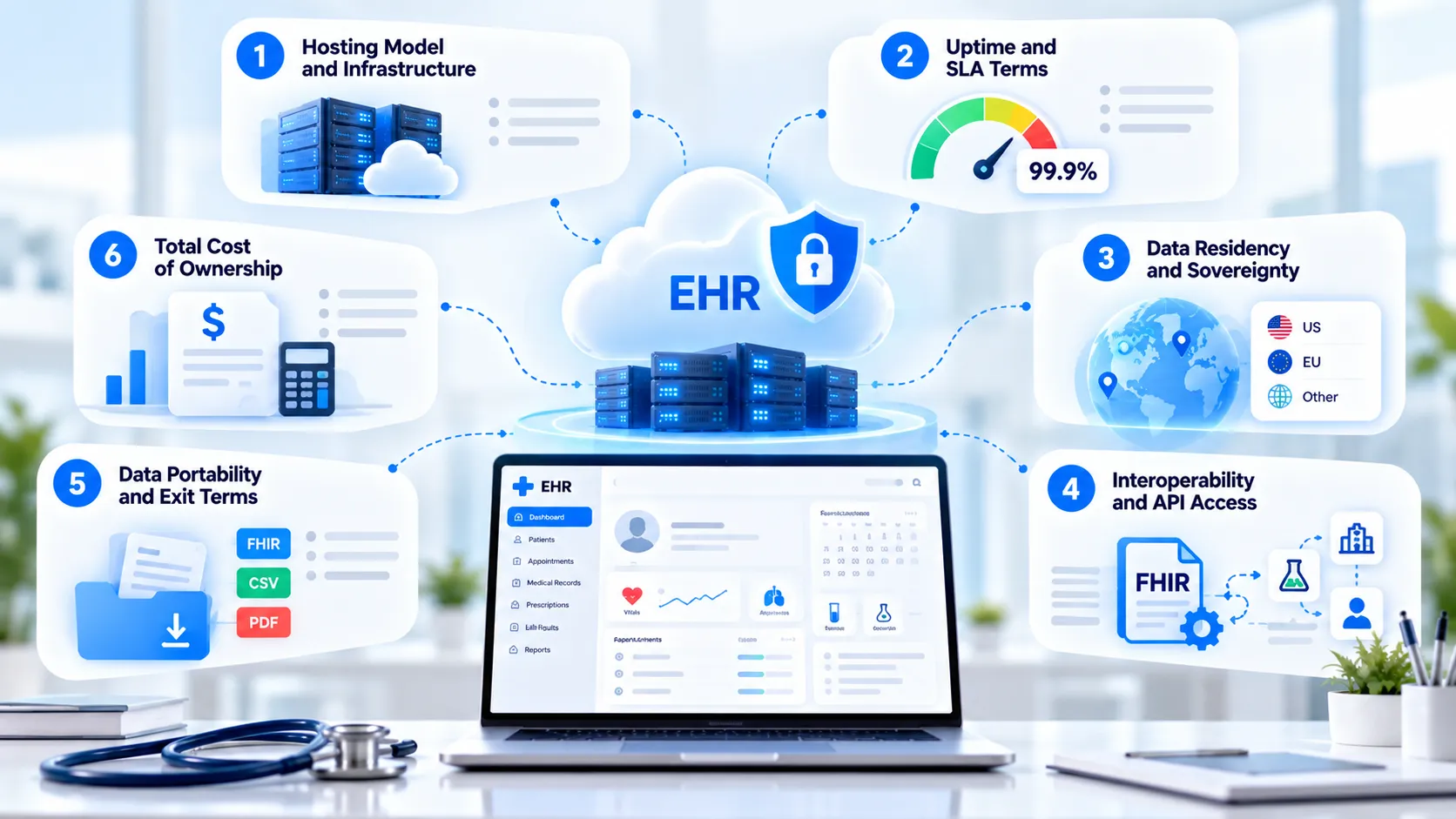
Score every vendor on the same six criteria, in writing, before you watch a single demo.
What I am evaluating on:
Hosting model and infrastructure
Uptime and SLA terms
Data residency
Interoperability and API access
Data portability and exit terms
Total cost of ownership
Each criterion below follows the same shape: what it is, what to check, the numbers that matter, and the bottom line.
1. Hosting model and infrastructure
Know exactly whose servers run your EHR and how changes reach them.
What to check:
Hosting model (multi-tenant, single-tenant or private)
Named cloud provider and region
How and when upgrades roll out
Whether you get a test environment before changes go live
Numbers that matter: the notice period for planned upgrades, in days.
Bottom line: a vendor that cannot name its cloud region in writing fails this criterion.
2. Uptime and SLA: what 99.9% really means
The SLA percentage matters less than what the contract excludes from it.
What to check:
Whether planned maintenance counts as downtime
Service credits and how you claim them
Recovery time objective (RTO) and recovery point objective (RPO)
A public status page with incident history
Numbers that matter:
SLA | Allowed downtime per year | Per month |
|---|---|---|
99.0% | about 87.6 hours | about 7.3 hours |
99.9% | about 8.8 hours | about 43.8 minutes |
99.95% | about 4.4 hours | about 21.9 minutes |
99.99% | about 52.6 minutes | about 4.4 minutes |
Bottom line: if maintenance is excluded and credits are capped low, the headline uptime figure is mostly decoration.
Ask yourself one thing. Can your front desk run for 43 minutes on paper?
3. Data residency and data sovereignty
Data residency means every copy of your data, not just the main database.
What to check:
Region of the primary database
Region of backups and disaster recovery copies
Where logs and analytics data are stored
Whether offshore support staff can view PHI
Where AI features send data for processing
Numbers that matter: the count of regions and countries where PHI or its copies can exist. You want a written map.
HHS allows ePHI storage outside the US under a BAA. It also says offshore storage may increase risk, which you must cover in your risk analysis (HHS FAQ).
So HIPAA alone is rarely the blocker.
Your payer contracts, state rules or federal agreements often are. Check those with counsel.
Bottom line: no written residency map, no shortlist spot.
4. Interoperability and API access
Good interoperability means you can read and write your own data through standard APIs without a surprise bill.
What to check:
Support for HL7 FHIR R4 APIs
USCDI version supported. ONC's HTI-1 rule set USCDI v3 as the certification baseline from January 1, 2026
API rate limits and per-call fees
Whether the vendor takes part in TEFCA exchange
Numbers that matter: API fees per call or per month, and rate limits per minute.
Bottom line: "we have an API" is not an answer. Ask for the documentation link.
5. Data portability and exit terms
Your exit plan is part of the purchase, so write it into the contract.
What to check:
Export formats (FHIR bulk export, CSV, PDF of charts)
Export fees and timelines
Data retention and deletion after termination
Help with transition to the next vendor
Numbers that matter: days to deliver a full export, and its cost.
Bottom line: if the export costs more than the first year's discount saved you, you did not get a discount.
6. Total cost of ownership
The subscription is the smallest line on the real bill in many deals I have seen.
What to check:
Pricing unit (per provider, per encounter or per location)
Implementation and data migration fees
Training and support tiers
Add-on modules, API fees and integration costs
Numbers that matter: a three-year total, not a monthly price.
Bottom line: compare three-year totals side by side, or you compare marketing.
Copy-paste vendor scorecard
Use this table on every demo call and score 0, 1 or 2.
Criterion | Question to ask | Good answer | Red flag | Score |
|---|---|---|---|---|
Hosting | Which provider and region host our data? | Named provider and region in writing | "Industry-leading cloud" | |
Uptime | Is maintenance counted as downtime? | Yes, or capped and scheduled | Unlimited exclusions | |
Residency | Where do backups and logs live? | Written map of all copies | "All in the US" with no detail | |
Interoperability | Where is your FHIR API documentation? | Public link | "Ask your account manager" | |
Exit | What does a full export cost? | Fixed fee and timeline in contract | "Case by case" | |
Cost | What is our three-year total? | Itemized quote | Monthly price only |
Wait, you might be thinking: is this overkill for a small practice?
It is not, because small practices have the least room to absorb a bad contract.
You do not need a procurement team. You need one hour, this scorecard and the willingness to ask for answers in writing.
Cloud based EHR providers: how the main categories differ
Cloud based EHR providers fall into four broad categories, and the right category narrows your shortlist faster than any feature list.
Category | Best fit | Typical trade-off | What to verify |
|---|---|---|---|
Enterprise suites | Health systems, hospitals | Long implementations, high cost | Hosting model and regions |
Ambulatory SaaS | Small and mid-size practices | Less customization | SLA exclusions, API fees |
Specialty-specific EHRs | Single specialties such as behavioral health or chiropractic | Narrow fit outside the specialty | Exchange with other care settings |
FHIR-native platforms | Healthtech companies building their own product | You build more of the experience | Who owns the front end and the data |
This is a category map, not a ranking. If you are shortlisting cloud-based EHR providers in USA, pick two or three per category, then run the scorecard on each.
One distinction saves a lot of wasted demos:
→ EHR provider = sells you a ready product on a subscription
→ EHR development company = builds or extends a system you own
If the second one fits you better, keep reading.
Cloud based EHR systems development companies in USA to shortlist
If no off-the-shelf product fits, these five companies build or extend cloud EHR systems for US healthcare clients.
What I am evaluating on:
Published EHR-specific services, not just general healthcare work
Interoperability standards named on their own site (FHIR, HL7)
Compliance wording that is specific, not vague
US presence or stated US client work
Clear fit for a specific buyer type
Every fact below comes from each company's own website as of October 2026. Numbers are their claims, not my test results. Verify before you sign.
Disclosure: I work with Mind Stack Labs, so read that entry with that in mind.
1. Mind Stack Labs
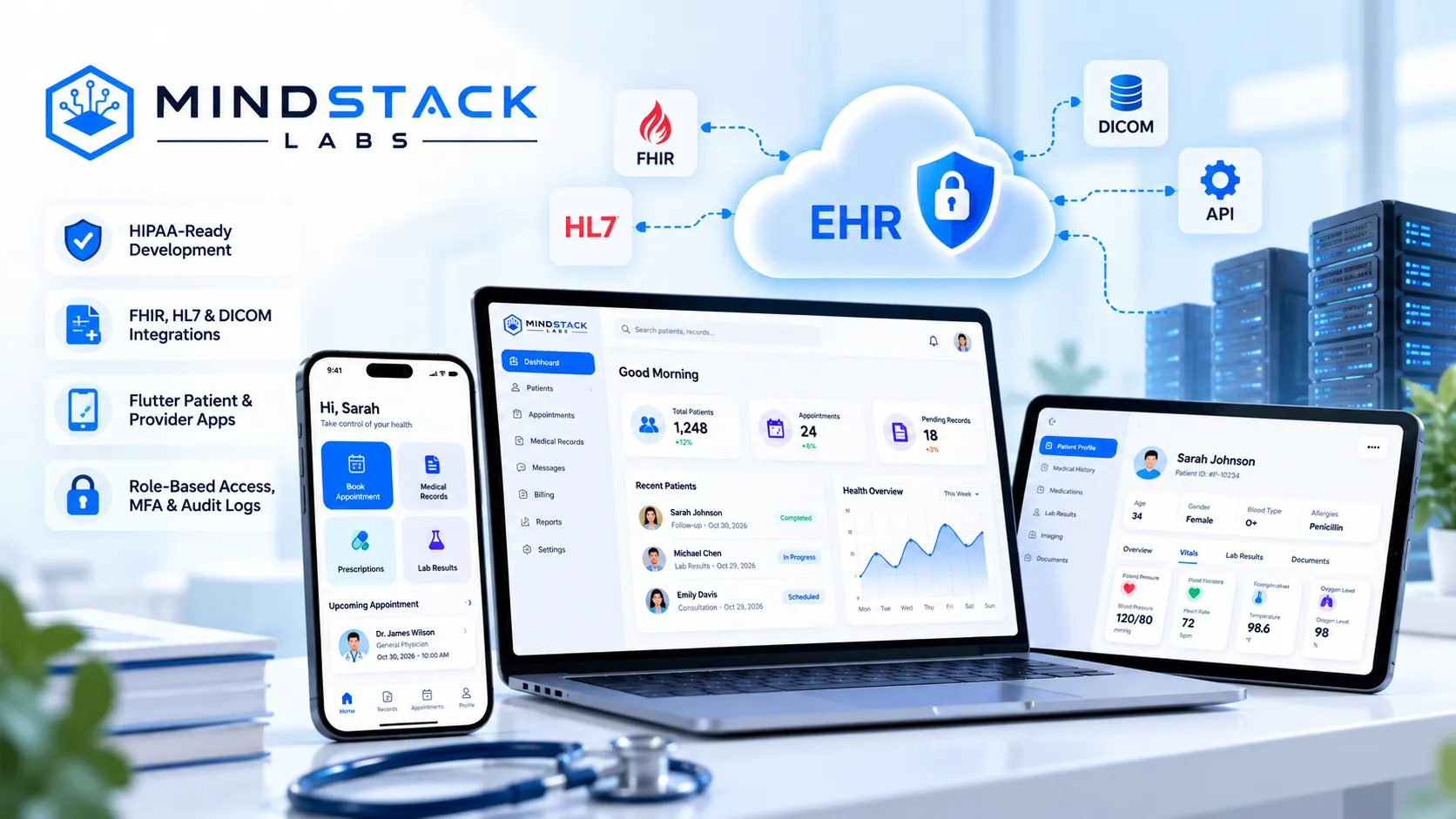
A Flutter-first product team building HIPAA-ready patient-facing apps and custom layers on top of existing EHRs.
Key capabilities:
HIPAA-ready healthcare software with a signed BAA for US clients
HL7, FHIR and DICOM-aware integrations, role-based access, MFA and audit logs
Google-certified Flutter consultancy for cross-platform patient and provider apps
Healthcare proof such as CareBot AI (AI appointment booking) and CareVault (consent-based record sharing, a portfolio build)
Numbers: 23 projects in the healthcare, wellness and beauty portfolio category. Pricing is scoped per project.
Best for: startups and clinics that need a patient-facing app or custom workflow layer on top of an existing cloud EHR, not a full EHR from scratch.
2. Mindbowser
A healthcare engineering firm building FHIR-native custom EHRs and SMART on FHIR apps, with a US office in Jersey City, NJ.
Key capabilities:
Custom EHRs with FHIR R4, HL7 and SMART on FHIR support
Builds on FHIR backends such as Medplum and on Healthie via its API
Own accelerators, including ConnectHealth for EHR integration
States it is SOC 2 Type II audited
Numbers: its FAQ states $50K to $150K for a platform build on a FHIR backend, and $300K to $500K+ for a fully custom, ONC-certified EHR.
Best for: digital health companies that want a FHIR-native EHR or apps that extend Epic, Cerner or eClinicalWorks.
3. CapMinds
A US-based healthcare IT company in Leesburg, VA, focused on custom EHR and EMR builds and OpenEMR modernization.
Key capabilities:
Custom EHR and EMR, white-label EHR and dedicated team models
EHR migration, HL7/FHIR interoperability and Mirth Connect work
Integrations listed for labs, ePrescribing, clearinghouses and HIEs
Lists HIPAA, SOC 2 Type 2 and ISO 9001:2015 on its site
Numbers: states core modules within 90 days and go-live in 3 to 6 months. No published prices.
Best for: specialty practices and health organizations that want to own their EHR and move off per-provider licensing.
4. MindK

A software company building specialty EHRs with AI agents on Medplum's FHIR-compatible backend.
Key capabilities:
Custom EHR/EMR development and legacy EHR modernization
EHR integration, EHR-to-RCM integration and EMR data migration
FHIR/HL7 interoperability
States it builds to HIPAA and SOC 2 requirements
Numbers: its FAQ states $50,000 to $150,000 for an EHR MVP and 4 to 6 months for MVP development.
Best for: specialty practices (mental health, oncology, telehealth) that want an AI-assisted specialty EHR.
5. Relevant Software
A custom software company with offices in Ukraine, Poland and Spain, offering custom EHR and EMR development.
Key capabilities:
Custom EHR and EMR development and system modernization
HL7 FHIR integration and clinical data migration
EHR mobile apps, analytics and AI-assisted documentation
States encryption, role-based access, audit logging and consent management are standard on every EHR project
Numbers: states 12+ years in healthcare. No published prices.
Best for: organizations comfortable with a European delivery team that need modernization plus migration in one project.
For a wider list beyond EHR work, see my medical software development companies comparison.
How AI features change your data residency answer
AI features can quietly add new places your PHI travels, so treat each one as a new subprocessor.
Ambient scribes, AI summaries and smart intake tools often call a model hosted somewhere else.
Ask three questions:
Which model provider processes our data, and in which region?
Is our data used to train any model?
Is that AI provider covered by a BAA?
→ New AI feature = new subprocessor = new residency check
Migrating to a cloud EHR without losing a week
Plan migration as a clinical project, not an IT ticket, and set the exit plan at the same time.
Decide what moves. Active patients and recent records migrate. Older records can go to a read-only archive.
Map the data. Match old fields to new ones. Test with a sample of real charts.
Run a trial import. Clinicians check accuracy before go-live, not after.
Plan the cutover. Pick a low-volume day and prepare paper downtime forms.
Keep read access to the old system for a fixed period after go-live.
Migrations rarely fail on the data itself.
They fail on the mapping nobody tested. Test it twice.
Pro tip: write the export clause for your new vendor while you are still migrating away from the old one, because you will never remember the pain more clearly.
When custom beats off-the-shelf
Buy an off-the-shelf cloud EHR in most cases, and build only when your workflow, data control needs or product model rule out every vendor.
When buying is the right call
Your workflows match standard ambulatory care
You need to go live in weeks
You have no unusual integrations or residency rules
When a custom or hybrid build makes sense
You are a healthtech company and the EHR experience is your product
Your workflow is one no vendor supports without heavy workarounds
You need PHI to stay in your own cloud account
You need a custom layer on top of an existing EHR through FHIR APIs
Build vs buy decision matrix
Factor | Buy | Build or hybrid |
|---|---|---|
Time to launch | Weeks to months | Months |
Workflow fit | Standard | Custom |
Data control | Vendor's cloud | Your cloud account |
Upfront cost | Lower | Higher |
Compliance work | Shared with vendor | Mostly yours |
Building is hard. Not impossible, if you scope compliance before code.
At Mind Stack Labs, we build to HIPAA technical safeguards from the first sprint: role-based access, audit logs and encryption in transit and at rest.
For a portfolio project, we built CareVault, a Flutter app where patients grant providers time-limited access to chosen record categories and can revoke it.
It is a learning build, not a production EHR. It shows how we approach consent and access design.
As a Google-certified Flutter tech consultant, we often use Flutter for patient-facing apps that sit on top of an existing EHR. See our healthcare app development work for more.
Which cloud EHR approach fits your situation?
Match your top priority to the approach that serves it.
If you need to go live fast, go with a multi-tenant ambulatory SaaS EHR.
If you need control over upgrades, go with a single-tenant hosted EHR.
If your contracts restrict data location, go with a vendor that gives a written residency map, or a private cloud deployment.
If you are a healthtech startup, go with a FHIR-native platform plus a custom front end.
If your workflow fits no product, go with a hybrid build on top of an existing EHR's APIs.
FAQs
Cloud EHR vs on-premise EHR: which is better?
For most small and mid-size practices, a cloud EHR is the better fit because the vendor handles hosting, patching and backups. On-premise suits organizations with strong IT teams and strict control needs.
Is a cloud based EHR HIPAA compliant?
It can be, if every party that touches PHI signs a BAA and runs proper safeguards. No product is "HIPAA certified," so ask for SOC 2 or HITRUST evidence instead.
What uptime should a cloud EHR guarantee?
Look for 99.9% or higher, with planned maintenance counted or tightly capped. Then check service credits, because they show how seriously the vendor takes the number.
Does HIPAA require patient data to stay in the US?
No. HHS allows offshore storage under a BAA, but it must be covered in your risk analysis. Payer, state or federal contracts may still restrict it.
Can I take my data with me if I leave my EHR vendor?
Yes, if your contract says so. Ask for export formats, fees and a delivery timeline before you sign, not when you leave.
My recommendation
Start with the scorecard, and shortlist only vendors that answer the hosting, uptime and residency questions in writing. Consider a custom or hybrid build only if no vendor fits your workflow or data control needs.
Want a second opinion on your shortlist, or a scope for a custom layer? Read our HIPAA compliant app development guide, or talk to us.