

If you need a HIPAA-ready build shipped this year, start with Mind Stack Labs for fast MVPs and patient-facing mobile, ScienceSoft for enterprise EHR and analytics work, and HTD Health for regulated, provider-side platforms.
Every other medical software development company below is genuinely good at something specific, and the wrong fit is usually a scoping failure, not a skill failure.
I have scoped, shipped, or audited healthcare builds for roughly seven years, including two projects where I underestimated FHIR mapping so badly that we lost three weeks re-modeling patient resources.
That mistake is why this list ranks integration capability above logo walls.
TL;DR
→ Fast HIPAA-ready MVP = Mind Stack Labs or TATEEDA
→ Enterprise EHR, analytics, or legacy modernization = ScienceSoft or Itransition
→ Provider-side, clinically complex, regulated = HTD Health
→ Lowest blended rate with deep healthcare backlog = Chetu, OSP, or Belitsoft
→ Budget reality check: a compliant MVP tends to land at $45k to $120k, and compliance engineering eats 15 to 25% of that before a single patient screen ships
How I evaluated these medical software development companies
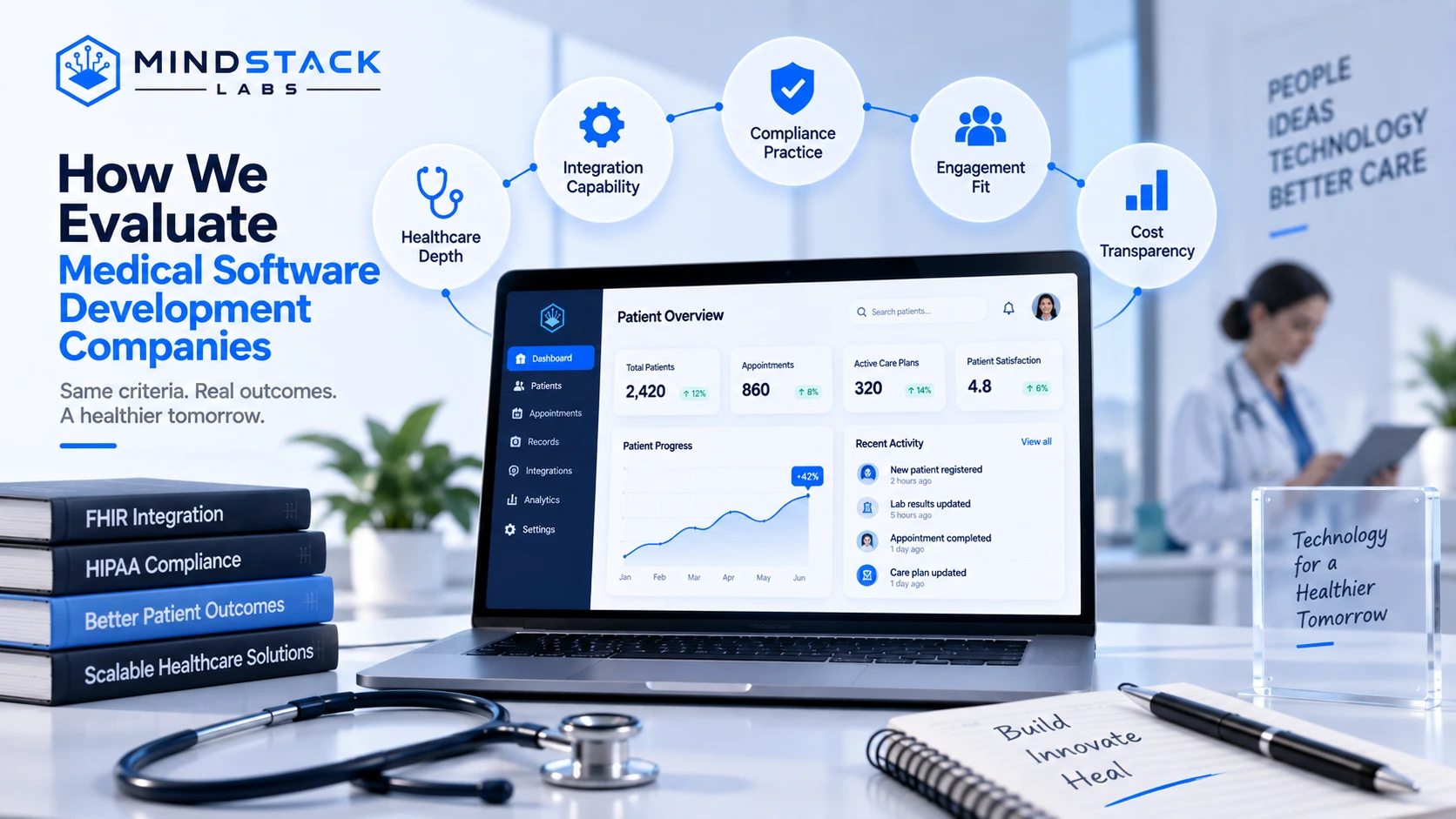
I ranked on five criteria only, and I applied the same five to every company including the one I work with.
Healthcare depth, not general software volume. Shipped medical products beat a healthcare tab on a services site.
Integration capability. HL7 v2, FHIR R4, DICOM, and real EHR connections. This is where projects die.
Compliance as engineering practice. Audit trails, access controls, BAA-ready contracts, encryption at rest and in transit.
Engagement fit. Can they work fixed-price for an MVP, or only staff-augmentation retainers?
Cost transparency. Published rate bands and honest timelines.
What I excluded: pure staffing agencies, offshore shops with no US entity or BAA path, and anyone whose healthcare portfolio was a single telemedicine screenshot.
Disclosure: I work with Mind Stack Labs. That is why every entry below carries an identical structure and a "watch for" line, including ours.
Top 10 medical software development companies in the USA at a glance
# | Company | Best for | HQ | Team size | Published rate band |
|---|---|---|---|---|---|
HIPAA-ready MVPs, patient-facing mobile | USA and India delivery | 50+ engineers | On request | ||
2 | ScienceSoft | Enterprise EHR, healthcare analytics | McKinney, TX | 250 to 999 | $50 to $99/hr |
3 | HTD Health | Provider-side regulated platforms | New York, NY | 50 to 249 | $100 to $149/hr |
4 | Itransition | Legacy modernization, large programs | Denver, CO | 3,000+ | $50 to $99/hr |
5 | TATEEDA GLOBAL | Mid-size custom builds, nearshore mix | San Diego, CA | 100+ engineers | $50 to $99/hr |
6 | Chetu | Niche medical verticals, fast staffing | Sunrise, FL | 1,000 to 5,000 | $25 to $49/hr |
7 | OSP | Prebuilt healthcare modules | Arlington, TX and LA | 250 to 999 | $25 to $49/hr |
8 | Appinventiv | Consumer health apps at scale | New York, NY and Noida | 1,200+ | $25 to $49/hr |
9 | Belitsoft | Long-running maintenance and QA | US office, EU delivery | 200+ | $25 to $49/hr |
10 | Andersen | Multi-team enterprise engagements | New York, NY | 3,500+ | $50 to $99/hr |
Rate bands come from publicly published profiles. Ask for a written rate card before you believe any of them, including mine.
The 10 best medical software development companies in the USA
Every entry uses the same four blocks: what they are, capabilities, numbers, and who they suit.
1. Mind Stack Labs
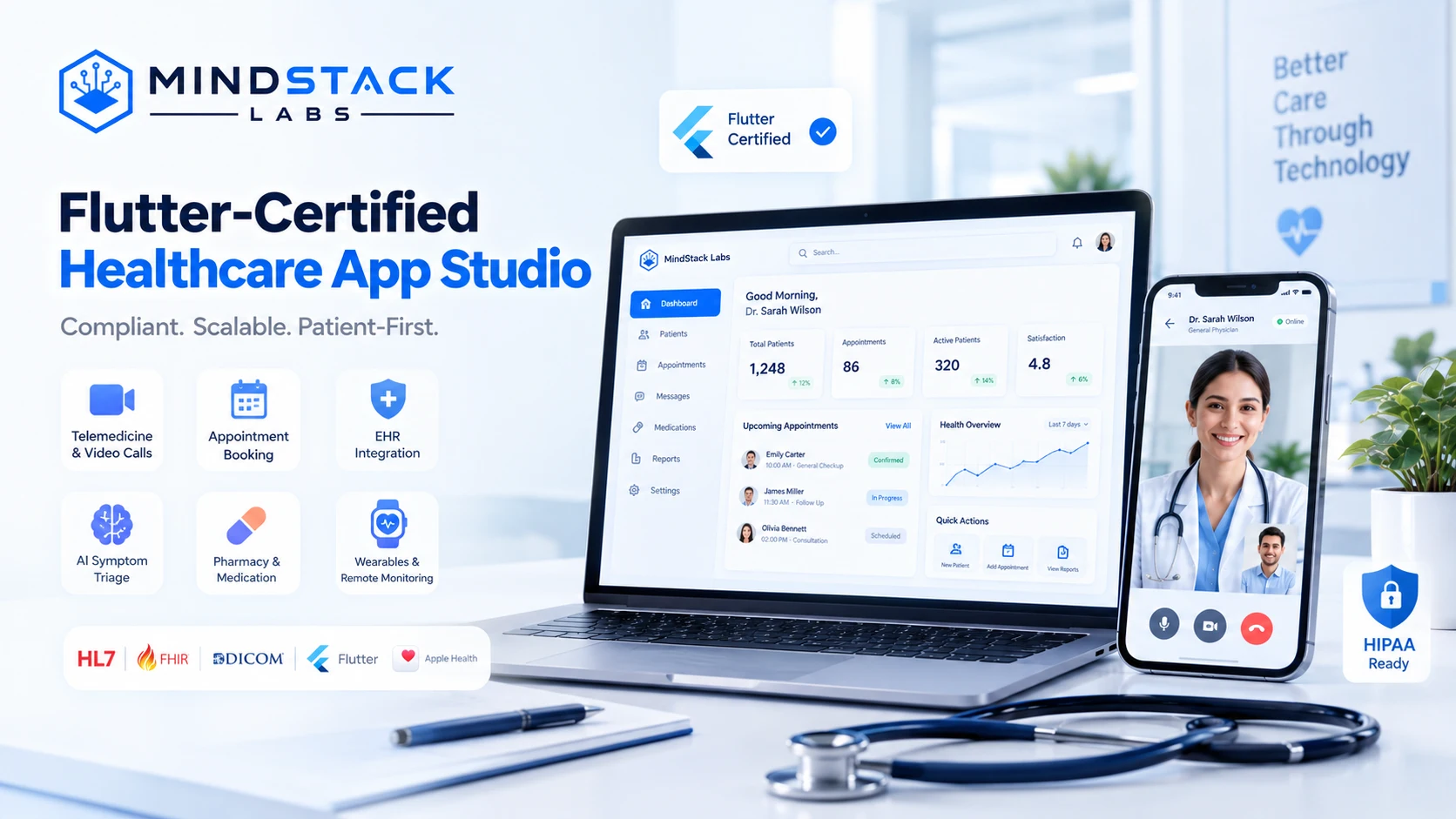
A Flutter-certified product studio that builds HIPAA-ready healthcare apps for clinics, hospitals, and digital health startups, with compliance mapped during discovery rather than bolted on at QA.
Key capabilities
Telemedicine and video consultation apps, doctor appointment booking, patient management with EHR integration
AI symptom triage and intake, pharmacy and medication apps, wearables and remote patient monitoring
Integrations across HL7, FHIR, DICOM, Apple Health, Google Fit, Health Connect, Fitbit, and Garmin
Compliance engineering practice: privacy-by-design PHI handling, BAA-ready contracts, access controls with full audit trails
By the numbers
Published healthcare MVP timeline: 6 to 10 weeks
Full platform builds: 10 to 16 weeks
Engagement models: fixed-price MVP, sprint-based, dedicated team
Rate: on request
Watch for: smaller review base than the 3,000-person firms, and no white-label reseller program.
Best for: founders and clinic groups who need a compliant, patient-facing product live in one quarter.
2. ScienceSoft
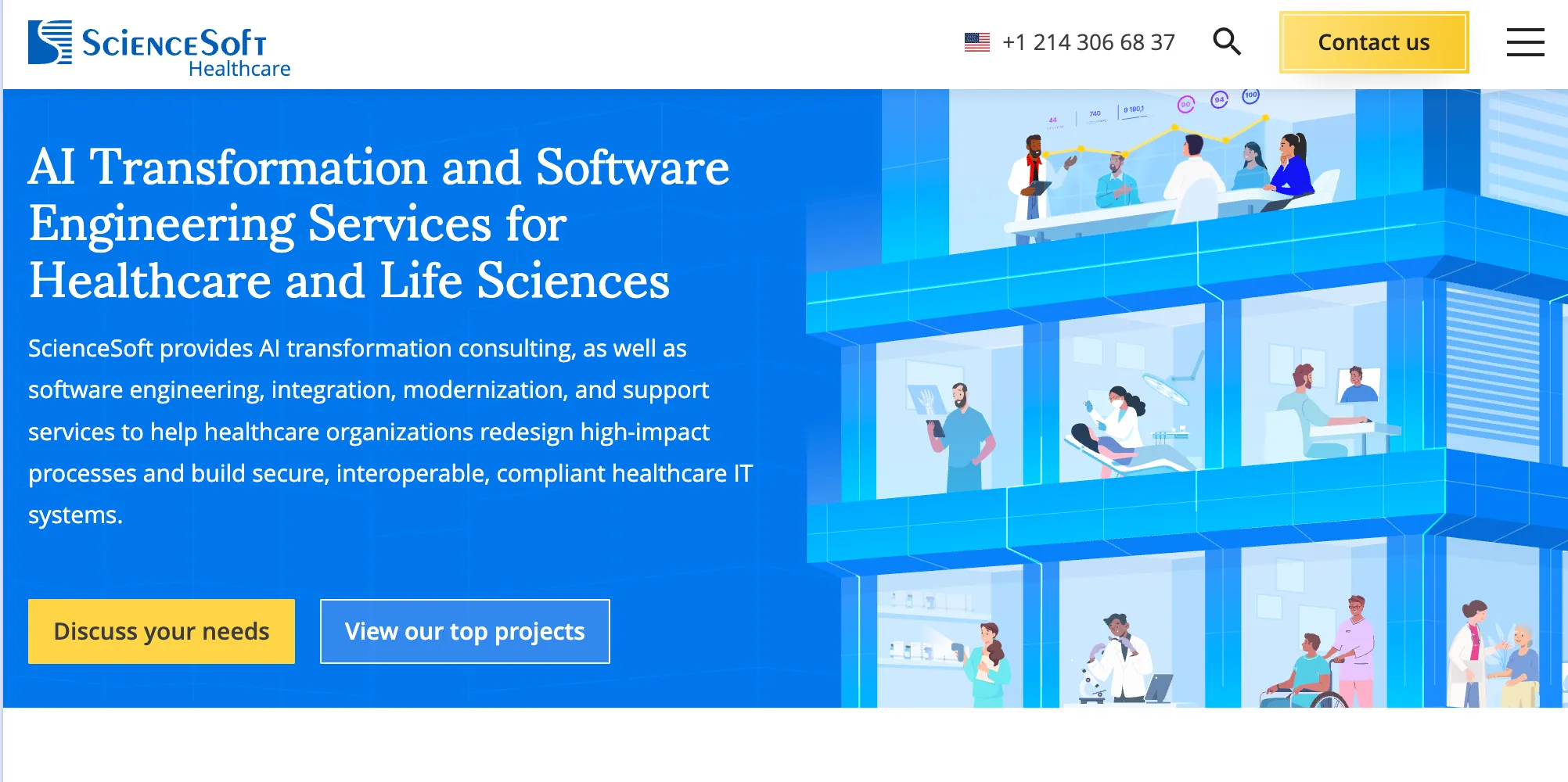
A 35-year-old IT consultancy with one of the deepest enterprise healthcare practices in the US, strongest on EHR, analytics, and imaging.
Key capabilities
Custom EHR and EMR builds, plus module development on existing systems
Healthcare data warehousing, BI, and predictive analytics
Medical imaging, DICOM and PACS work
HL7, FHIR, and X12 EDI integration for payer workflows
By the numbers
Founded 1989, HQ McKinney, Texas
Team: 250 to 999
Published projects range from $8,000 to $1M+
Engagement models: fixed-price, T&M, dedicated team
Rate: $50 to $99/hr
Watch for: enterprise process overhead that can slow a lean MVP, and less consumer-app polish than mobile-first shops.
Best for: hospitals and payers running data-heavy or integration-heavy programs.
3. HTD Health
A healthcare-only strategy and technology consultancy in New York that works almost exclusively on provider and payer transformation.
Key capabilities
Clinical workflow platforms, care coordination, patient engagement
Interoperability architecture and FHIR API strategy
Healthcare AI practice launched in 2023
Regulatory and clinical advisory alongside engineering
By the numbers
Founded 2017, HQ New York, NY
Team: 50 to 249
A decade of healthcare-only delivery
Engagement models: consulting retainer, dedicated pods
Rate: $100 to $149/hr
Watch for: the highest rate band on this list, and startup budgets often cannot clear their minimum engagement.
Best for: funded provider organizations where clinical correctness outranks speed.
4. Itransition
A large full-service software firm with a mature healthcare vertical, best used on multi-year modernization rather than greenfield apps.
Key capabilities
Legacy healthcare system modernization and re-platforming
Custom EHR, telehealth, and practice management builds
Healthcare data engineering and interoperability layers
Dedicated QA and compliance testing teams
By the numbers
Founded 1998, US HQ Denver, Colorado
Team: 3,000+
25+ years in IT services
Engagement models: T&M, dedicated team, managed delivery
Rate: $50 to $99/hr
Watch for: healthcare is one vertical among many, so ask which specific pod you get.
Best for: enterprises replacing systems that cannot go offline.
5. TATEEDA GLOBAL
A San Diego custom software company with a real healthcare and fintech focus and a nearshore plus offshore delivery mix that keeps rates mid-band.
Key capabilities
Custom clinical and patient-facing platforms
HIPAA-aligned architecture and cloud infrastructure
Staff augmentation with senior engineers
Integration work across lab, EHR, and device data
By the numbers
Founded 2013, HQ San Diego, California
Team: 100+ senior engineers
Inc. 5000 honoree, 2025
Engagement models: fixed-price, T&M, augmentation
Rate: $50 to $99/hr
Watch for: distributed delivery hubs mean timezone overlap needs to be written into the contract.
Best for: California healthcare companies who want a local entity with offshore economics.
6. Chetu

A very large Florida development firm organized by industry vertical, with unusually specific medical sub-practices.
Key capabilities
EHR, EMR, practice management, and revenue cycle management software
Medical billing and coding, claims processing
Dental, veterinary, pharmacy, and lab information systems
Delivery windows published as short as 90 days
By the numbers
Founded 2000, HQ Sunrise, Florida
Team: 1,000 to 5,000
Engagement models: dedicated developers, T&M
Rate: $25 to $49/hr
Watch for: a staffing-led model, so product thinking and UX usually stay on your side of the table.
Best for: teams who know exactly what to build and need capable hands cheaply.
7. OSP
A healthcare-focused firm with a library of prebuilt modules you can configure instead of building from zero.
Key capabilities
Custom EHR, telehealth, and home health platforms
Prebuilt healthcare modules to shorten delivery
Medical billing, claims, and patient portal products
AI-driven healthcare solutions as a published practice
By the numbers
US presence in Arlington, Texas and Los Angeles
Team: 250 to 999
Award-recognized healthcare products including home health tooling
Engagement models: fixed-price, dedicated team
Rate: $25 to $49/hr
Watch for: module-based starting points can constrain unusual workflows, so validate fit before signing.
Best for: providers who want 70% of the product on day one.
8. Appinventiv

A large app development company with strong consumer health and wellness work, and a New York presence backed by offshore delivery.
Key capabilities
Patient-facing mobile apps, fitness and wellness platforms
Telemedicine and on-demand care apps
AI and ML features, including triage and personalization
Design-led product discovery
By the numbers
Founded 2015, offices in New York and Noida
Team: 1,200+
Engagement models: fixed-price, dedicated team
Rate: $25 to $49/hr
Watch for: consumer-app strength is clearer than deep clinical or payer integration experience.
Best for: direct-to-consumer health brands prioritizing design and scale.
9. Belitsoft
A two-decade custom development firm with a healthcare practice and a strong reputation for long-term maintenance and QA rather than zero-to-one product work.
Key capabilities
Healthcare web and mobile application development
Independent QA and regression testing services
Healthcare data and BI work
.NET and enterprise stack depth
By the numbers
Founded 2004, North American office with EU delivery
Team: 200+
Healthcare practice since the mid-2010s
Engagement models: T&M, dedicated team, augmentation
Rate: $25 to $49/hr
Watch for: thinner US-based clinical advisory, so plan for your own compliance lead.
Best for: teams inheriting an existing platform that needs stabilizing.
10. Andersen
A large multi-vertical firm that fields whole engineering departments, with healthcare among its named industries.
Key capabilities
HIPAA-oriented EHR systems and telemedicine platforms
AI care assistants and PACS work
Multi-team, multi-workstream program delivery
Broad technology coverage across mobile, web, and data
By the numbers
Founded 2007, US HQ New York, NY
Team: 3,500+
Engagement models: dedicated team, T&M, managed delivery
Rate: $50 to $99/hr
Watch for: you are buying capacity more than healthcare specialization, so vet the assigned team's medical history specifically.
Best for: scale-ups that need five squads next month.
Medical software development companies compared: the full table
Company | Delivery model | Healthcare focus | HL7 / FHIR / EHR | Engagement models | Rate band | Typical MVP timeline |
|---|---|---|---|---|---|---|
Mind Stack Labs | US and India, Flutter-certified | High, patient-facing and clinic ops | HL7, FHIR, DICOM, wearables APIs | Fixed-price, sprint, dedicated | On request | 6 to 10 weeks |
ScienceSoft | US onshore plus EU | Very high, enterprise side | HL7, FHIR, DICOM, X12 EDI | Fixed, T&M, dedicated | $50 to $99 | 3 to 5 months |
HTD Health | US onshore | Exclusive healthcare | FHIR-first architecture | Retainer, pods | $100 to $149 | 4 to 6 months |
Itransition | US plus global | Medium-high, one of many verticals | HL7, FHIR, data layers | T&M, dedicated | $50 to $99 | 4 to 6 months |
TATEEDA | US plus nearshore | High | HL7, FHIR, lab and device data | Fixed, T&M, augmentation | $50 to $99 | 3 to 4 months |
Chetu | US onshore plus offshore | High, vertical sub-practices | HL7, billing and claims standards | Dedicated, T&M | $25 to $49 | 90 days+ |
OSP | US plus offshore | High, module-led | HL7, FHIR via modules | Fixed, dedicated | $25 to $49 | 2 to 4 months |
Appinventiv | US plus India | Medium, consumer health | FHIR on request | Fixed, dedicated | $25 to $49 | 3 to 5 months |
Belitsoft | US office, EU delivery | Medium | HL7, FHIR | T&M, dedicated | $25 to $49 | 3 to 5 months |
Andersen | US plus global | Medium | HL7, FHIR, PACS | Dedicated, T&M | $50 to $99 | 4 to 6 months |
One column I deliberately left out: certification badges. Several firms advertise HIPAA compliance, and almost none publish an audit report next to it. Treat that as a question for the call, not a ranking input.
Wait, you might be thinking: can I trust a list that ranks its own company first?
Fair. You should not trust any of it on vibes, which is why the five criteria sit above the ranking and every entry carries the same "watch for" line.
Run our profile against criteria three and four yourself. If ScienceSoft's enterprise depth or HTD's clinical advisory fits your project better, hire them. A misfit engagement costs you a quarter, and I would rather not be the reason for that.
Which company fits your situation
If you need a compliant MVP in one quarter, go with Mind Stack Labs or TATEEDA.
If you are integrating with Epic or Cerner at hospital scale, go with ScienceSoft or HTD Health.
If clinical accuracy carries regulatory risk, go with HTD Health.
If your budget is fixed and the spec is finished, go with Chetu or OSP.
If you need multiple squads immediately, go with Andersen or Itransition.
Pro tip: shortlist on the criterion you cannot compromise on, then price. Pricing first produces cheap software you rebuild in eighteen months.
What custom medical software development costs in the USA in 2026
Expect $45,000 to $120,000 for a compliant MVP and $150,000 to $600,000 for a full platform. In the builds I have worked on, compliance and integration work absorbs 15 to 25% of total budget before the first patient-facing screen is finished.
Project type | Typical range | Timeline | Main cost driver |
|---|---|---|---|
Patient portal | $40k to $90k | 2 to 3 months | Auth, PHI access control |
Telemedicine MVP | $50k to $120k | 2 to 4 months | Video infrastructure, scheduling |
Appointment and intake app | $45k to $100k | 6 to 12 weeks | EHR sync, no-show logic |
Remote patient monitoring | $90k to $250k | 4 to 7 months | Device integrations, alerting |
EHR module or integration | $70k to $200k | 3 to 6 months | FHIR mapping, testing |
Full clinical platform | $250k to $600k+ | 8 to 14 months | Scope, audit requirements |
Fixed price, time and materials, or dedicated team
→ Fixed price = known spec, capped risk, expensive change requests
→ Time and materials = evolving scope, needs your active product owner
→ Dedicated team = 6 months or longer, cheapest per hour, slowest to start
For a first healthcare product, fixed-price the discovery and compliance mapping phase, then move to sprints. That is the split that has failed least often in my experience.
HIPAA, FHIR, and the compliance work that quietly drives your budget
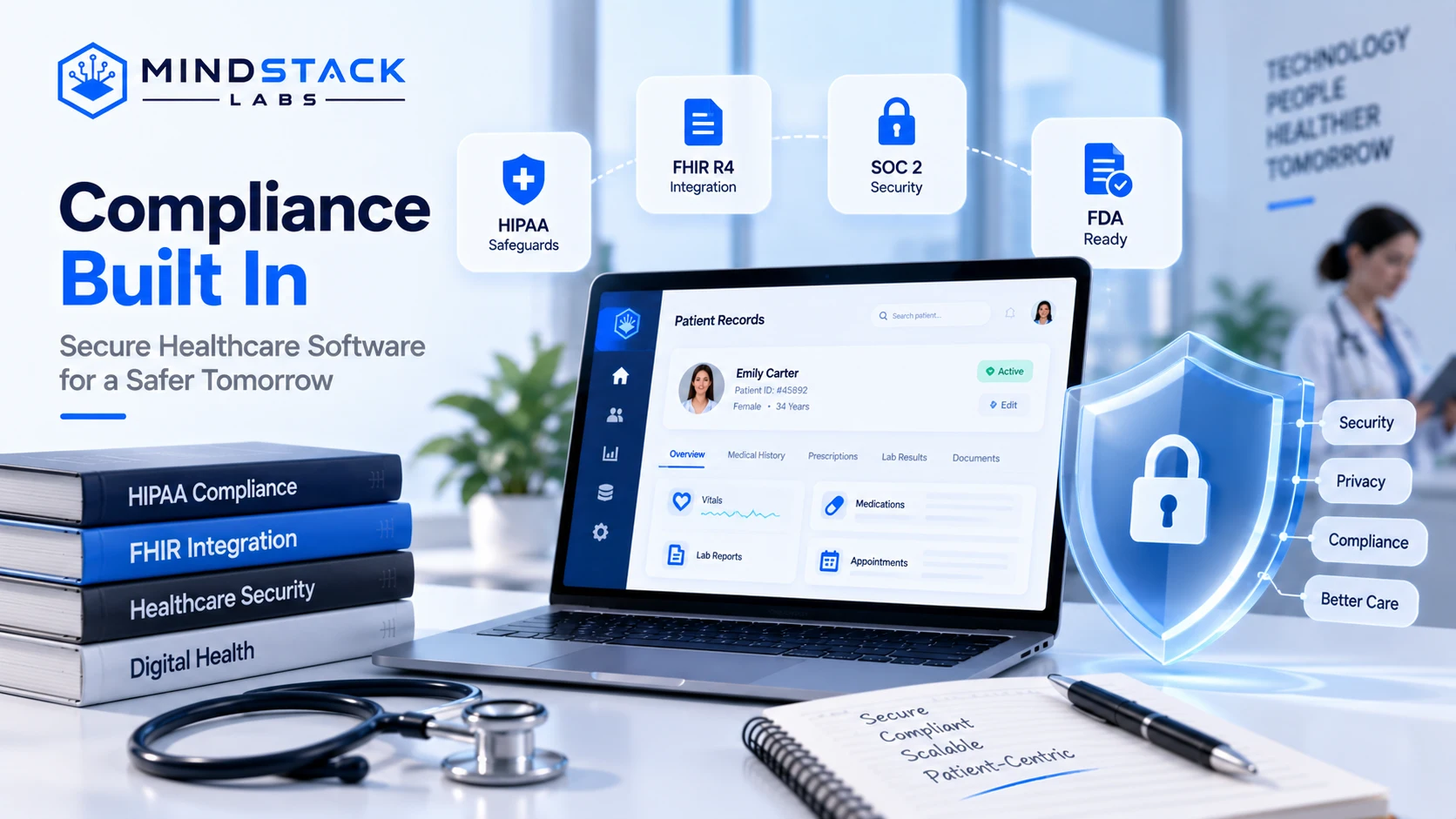
Compliance is architecture, not paperwork you attach at the end. The teams that treat it as a final checklist are the teams that rebuild their data layer.
Four things belong in your scope document from week one:
HIPAA technical safeguards. Encryption, unique user identification, automatic logoff, and audit controls. A signed BAA with every vendor touching PHI, including your cloud provider.
FHIR R4 as the integration baseline. The CMS Interoperability and Prior Authorization rule, finalized in January 2024, pushes payer and provider APIs onto FHIR with compliance dates landing in January 2027. Building on anything older is buying a migration.
SOC 2 Type II. Not legally required, but enterprise procurement will ask. Know whether your vendor has one or is simply aligned to the controls.
Information blocking rules. The ONC HTI-1 final rule, effective from 2024, tightened certification and data-sharing expectations for anyone in the certified health IT path.
One clarification worth making, since vendors blur it constantly: "HIPAA compliant" is not a certification anyone issues. A company can build to HIPAA technical safeguards. It cannot be certified HIPAA compliant. Ask for their security documentation, penetration test summary, and BAA template instead of a badge.
When your software becomes a regulated medical device
If your product interprets clinical data and drives a treatment decision, you may be in FDA Software as a Medical Device territory. That changes everything about timeline and documentation.
Decision aid, class exempt, or class II submission: establish this in discovery. Finding out in month five is the single most expensive discovery I have watched a client make.
The 2026 capability I would scope for now: ambient AI and agentic intake
AI documentation is moving from pilot to procurement expectation, and it changes your vendor shortlist. Ambient scribing, automated intake summarization, and agentic triage are now standard asks in RFPs I see, not differentiators.
What that means practically:
Your data model needs to store structured clinical summaries, not just free text
You need an audit trail showing which model produced which note and who approved it
Consent language has to cover AI processing of PHI, which most 2022-era privacy policies do not
Ask any vendor how they handle model outputs in a HIPAA context. Vague answers here tend to predict vague answers everywhere.
How to vet a healthcare software development company in one call
A single 45-minute call filters most of the list. Ask these eight questions and listen for specifics, not enthusiasm.
Which healthcare products have you shipped that are still in production today?
Who on the proposed team has worked with PHI before?
Walk me through your last FHIR or HL7 integration. What broke?
Will you sign a BAA, and can I see the template now?
How do you handle PHI in development and test environments?
What does your audit logging implementation look like?
Who owns the code and the infrastructure accounts?
What happens to my project if your assigned lead leaves?
Seven red flags that should end the conversation
"We are HIPAA certified" stated as a credential
No healthcare-specific references they will let you call
Test environments using real patient data
A fixed-price quote before any discovery
No named technical lead in the proposal
Code hosted in their accounts, not yours
Integration described as "standard API work"
Pro tip: ask for the most recent failed or delayed healthcare project and what they changed afterwards. Honest teams answer that in detail.
FAQs
Which is the best medical software development company in the USA?
There is no single best one. ScienceSoft leads on enterprise EHR and analytics, HTD Health on regulated provider work, and Mind Stack Labs on compliant MVPs shipped in weeks rather than quarters.
How much does it cost to build custom medical software in 2026?
Budget $45,000 to $120,000 for a compliant MVP and $150,000 to $600,000 for a full platform. Compliance engineering and integrations typically consume 15 to 25% of that total.
ScienceSoft vs Mind Stack Labs: which is better for a healthcare startup MVP?
Mind Stack Labs, in most startup cases. ScienceSoft's enterprise depth is stronger for hospital-scale data programs, but its process overhead and rate band rarely suit a 6 to 10 week MVP on seed funding.
Is it safe to outsource healthcare software development?
Yes, if the contract does the work. Require a signed BAA, your own cloud accounts, no real PHI in test environments, and full IP assignment in writing.
Do I need FDA approval for my medical software?
Only if it qualifies as Software as a Medical Device, meaning it informs or drives clinical decisions. Wellness trackers and appointment tools usually sit outside that scope, so confirm classification during discovery.
My recommendation
Start with Mind Stack Labs if you need a HIPAA-ready product live this quarter, and use ScienceSoft or HTD Health instead if your project is hospital-scale or carries clinical regulatory risk. Whoever you pick, run the eight-question call before you sign anything, because the cheapest way to fix a healthcare build is to scope it correctly the first time.