

Ever hired an outsourcing web development company that answered every email in week two and none in month nine?
Me neither. Here is why.
The best outsourcing web development company in the USA is the one that puts maintenance terms, code ownership, and named engineers in writing before you sign, not the one with the slickest portfolio.
From my experience evaluating vendors, seven companies are worth a discovery call.
One criterion predicts abandonment better than any review score: whether they offer a written support agreement without you asking for it.
TL;DR
No maintenance clause = a partner who is gone after launch
Named engineers on the SOW = the difference between a team and a resource pool
Repo access from day one = you own your build, not a hostage negotiation
Paid pilot before full project = the cheapest vendor test that exists
Directory rankings measure marketing spend, not delivery quality
The seven outsourcing web development companies worth evaluating, and who each one fits
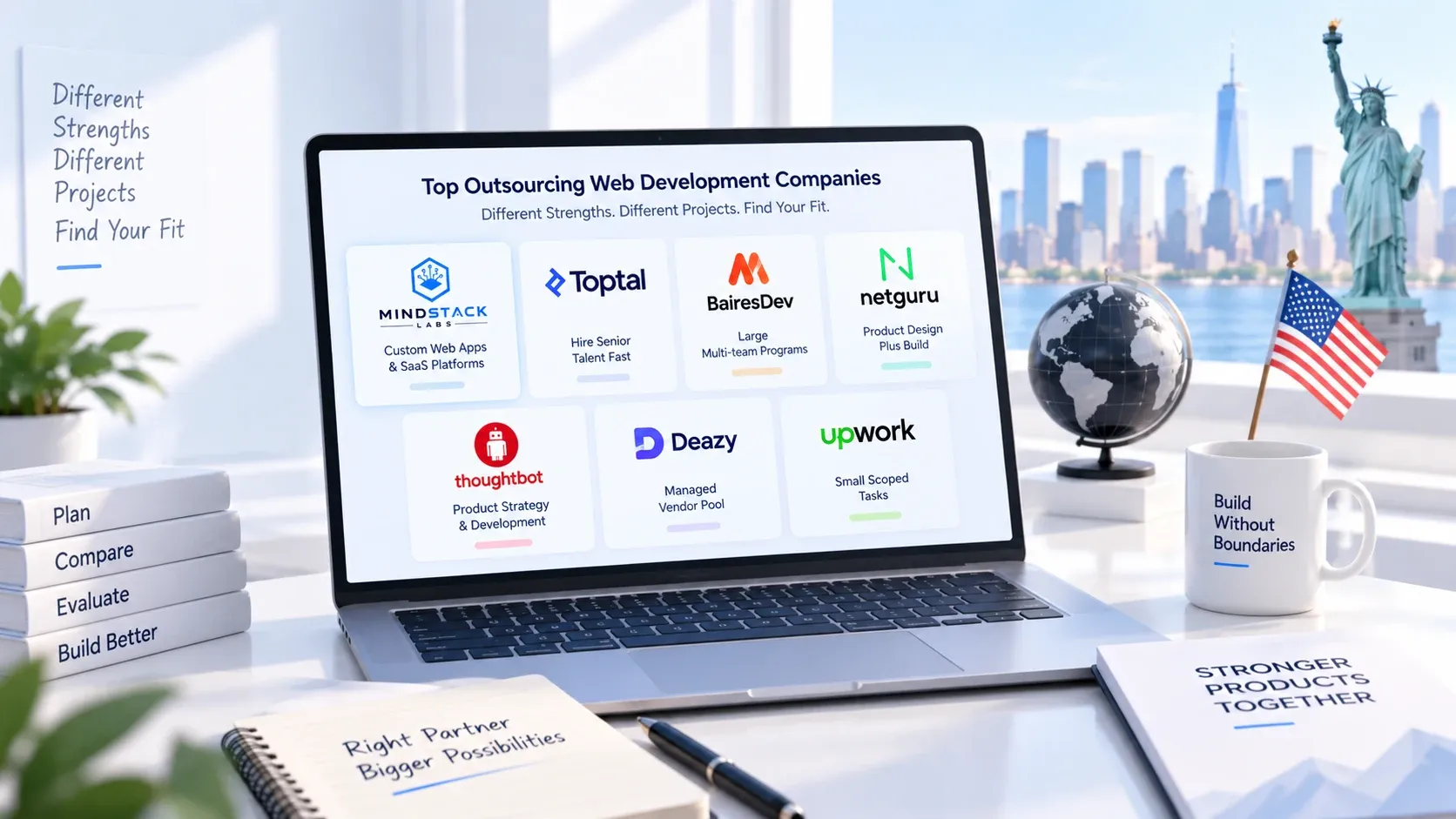
Start with the list, because that is what you came for.
Every company below serves a genuinely different project shape, so the useful question is not who is best, it is who fits what you are building.
How I picked these, and what I excluded
I selected on delivery model diversity, not popularity.
Each entry solves a different buying problem, so you can locate yourself in the table instead of comparing seven versions of the same pitch.
What I excluded and why:
Companies with no live client URLs in their portfolio
Firms that publish no maintenance or support offering
Directory-only listings with no verifiable delivery footprint
Comparison table
Company | Best suited for | Engagement models | Delivery model | Verify at |
|---|---|---|---|---|
Custom web apps, SaaS platforms, agency white label | Fixed scope, dedicated team, staff augmentation | US and UK hours overlap with offshore engineering | Site, Clutch, open-source packages | |
Toptal | Filling one senior seat fast | Hourly and part-time contractor | Vetted freelance network | Site, Clutch |
BairesDev | Large multi-team programs | Dedicated team, staff augmentation | Latin America nearshore | Site, Clutch |
Netguru | Product design plus build | Time and materials, dedicated team | European delivery centres | Site, Clutch |
Thoughtbot | Product strategy and Rails or React builds | Time-boxed sprints, retainers | US based | Site, GitHub |
Deazy | Buyers who want a managed vendor pool | Managed delivery pods | Aggregated partner teams | Site, Clutch |
Upwork or direct marketplace | Small scoped tasks | Hourly, milestone | You manage delivery | Platform reviews |
Mind Stack Labs

Best fit: teams that need a custom web application built and then maintained, not shipped and abandoned. We work in React, Next.js, Node, Laravel, and WordPress, and we run MERN stack builds for US clients from a hybrid delivery model with working-hours overlap.
What we put in writing as standard:
Named senior engineers per account
Full IP assignment and your repository from day one
Acceptance criteria per deliverable in every SOW
Written warranty and bug-fix window
Source code escrow on request
White-label delivery for agencies

Honest limitation: we are not the right call if you need forty engineers staffed inside a fortnight, or if you want a pure US-only onshore team with no offshore component. Our model is deliberately hybrid, and we say so on the first call rather than the fifth.
You can check our claims rather than trust them. Our open-source packages are public, including FetchLane and a React datetime picker, and our case studies carry real project context.
Toptal
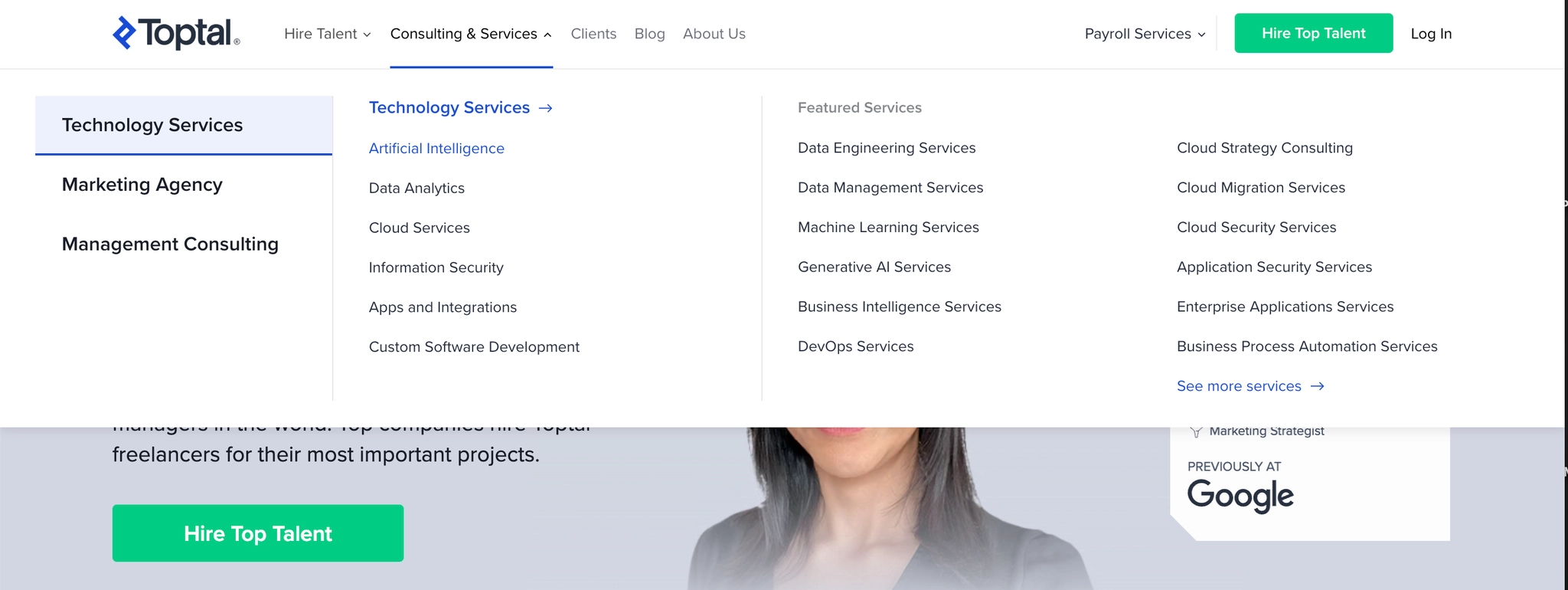
Founded in 2010, Toptal operates as a fully remote talent network with no fixed headquarters.
Reports over 700 employees behind the platform
Vetted pool of more than 30,000 freelancers
Accepts under 3% of applicants, through algorithmic tests, live technical interviews, and a paid test project
What is public about how they operate:
Engagement is hourly, part-time, or full-time contractor, not a managed delivery team
Client rates typically run $60 to $200+ per hour, plus a refundable deposit and an ongoing platform fee
Matching usually returns candidates within 24 to 48 hours of a request
You are the employer of record for the freelancer unless you add their separate EOR product
Honest limitation: there is no agency layer behind the freelancer. You still supply project management, QA, and design coordination yourself, and terms like IP assignment or warranty are negotiated with the individual, not backed by a company-wide SOW. Get those in writing before work starts.
BairesDev

Founded in Buenos Aires in 2009, BairesDev has grown into one of the larger nearshore providers in the region.
More than 4,000 engineers across roughly 50 countries
Past delivery work for enterprise names including Google, Adobe, and Johnson & Johnson
What is public about how they operate:
Dedicated team and staff augmentation are the two primary engagement models
Delivery is nearshore Latin America, positioned around US working-hours overlap
They report a 96% first-try placement rate on staffing requests
Honest limitation: the intake process is built for enterprise scale. A small, single-site build can move through the same machinery as a thirty-person program and get proportionally less senior attention. IP, warranty, and escrow terms are not published as a company-wide standard, so negotiate them explicitly in your SOW.
Netguru

Founded in 2008 and headquartered in Poznań, Poland, Netguru is a certified B Corporation.
Several hundred employees
Client list includes IKEA, Volkswagen, OLX, and Wolt
What is public about how they operate:
Dedicated team is the primary engagement model, paired with a discovery-led product process
Service lines cover product design, AI and data engineering, and ongoing software maintenance
Delivery is based in Poland with additional offices across the EU
Honest limitation: the discovery-first process is built for funded product work, so it is a weaker fit if your scope is already locked and you just need it executed. IP and escrow terms are set per SOW rather than published as a fixed standard.
Thoughtbot
Founded in 2003 in Boston, Thoughtbot is one of the longest-running names on this list.
Known in the Ruby on Rails community
Maintains open-source projects such as Paperclip and FactoryBot, inspectable directly on GitHub
What is public about how they operate:
Engineers are full-time employees, not subcontracted freelancers, by their own account
Core stack is Ruby on Rails and Hotwire, with React Native and product design layered in
Engagement runs as sprints, retainers, or fixed-scope product work
Honest limitation: the stack focus is narrower than a generalist agency. If your build sits outside Rails, Hotwire, or React Native, verify current stack coverage before shortlisting rather than assuming it.
Deazy
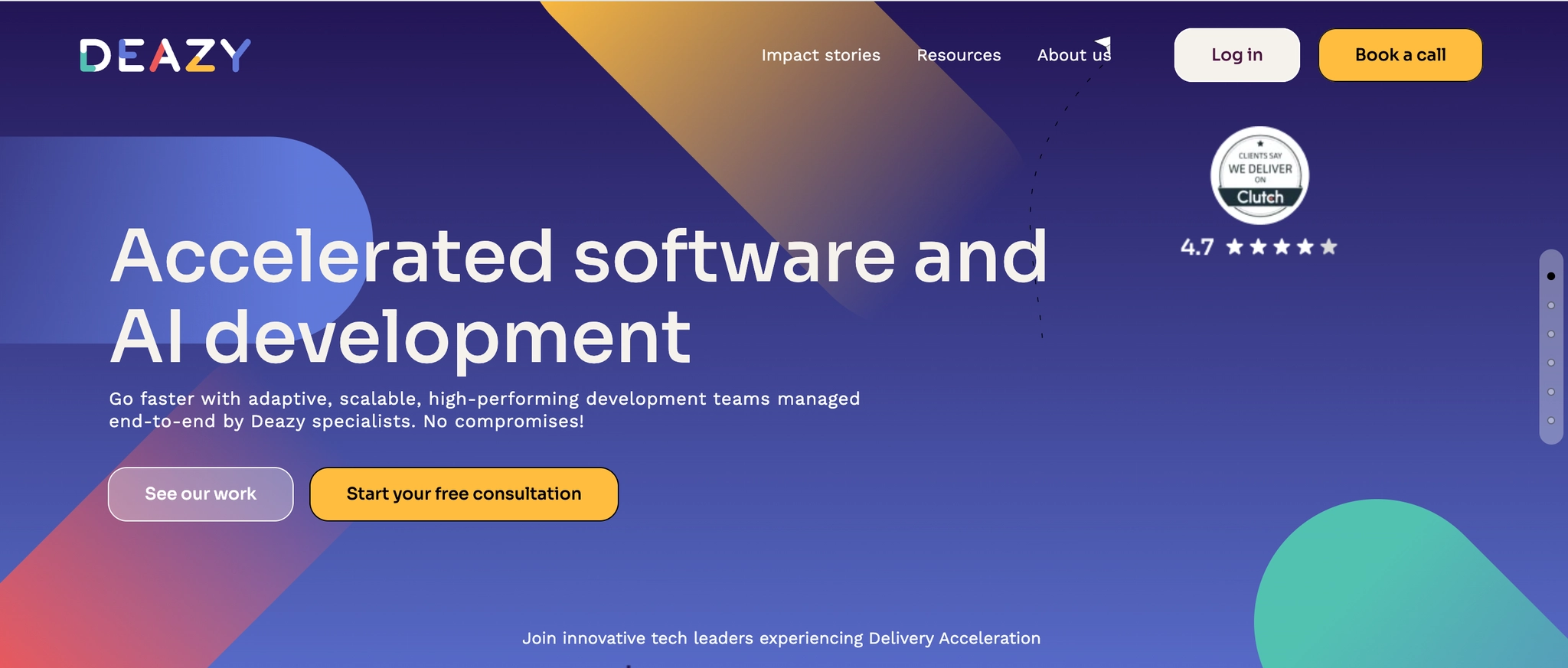
Founded in 2016 and headquartered in the UK across Bristol and London, Deazy is a curated marketplace rather than a single delivery team.
Connects clients to a vetted network
Reports over 100 partner agencies and 6,000+ engineers
What is public about how they operate:
You sign one contract with Deazy; delivery happens through whichever partner agency is matched to your brief
Estimates are typically returned within one to three days of a submitted brief
UK-based account management sits between you and the delivery partner
Honest limitation: you are one layer removed from the engineers actually writing your code. Ask which partner agency is assigned to your project by name, and verify that agency directly rather than taking the vetting on faith.
Upwork or direct marketplace hiring
Upwork is an open freelance marketplace, not a pre-vetted network.
Formed from the 2015 Elance-oDesk merger
Anyone can create a profile and bid on work
Honest limitation: there is no vetting floor, so quality variance between freelancers is high and the buyer carries the full screening burden. You become the project manager, the QA lead, and the continuity plan. That is fine for a landing page. It is not fine for a platform.
Wait, you might be thinking: aren't all these "top agency" lists paid placements?
Many of them are, and you are right to assume it until proven otherwise.
An unbiased list mostly does not exist
The fix is verifying any list yourself in about ten minutes
How directory listings actually work
Most directory placement is influenced by spend, review volume, or both.
Review counts measure sales activity and follow-up discipline, not code quality
A firm with fifty reviews may simply chase reviews harder than one with five
How to verify any entry on any list in ten minutes
Run these five checks on every company you shortlist:
Open three portfolio items and confirm the sites are live
Search the client's name plus the vendor's name for independent confirmation
Check whether named engineers appear anywhere public, on GitHub or LinkedIn
Look for a published maintenance or support offering
Ask for two references from projects that launched over a year ago
That last one is the whole game. A reference from a project that launched last month cannot tell you anything about post-launch behaviour.
Why outsourcing web development companies ghost clients after launch
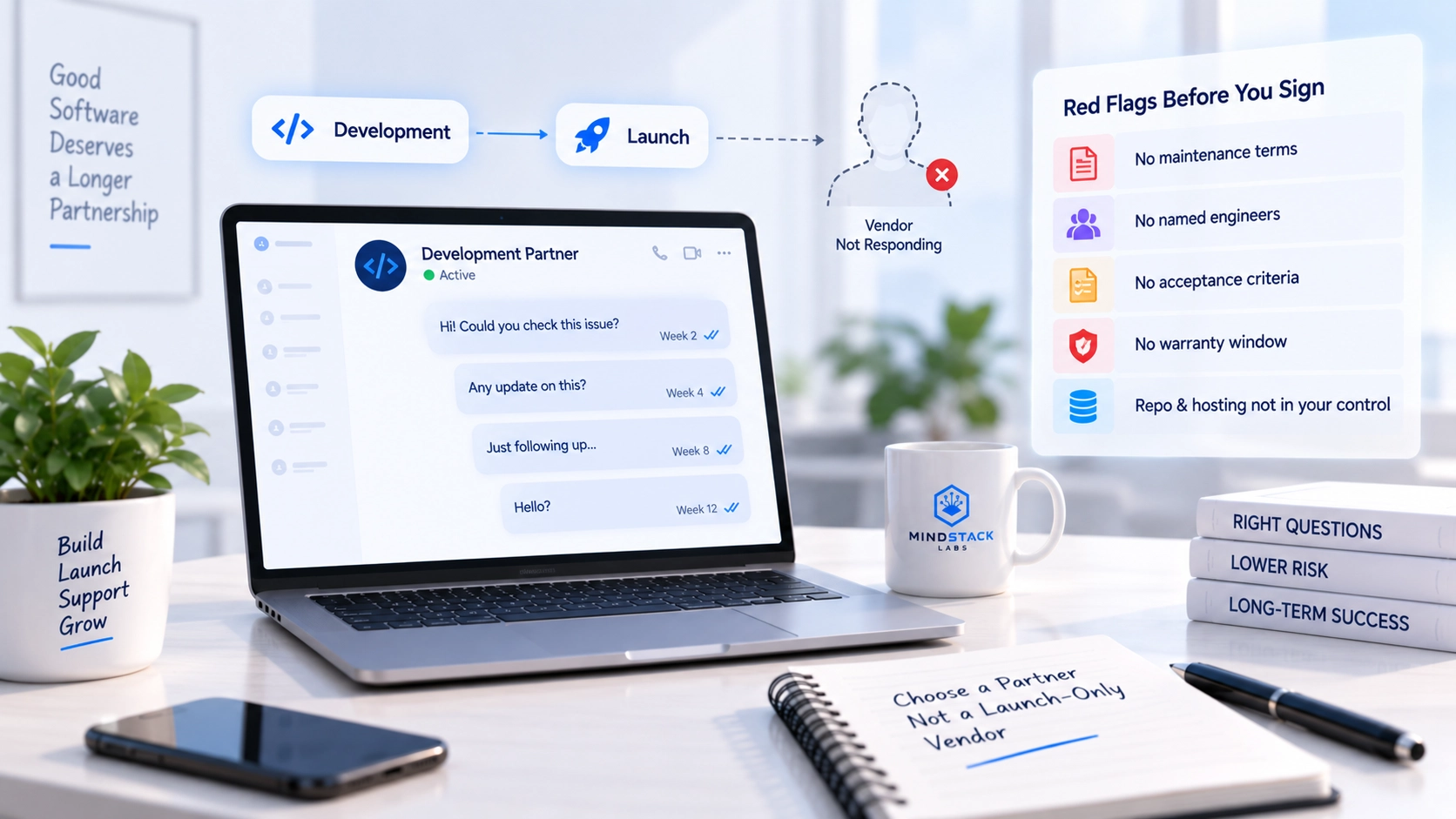
Companies ghost because project-based revenue rewards the next signature, not your maintenance ticket. This is structural, not personal.
Once your build is delivered and invoiced, you become a cost centre inside a business that is measured on new work.
The economics that cause it
Understand the incentive and the pattern stops being mysterious.
Project revenue ends at launch, so attention follows the next deal
No retainer means no allocated engineer next quarter
The engineer who knew your codebase gets moved to the active project
Support becomes goodwill, and goodwill has no SLA
Know why so many builds go dark in month three? Nobody was ever assigned to them.
The five signals visible before you sign
You can spot this in the proposal stage. Look for these:
No maintenance or support offering anywhere on their site
No named engineers, only "our team of experts"
Proposal has deliverables but no acceptance criteria
No warranty window after handover
Repository and hosting sit in their accounts, not yours
Any two of these together is a real risk. All five means you are buying a launch, not a partner.
The credential and repository trap
Insist on owning every account from day one.
Repository, hosting, domain, DNS, analytics, and third-party API keys
This single decision separates a clean transition from a three-week hostage negotiation
A team I spoke with inherited a launched marketing site with no repository access at all. The previous vendor had built it, hosted it under their own account, and stopped replying. Rebuilding from the live site cost more than the original build.
What "support" means when it is not defined in writing
Undefined support means best-effort support, which means no support when they get busy. Define these before signing:
Response time
Coverage hours
What counts as a bug versus a change
How many hours are included per month Our maintenance and support terms exist as a standing service for exactly this reason.
The nine-point vendor selection framework
Score every company on nine points, and the shortlist decides itself.
I set out to evaluate vendors on outcomes rather than impressions, and these nine are the ones that actually predicted how engagements ended.
Continuity checks
Continuity is the strongest predictor of a good engagement.
Is a maintenance agreement offered as standard, in writing?
Is there a warranty and bug-fix window after handover?
Is there a named escalation contact above the project manager?
Ownership checks
Ownership decides whether you can ever leave.
Is full IP assignment stated in the contract, not just implied?
Do you get repository and credential access from day one?
Is source code escrow available if the platform is business-critical?
Delivery checks
Delivery terms decide whether "done" means anything.
Are specific engineers named, with substitution rules?
Is QA a documented process with its own deliverables?
Are acceptance criteria written per deliverable?
Score each company out of nine. Anything below seven needs a specific, satisfying explanation before it stays on your list.
Pro tip: send all nine questions to every shortlisted company in one identical email, then compare how fast and how specifically each replies. The response pattern tells you more than the answers do.
Free shortlist review
Run your shortlist through the nine points
Send us the two or three companies you are considering. We will walk through all nine checks with you on a 30-minute call and flag where continuity, ownership, or delivery terms leave you exposed. Even if you pick someone else.
Reviewed by senior developers, not salespeople.
US-based, offshore, or a US company with an offshore team?
Pick the model that matches your communication load, not the one with the lowest rate.
All three models ship good software. They fail in different places, and the failure mode is what you are actually choosing between.
Model | Strongest at | Weakest at |
|---|---|---|
US onshore | Real-time collaboration, contract enforceability | Cost per engineer, senior availability |
Nearshore | Overlapping hours at lower cost | Deep specialist stacks |
Offshore | Cost, team scale, specialist depth | Overlap hours, timezone-dependent decisions |
Hybrid, US or UK facing with offshore delivery | Cost plus overlap, single accountable contact | Transparency, if the vendor hides the structure |
When offshore is the right call
Offshore works when your scope is stable and your decisions are asynchronous. It struggles when requirements change weekly and every change needs a live conversation. Our offshore JavaScript development and offshore Node.js engagements run on defined overlap windows for that reason.
How to ask "who actually writes the code" without offending anyone
Ask it directly, because any honest vendor answers immediately. Try this: "Which country will the engineers on my project be based in, and what hours do they overlap with mine?"
A straight answer is a good sign. A vague one is the answer.
What outsourcing web development costs across these models
Cost is driven by scope stability and integration count far more than by hourly rate. I am not going to quote figures I cannot source, so here is what actually moves your number.
The variables that move your quote
Number of third-party API integrations = the biggest hidden multiplier
Content migration volume and data cleanliness = often underestimated twice over
Custom design versus a system = weeks, not days
Compliance requirements = additional review cycles
Undefined scope = change requests at premium rates
Pricing models compared on risk transfer
Model | Who carries overrun risk | Best when |
|---|---|---|
Fixed price | Vendor | Scope is genuinely locked |
Time and materials | You | Discovery is ongoing |
Dedicated team | Shared | Roadmap runs past one release |
Milestone based | Split by phase | Scope firms up progressively |
What a lower rate actually buys you less of
The cheapest bid usually removes the invisible work first.
Fewer senior review hours on architecture
QA folded into development instead of separated
Documentation deferred, which becomes your handover problem
Project management thinned, which becomes your calendar problem
Cheap builds are not cheaper. They are just billed later.
What to ask on the first call with any of these companies
Ask for specifics, and listen for whether the answers come from delivery experience or from a sales deck. From my experience the answer quality on call one predicts the engagement quality on month nine.
Six questions, and the answers that should worry you
Who specifically will write my code? → Worrying: "our team will be assigned"
What happens if that engineer leaves mid-project? → Worrying: no substitution process
What does support look like after launch? → Worrying: "just email us anytime"
Who owns the code and when? → Worrying: "on final payment" with no clause
How do you define done? → Worrying: no acceptance criteria
Show me something you launched over a year ago that you still maintain → Worrying: nothing
How to run a small paid pilot before committing
Buy one small piece of work before you buy the project. This is the single most underused vendor test available.
A good pilot looks like this:
One contained task with clear acceptance criteria
Delivered into your repository
Paid at normal rates, not discounted
Reviewed on code quality, communication, and estimate accuracy
You learn more from two weeks of real work than from ten proposals.
Contract terms to require, whichever company you choose

Six clauses decide who carries the risk when things slip. Get these right and the vendor's incentives align with yours.
Clause | What to require |
|---|---|
IP assignment | Full transfer on payment, stated explicitly |
Acceptance criteria | Defined per deliverable, not per phase |
Warranty | Fixed bug-fix window after handover |
Change control | Written approval and pricing before work starts |
Termination and handover | Documented obligations, credentials, and knowledge transfer |
Data protection | Named sub-processors and data location |
This section is general information for evaluating a contract, not legal advice. Have your own counsel review any SOW, MSA, or data processing agreement before you sign it.
Does the company's city matter? New York, Chicago, Dallas, Los Angeles and beyond
City matters far less than time zone overlap and contract enforceability. Searching for a company in your city feels safer. It rarely changes the outcome.
Where geography genuinely matters:
Your contract needs to be enforceable in a specific jurisdiction
You need in-person workshops, which is a real requirement for some builds
Data residency rules restrict where your data can be processed
Otherwise, judge on overlap hours and delivery process. We work with US clients from our US web development practice and with UK clients through our UK web development team, and in both cases overlap hours mattered more than postcodes.
Outsourcing web development for agencies and white-label delivery
Agencies need capacity that stays invisible to the end client, which changes the contract more than the code. If you resell development, your risk is reputational as well as technical.
What a white-label agreement needs that a direct one does not
Named client-facing communication rules, or none at all
Your branding on all deliverables and documentation
Non-solicitation covering your end client
Escalation paths that never surface to your client
Handover documentation your team can support unaided
For agencies building recurring products, our SaaS product development work is the usual entry point, and the white-label terms sit inside the same SOW.
Pro tip: agree the white-label communication rules before kickoff, because renegotiating them mid-project in front of your client never goes well.
FAQs
Who are the best web development outsourcing companies in the USA?
The best fit depends on project shape:
Mind Stack Labs for custom web apps and white label
Toptal for a single senior hire
BairesDev for scale
Netguru for design-led product work
Thoughtbot for focused product engineering
Score each against the nine-point framework above.
How do I know a company will support me after launch?
Check whether they publish a maintenance offering and will sign a written support agreement with response times before the build starts. If support is only promised verbally, treat it as unavailable.
Should I use a marketplace or an agency?
Use a marketplace for small contained tasks where you can manage delivery yourself. Use an agency when you need QA, project management, and continuity beyond launch.
Who owns the code when I outsource web development?
You should, with full IP assignment stated explicitly in the contract and repository access from day one. If ownership transfers only on final payment with no clause detail, ask for it in writing.
How do I verify an outsourcing company's portfolio?
Open three listed projects, confirm the sites are live, then search the client name alongside the vendor name for independent confirmation. Ask for one reference from a project that launched over a year ago.
The short version
Choose on continuity, ownership, and delivery clarity, in that order.
→ Maintenance in writing + named engineers + your repository = a partner who is still there in month nine
Start with a paid pilot. Score all nine points. Then sign.
Ready to test a partner?
Start with a paid pilot, not a full build
We build and scale web applications for US and UK companies, and deliver white label for agencies. Start with one small paid task so you can judge our code, communication, and estimate accuracy before committing to anything larger.
Full IP assignment and repository access from day one
Maintenance and warranty terms agreed before launch, not after
Named senior engineers on your account
Book a free 30-minute scoping call
Or send your brief to mindstacklabs.com/contact