

Choose an ewallet app development company by checking proof, compliance fluency and security engineering, not by trusting a ranked list. The right partner is one you can verify on those points today and still trust when your wallet starts to grow.
A listicle can start your shortlist. It cannot finish it.
Many lists I read rank on marketing reach, and some are published by the companies they rank.
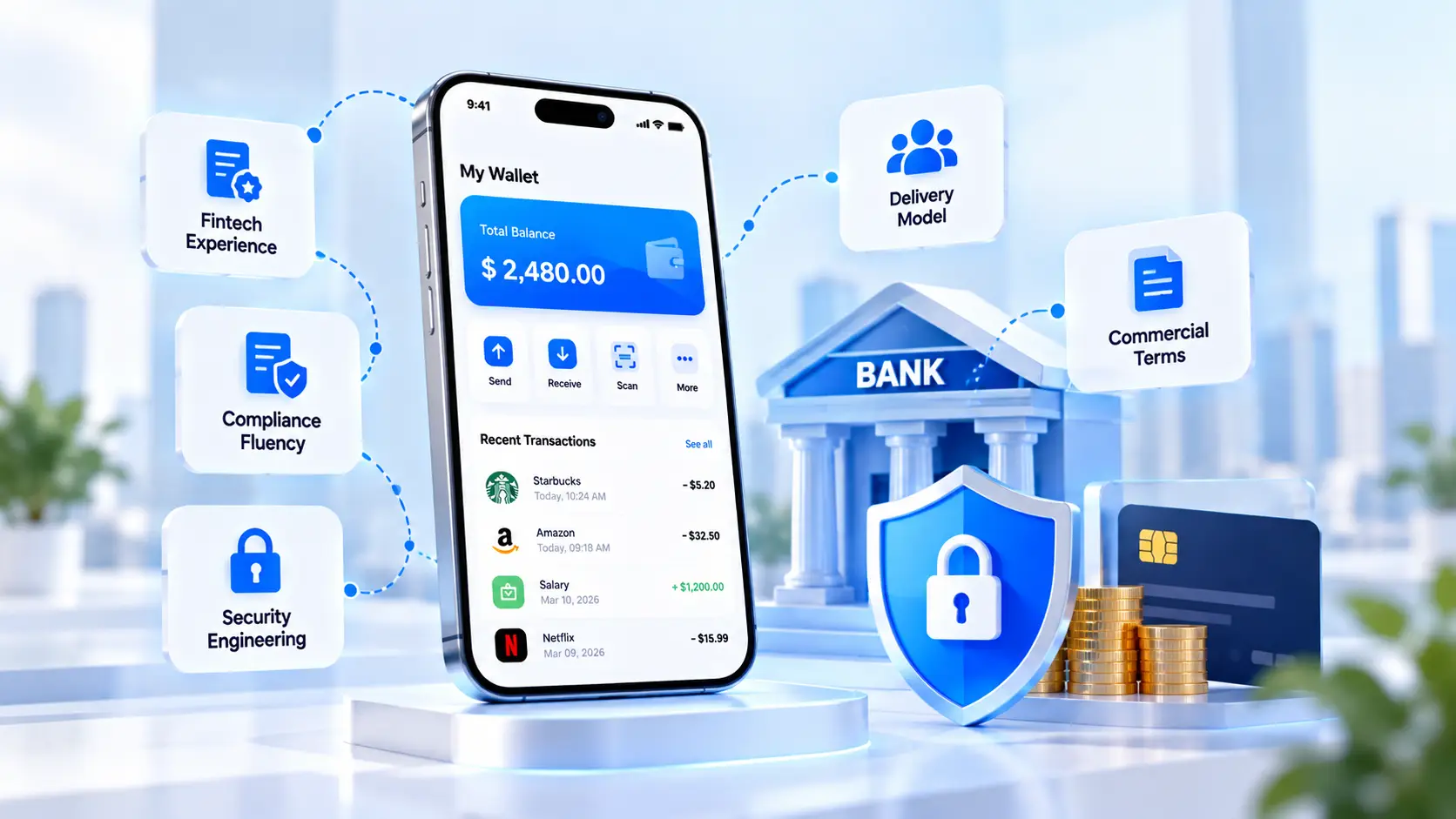
Choose an ewallet app development company by running five checks in order:
Wallet or fintech proof
Compliance fluency
Security engineering
Delivery model
Commercial terms.
Pick the partner type first, because your licensing path decides which type fits.
Mind Stack Labs has shipped 100+ products, and fintech is one of our flagship verticals. We list ourselves first because we publish this guide. I scored every company, us included, on the same criteria.
Can you name the bank that holds your users' money? Me neither, at first. Here is why that one question shapes your whole shortlist.
TL;DR
Match the partner type to your licensing path before you compare quotes.
Score every vendor on the same five criteria.
Ask each vendor who holds the funds, who runs KYC, and who owns the code.
Budget for costs outside the dev invoice: sponsor bank, KYC vendor, audits.
Start with a paid discovery phase, not a fixed price.
How I compared these eWallet app development companies
I scored each company on five plain criteria. You can reuse them on any shortlist.
What I am evaluating on
Wallet or payments proof: a named case study, not a service-page claim.
Security engineering: encryption, tokenization and access control built into the product.
Compliance fluency: the vendor raises KYC, AML and licensing in discovery.
Integration depth: payment gateways, card issuing, open banking APIs.
Delivery and terms: team model, post-launch support, code ownership.
Same rubric for everyone. Same order in every profile.
You might be thinking: "You ranked yourselves first. Isn't that biased?"
Fair. The order below follows partner type, not a score. I wrote our entry to include what our public portfolio does not show.
Check every claim against each company's own case studies. A self-ranked list deserves suspicion, so I would rather you check my homework than trust my trophy.
eWallet app development companies at a glance
Nine companies, several partner types, and no single winner for every build.
# | Company | Partner type | Best for | Public focus |
|---|---|---|---|---|
1 | Mind Stack Labs | Full-cycle product agency | A wallet inside a larger product | Fintech tools, one team from design to deployment |
2 | Itexus | Fintech specialist | Banking and payments-heavy products | Digital banking, payments, lending, trading |
3 | White-label platform plus dev team | Fast launch on a ready core | Ready core payment platform | |
4 | Dev Technosys | eWallet-focused vendor | Teams that want a wallet-first vendor | Dedicated eWallet service pages |
5 | Innowise | Large engineering firm | Wallet as one workstream in a bigger program | Banking and eWallet service page |
6 | Algoscale | Data and AI firm | Wallets with a data layer or crypto scope | Wallet development, including NFT and crypto wallets |
7 | ELEKS | Enterprise consultancy | Banks and large enterprises | Global fintech work |
8 | Chetu | Dedicated-team provider | Adding capacity to an in-house team | Payments-focused dedicated teams |
9 | Appinventiv | Mobile product agency | Mobile-first consumer wallets | Publishes a digital wallet guide |
Descriptions come from each company's public pages. Confirm current case studies before you shortlist.
The 9 eWallet app development companies, profiled
1. Mind Stack Labs
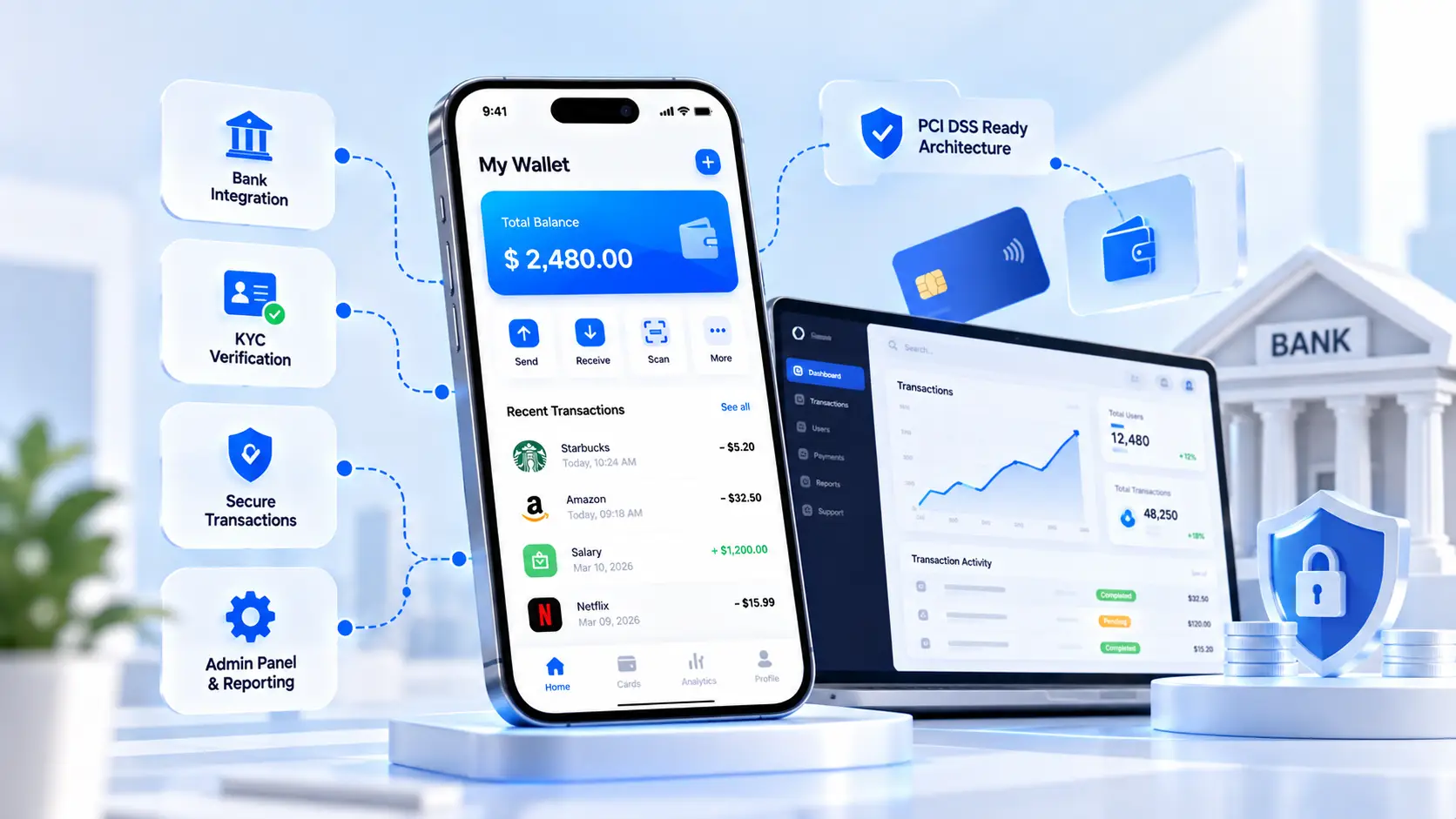
Mind Stack Labs is a full-cycle web and app studio, so one team handles design, development, QA and deployment in-house, with AI and automation capability on top.
Key capabilities
Fintech products shipped: MoneyMind (personal finance and expense tracking), FinCalc360, Invoice Factory (invoice hub and QR code management), True Invoice and SutraPlus (billing and accounting).
Mobile builds on Flutter and React Native, with Node.js backends.
Admin panels for the operations side of a wallet: review queues, support tools and reporting.
On-demand and mobility delivery, including Sprut taxi and Diz Carpooling. Those are not wallet products. They show how we deliver marketplace and mobility builds, where in-app wallets often appear.
Post-launch support through our maintenance services.
How I would scope a wallet build
Design the ledger first, because every balance depends on it.
Raise the sponsor bank, KYC vendor and licensing questions in discovery, not after the build.
Keep card data off our servers by using a tokenizing provider.
Build the admin panel alongside the app, not after it.
Numbers and pricing: 100+ products shipped. Wallet pricing comes from a scoped estimate after discovery. For a worked example of a Mind Stack build, read the TEPS Tabadul case study.
Best for: startups and growth-stage teams that need a wallet inside a larger product, with one team across design, build, QA and launch.
Watch-out: our public portfolio shows fintech tools, not a standalone wallet. We do not hold a licence for you or certify your program. Licensing sits with you and your bank partner. We design to PCI DSS technical controls as an engineering practice, not as a certification claim.
2. Itexus
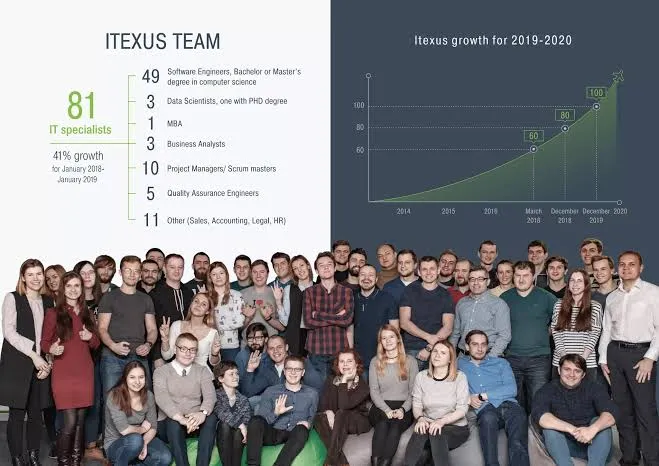
Itexus is a fintech-focused software company that serves both traditional financial services firms and fintech startups.
Key capabilities
Custom software for financial services, from enterprise builds to startup MVPs.
Staff augmentation, which suits teams that already have a product owner.
Client-reported fintech work on Clutch: mobile and web development for a loyalty fintech platform, UI/UX for a peer-to-peer lending company, and web development for an AI finance assistant.
Wider custom work across e-commerce, healthcare and insurance platforms.
Numbers and pricing: its Clutch profile states 130+ developers (self-reported). No public price list found. Request a scoped quote.
Best for: regulated fintech products where lending, banking or trading logic is the hard part, not the wallet screen.
Watch-out: in the Clutch entries I reviewed, the fintech projects were loyalty, lending and AI finance, not a labeled wallet. Ask for a wallet-specific reference.
3. SDK.finance
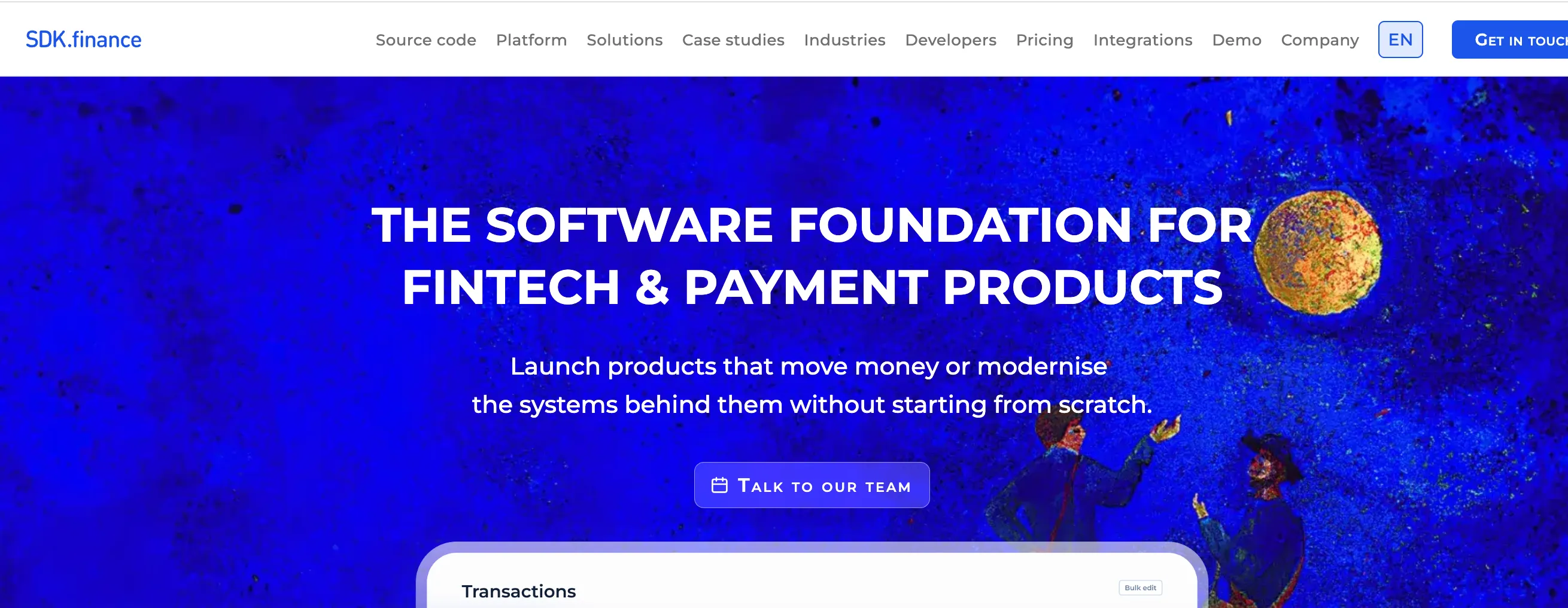
SDK.finance sells a ready fintech platform with wallet features, so you start from a working core instead of a blank repository.
Key capabilities
Backend platform for digital wallets, neobanks, remittance and payment processing, per its platform page.
Wallet features on its site: top-up, withdrawal, P2P transfers, currency exchange, payment requests and QR payments.
Ready UI, APIs and ledger, plus reconciliation and finance management tools.
Two buying options: a source code license, or a platform-as-a-service subscription.
Source code delivered to your private GitLab repository, per its source code page.
Numbers and pricing: its wallet page says the source code license carries no subscription fees. No public price list found. Request a quote for either model.
Best for: teams that want a fast launch on a ready core and are fine working inside a defined platform.
Watch-out: its site describes the platform as PCI DSS-certified. Ask for the current attestation and its scope. Also ask where customization ends and who owns your changes.
4. Dev Technosys
Dev Technosys is a vendor that positions eWallet development as a core service, with dedicated eWallet pages.
Key capabilities
Custom eWallet development for iOS, Android and web, per public listings.
Features its materials mention: multi-currency support, biometric authentication, encrypted transactions and blockchain integration.
Multi-currency wallet development through its UAE site.
A fintech and digital banking service line around the wallet offer.
Numbers and pricing: no verified figures. Some third-party pages quote team size and price ranges for it, but I could not trace them to the company, so I left them out. Request a scoped quote.
Best for: teams that want a vendor whose pitch centers on wallets and mobile delivery.
Watch-out: much of the public text about Dev Technosys is self-published or appears in syndicated listicles. Its own insights section publishes a top eWallet companies list that puts Dev Technosys first. Treat it like any self-ranked list, ours included. Ask for named case studies and a reference call.
5. Innowise
Innowise is a large engineering firm that runs eWallet development as a banking and fintech service line.
Key capabilities
Native and cross-platform eWallet apps, plus banking apps.
Use cases on its page: banking and fintech wallets, loyalty with in-app bonuses, subscription and pass management, and travel wallets with local currency.
A stated partnership with platforms like SDK.finance to speed up builds while keeping flexibility.
A process that runs through to app store listings.
Numbers and pricing: its page shows delivery counters, but I could not capture the figures reliably, so I left them out. Request a scoped quote.
Best for: a wallet as one workstream inside a bigger engineering program, or a wallet that needs loyalty and subscription features from day one.
Watch-out: ask whether your project would sit on a partner platform, and what that adds to cost and code ownership. Ask for the featured wallet projects behind its page.
6. Algoscale

Algoscale is a data and AI company that also sells wallet development, including crypto and NFT wallets.
Key capabilities
eWallet and digital wallet apps for startups, banks and enterprises, per its eWallet page.
Crypto wallet development with support for multiple blockchains.
NFT-based wallet development.
Custom branding and payment processing, with encryption and biometric authentication listed as features.
Numbers and pricing: no verified figures. Request a scoped quote.
Best for: wallets with a data or AI layer, or a build where crypto or NFT support is in scope from the start.
Watch-out: its page states PCI DSS compliance. Ask what that means in practice: which assessor, which scope, and whether it covers the product you would receive.
7. ELEKS
ELEKS is a global technology consultancy with a long fintech record, built around banks and large financial institutions.
Key capabilities
Banking software for retail and corporate banks: desktop, web and mobile apps, open banking solutions and cloud portals for internet banking and payments.
A dedicated cards and payments service area.
Loyalty management software and CRM systems for financial clients.
Trading and portfolio tooling for brokers.
Nearshore delivery and advisory services alongside engineering.
Numbers and pricing: its fintech page cites almost thirty years of experience (self-reported). No public price list found. Request a scoped quote.
Best for: banks and enterprises running a long program where the wallet connects to core banking and data systems.
Watch-out: ask for wallet-specific projects, since the public focus is broader banking software. Ask whether a startup-size engagement fits how they work.
8. Chetu

Chetu is a large custom software provider with a payments practice and a dedicated mobile wallet service page.
Key capabilities
Custom mobile wallet apps, cryptocurrency wallet development and wallet solutions for merchants.
Wallet integration with providers like Apple Pay and Google Pay.
P2P payments, NFC and contactless features.
Payment gateway integrations with providers such as Stripe, PayPal and Authorize.Net.
Payment standards it names on its pages: PCI-DSS, PA-DSS and EMV.
A hire-developers model for adding capacity to an existing team.
Numbers and pricing: its wallet page states 2,800+ software experts and 150+ awards (self-reported). No public price list found. Request a scoped quote.
Best for: teams with a product owner that need payments engineers, or that want to integrate existing wallet providers into an app.
Watch-out: integrating Apple Pay or Google Pay is not the same as building a branded stored-value wallet. Confirm which one you are buying. Dedicated teams also need your own product leadership.
9. Appinventiv
Appinventiv is a mobile product agency with a fintech practice that lists digital wallet development as a service.
Key capabilities
Digital wallet development covering multi-currency management, P2P transfers and contactless payments, per its UK fintech page.
Mobile banking, KYC platform and finance management app development.
P2P lending platform development.
Blockchain work that includes non-custodial crypto wallets, per a third-party listing.
Numbers and pricing: its fintech page states 1,600+ specialists and 3,000+ solutions (self-reported). No public price list found. Request a scoped quote.
Best for: mobile-first consumer wallets where app experience and adoption drive the business case.
Watch-out: it publishes a wallet guide that ranks well, and a ranking guide is not a case study. Ask for wallet portfolio work and a reference from a payments client.
Custom build, white-label or sponsor bank: which model fits?
White-label wins on speed, custom wins on control, and a sponsor bank decides what either can do.
Model | What you get | Trade-off | Fits |
|---|---|---|---|
Custom build | Own code and roadmap | Longer build, larger upfront scope | Wallet is your product edge |
White-label | Ready core platform | Customization limits, platform dependency | Fast pilot, standard features |
Sponsor bank (BaaS) | Bank holds funds and carries licensing | Bank approval, program fees | Stored value without your own license |
Most US launches I see tend to pair a sponsor bank with either a custom or white-label front end.
Scenario: a ride-hailing startup wants driver payouts and rider credits. It needs its own ledger logic, so it builds a custom front end on a sponsor bank program.
What compliance does a US eWallet need before launch?
A US eWallet needs a licensing answer before it needs a launch date.
Compliance feels like a wall. It is a checklist.
Money transmission: FinCEN treats a business that transfers funds as a money services business, whatever the transaction volume.
Closed-loop vs open-loop: closed-loop wallets, usable only with your own merchants, tend to face lighter treatment than open-loop ones. Confirm with counsel.
Sponsor bank: a bank can hold funds and carry licensing for you, in exchange for program approval and fees.
KYC and AML: identity checks and transaction monitoring, usually through a KYC vendor. Vendor choice shapes onboarding drop-off.
Consumer protection: Regulation E can apply to electronic fund transfers.
PCI DSS: the PCI Security Standards Council sets the card data standard.
Which features does a competitive eWallet need at launch?
Ship a narrow, secure core first and add growth features after real usage.
Stage | Features |
|---|---|
MVP | KYC onboarding, wallet top-up, P2P transfer, balance and history, cash-out, push alerts |
Security | Biometric authentication, encryption, tokenization, fraud rules |
Later | Loyalty, multi-currency, QR and NFC payments, card issuing |
Admin | KYC review queue, dispute handling, ledger view, reporting |
→ Ledger = source of truth for every balance.
→ Admin panel = where support and compliance teams spend their day.
Weak auth causes most of the incidents I read about. Our API security checklist for startups covers the basics.
How much does it cost to hire an eWallet app development company?
Cost depends on scope, compliance and integrations, and no honest vendor quotes it before discovery.
Cost driver | Why it moves the price |
|---|---|
Scope | MVP vs full feature set |
Integrations | Payment gateway, KYC vendor, card issuer |
Platforms | iOS, Android, web admin |
Security testing | Depth of testing and fixes |
Compliance support | Documentation and bank onboarding help |
Pricing models
Fixed price: works after discovery, risky before it.
Time and material: flexible, needs tight scope control.
Dedicated team: fits long roadmaps with a strong product owner.
Costs outside the dev invoice
Sponsor bank program fees.
KYC and AML vendor fees.
Legal and licensing counsel.
Security audits and cloud hosting.
In my experience, the non-dev costs surprise founders more than the build does.
How long does it take to launch an eWallet app?
Bank and compliance onboarding can run longer than the build itself.
Phase | What happens | Where delays hide |
|---|---|---|
Discovery | Scope, flows, ledger design | Unclear licensing path |
Design | UX and user flows | KYC screen revisions |
Build | App, backend, integrations | Third-party API access |
Security testing | Penetration tests, fixes | Late findings |
Bank and compliance onboarding | Sponsor bank review, KYC vendor setup | Approval queues |
Launch | Staged rollout | Support readiness |
I skip week counts here because they swing with scope. A vendor who quotes one before discovery is guessing.
Know why timelines slip? Nobody started the bank track early.
Red flags, and questions to ask before you request a quote
Walk away from any vendor that cannot explain who holds the funds.
Red flags
No compliance questions during discovery.
Fixed price before discovery.
Claims you cannot verify.
No wallet or payments proof in the portfolio.
No code ownership clause.
A ranked list with no stated criteria. That applies to lists like this one, which is why the criteria come first.
Ten questions to ask every vendor
Who held user funds in your past builds?
Which KYC and AML vendors have you integrated?
How do you keep card data off your servers?
Who owns the code and the infrastructure accounts?
What does post-launch support cover, and what is the response SLA?
Can I speak with a past client on a payments build?
How do you handle ledger reconciliation?
What happens when a third-party API changes?
Which senior person stays on my project?
What does discovery deliver, and can I keep it if we part ways?
Offshore or onshore: does location matter?
Proximity matters less than overlap hours and a named lead. "Near me" searches reward local offices, not better engineering.
Read our outsourcing guide for the trade-offs, or see how our USA Flutter team works.
FAQs
1. White-label vs custom ewallet app: which is better?
Custom is better when the wallet is your product edge. White-label is better for a fast pilot with standard features. In my experience, teams that outgrow white-label plan a migration, so ask about data export and code ownership on day one.
2. How do I choose an ewallet app development company?
Pick the partner type that fits your licensing path. Then score vendors on proof, security, compliance fluency, integrations and terms. Ask for a payments case study and a reference call before you request a quote.
3. Do I need a money transmitter license for a wallet app?
Possibly, if your business transfers funds for users. FinCEN treats funds transfer as a business activity with no volume threshold. A sponsor bank model can change who carries the license, so confirm with fintech counsel.
4. How much does an ewallet app development company charge?
It depends on scope, integrations and compliance support, so no reliable number exists before discovery. Ask for build costs and third-party costs as separate lines. Sponsor bank, KYC and audit fees sit outside the dev invoice.
5. How long does it take to launch an ewallet app?
The build is often not the slowest part. Sponsor bank review and compliance onboarding tend to set the launch date, in my experience. Ask your vendor to run those tracks alongside design and build.
Where I would start
Start with a paid discovery phase. Pick a product agency if the wallet lives inside a larger product, and a fintech specialist if licensing is your hardest problem. Use a white-label platform only if you need a pilot in market first.
Read next: Authentication vs authorization before you scope wallet security.