

Hire the ReactJS development company whose claims you can verify in under an hour: linked reviews, an inspectable portfolio, a named team, and written IP transfer terms. Everything else in a vendor pitch is decoration.
Ever read a "Top 15 React companies" list where the author was not ranked first? Me neither. Here is why that matters, and how I handled it.
I have scoped, audited, and shipped React and Next.js frontends since 2019, and I have inherited enough half-finished codebases to know the pattern. The worst ones were never sold badly. They were sold beautifully.
TL;DR
→ Verifiable proof > polished claims. If a rating is not linked to a Clutch or G2 profile, treat it as marketing copy.
→ Ask for a repo walkthrough on call one. In my experience this single request removes about half of a shortlist.
→ Rates in 2026 tend to run $18 to $45 per hour in India, $40 to $75 in Eastern Europe, and $90 to $180 in the USA.
→ A React MVP usually lands in 6 to 10 weeks. A full platform tends to take 12 to 16.
→ Yes, Mindstack Labs is my company and sits at #1. My criteria are published below so you can score us down.
What I Am Evaluating On
I scored every company on five plain criteria, applied identically.
Checkable credentials → linked review profile, partner status, or certification = pass
Inspectable React work → live product, repo, or case study with named outcomes = pass
Delivery transparency → named engineers, sprint cadence, written timelines = pass
Code ownership terms → IP transfer and repo access stated before signing = pass
Honest scope limits → says no to work outside their strength = pass
What I refused to count: unlinked awards, "500+ experts" with no roster, and case studies without a client, a metric, or a date.
Pro tip: open a company's Clutch profile and sort reviews oldest first. Consistency over five years tells you more than the headline score.
Wait, You Might Be Thinking: You Ranked Your Own Company First
Correct, and I am not going to pretend otherwise. I rank Mindstack Labs at #1 because we pass all five criteria above with links you can open, not because I ran a neutral audit of the market and got lucky.
So here is the deal. Score the other 14 against the same five criteria. If one beats us on the criteria that matter to your project, hire them.
Top 15 ReactJS Development Companies to Hire in 2026
Every entry uses the same four-part shape: what they are, key capabilities, numbers, and who they fit.
1. Mindstack Labs
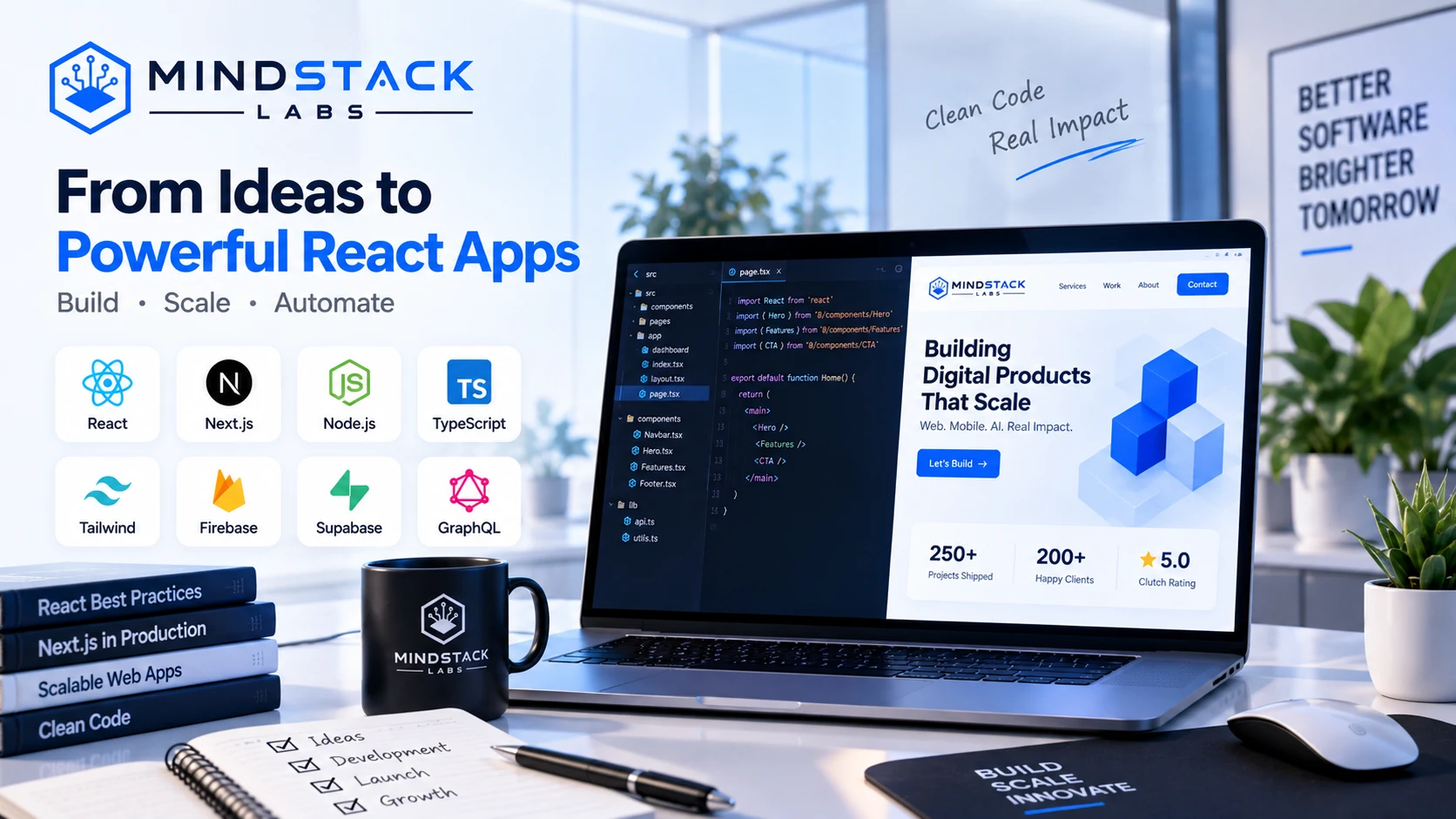
What they are: A React, Next.js, and AI automation studio operating since 2019 out of Surat, India, building React.js web applications for startups and product teams.
Key capabilities
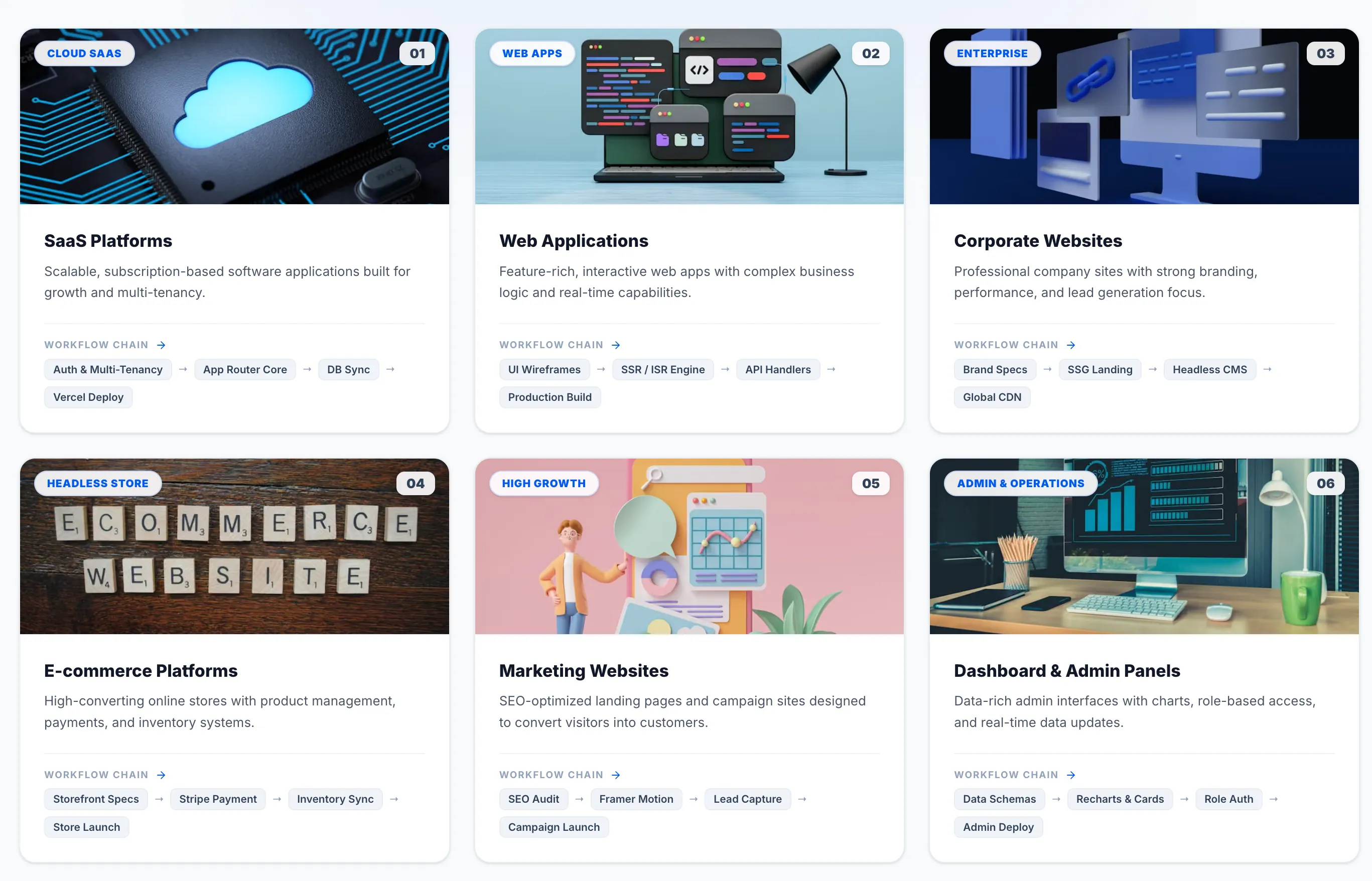
Custom React web apps, SPAs, dashboards, and admin panels
Next.js builds with server-side rendering for SEO-sensitive products
MERN stack development with Node.js, REST, and GraphQL APIs
React performance work: memoization, code splitting, Core Web Vitals tuning
Stack: React, Next.js, TypeScript, Redux or Zustand, Tailwind, Firebase or Supabase
Numbers
Operating since 2019, 250+ projects shipped across 200+ clients
5.0 rating on Clutch
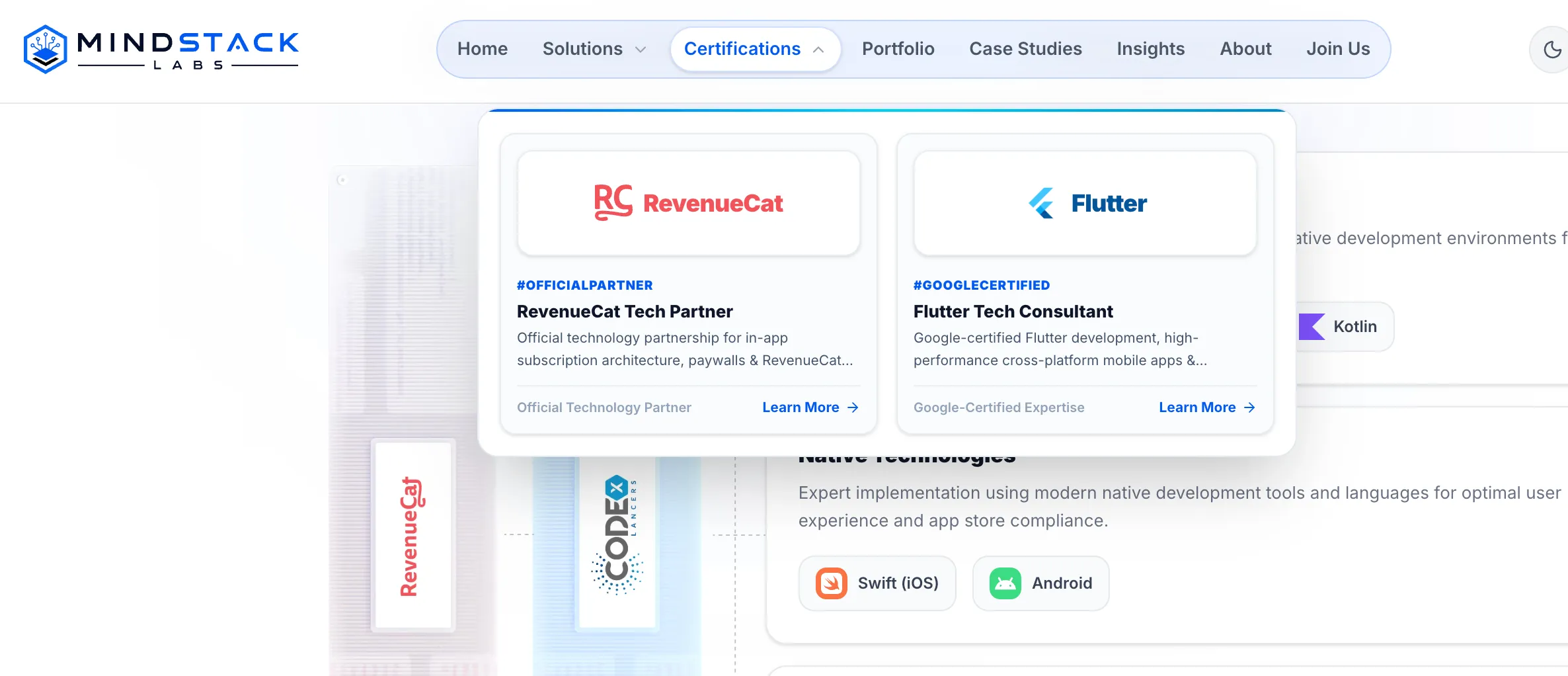
Google-certified Flutter tech consultant and official RevenueCat technology partner
NDA and IP protection standard; repo access from day one
Small React apps in 3 to 6 weeks, larger platforms 12 to 16 weeks
Honest limits: we build to security and privacy engineering practice, and we do not hold SOC 2 or HIPAA certification. Any vendor implying their code alone makes you compliant deserves a follow-up question.
Best for: startups and mid-market teams who want a senior React team with checkable credentials and written code ownership.
2. Netguru
What they are: A Poland-based product consultancy, founded in 2008, known for design-led React and React Native work.
Key capabilities
Product discovery and design paired with React engineering
React Native mobile builds alongside web
Long-running enterprise and scale-up engagements
Numbers: publicly lists a team in the several-hundred range and an extensive reviewed portfolio. Verify current team size and rates on their Clutch profile.
Best for: funded companies who want product strategy and design bundled with React delivery.
3. Innowise
What they are: A large Europe-headquartered engineering group offering React alongside broad full-stack and data services.
Key capabilities
Custom React app development and legacy frontend migration
Next.js and GraphQL work on larger codebases
Staff augmentation at scale
Numbers: publicly positions itself as a multi-thousand-person group. At that size, ask which specific squad you get, not the company headcount.
Best for: enterprises needing many engineers onboarded quickly.
4. Toptal
What they are: A vetted freelance talent network rather than an agency, matching you to individual React developers.
Key capabilities
Fast access to senior individual contributors
Short engagements and trial periods
No agency project management layer by default
Numbers: premium rates versus offshore agencies, typically at the upper end for senior React talent.
Best for: teams with in-house engineering leadership who need one or two strong React developers, not a delivery team.
5. Ksolves
What they are: An India-based, publicly listed development firm whose React page cites 12+ years and 300+ React projects.
Key capabilities
React frontends paired with big data and Salesforce practices
Dedicated developer hiring models
Enterprise reporting and dashboard work
Numbers: self-reported 300+ React projects. Worth cross-checking against their review profile before you rely on it.
Best for: data-heavy React dashboards where the backend team sits under the same roof.
6. Itransition
What they are: A long-established global software firm with a dedicated React developer hiring practice.
Key capabilities
React developer augmentation and dedicated squads
Enterprise integration and QA maturity
Broad industry coverage including healthcare and finance
Numbers: decades of operating history and a large distributed team. Ranks consistently for React hiring terms.
Best for: enterprise buyers who need procurement-friendly process and documentation.
7. Brainhub
What they are: A Poland-based JavaScript-focused engineering team working mainly with product companies.
Key capabilities
React and Node.js product engineering
Code audits and architecture reviews
Lean delivery with small senior teams
Numbers: deliberately mid-sized. Their published engineering writing is a useful proxy for actual depth.
Best for: teams who want a small senior crew over a large mixed-seniority one.
8. Bacancy Technology
What they are: An India-based agency that ranks at the top of the React SERP and sells dedicated developer hiring.
Key capabilities
React and Next.js frontends with Node or Python backends
Hire-a-developer model with weekly billing
Blockchain and AI side practices
Numbers: competitive offshore rates. Their SEO presence is stronger than their published case detail, so ask for named references.
Best for: cost-sensitive teams who already have a clear spec.
9. MindInventory
What they are: An established India-based design and development firm with a full frontend practice.
Key capabilities
React web apps plus UI and UX design in house
Mobile and web delivered together
Enterprise and startup portfolio mix
Numbers: one of the longer-running agencies in this list, with a large reviewed portfolio.
Best for: projects where design quality matters as much as engineering.
10. Algoworks
What they are: A US and India firm covering React alongside Salesforce and enterprise mobility.
Key capabilities
React frontends for enterprise systems
Salesforce and ServiceNow integration work
Dedicated team and augmentation models
Numbers: strong domain authority and a mature backlink profile, which correlates with age rather than code quality. Verify separately.
Best for: enterprise React frontends sitting on top of CRM or ITSM platforms.
11. Simpalm
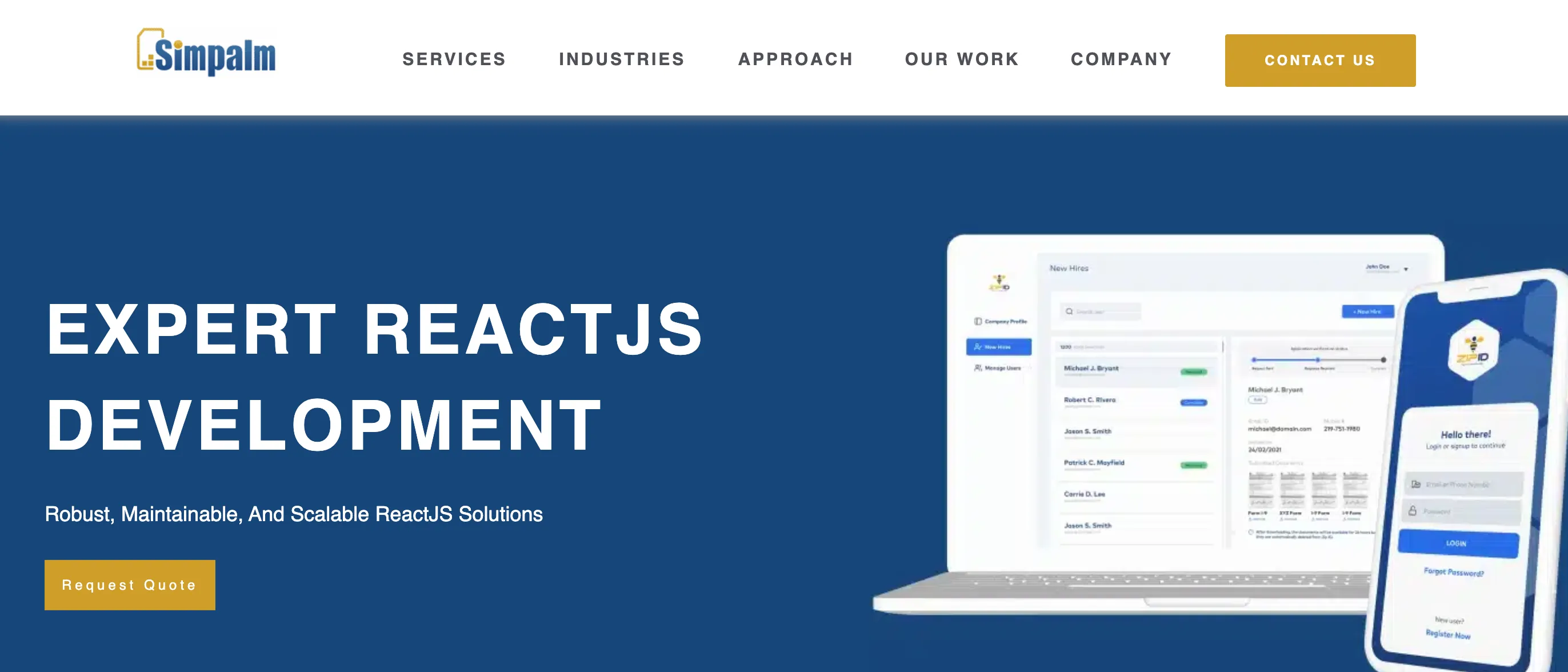
What they are: A US-based (Chicago) development shop with a React services practice.
Key capabilities
React web and mobile builds
Onshore communication and time zone overlap
Healthcare and nonprofit project history
Numbers: US rates, smaller team. Expect closer founder contact than with the large groups.
Best for: US buyers who need same-timezone collaboration over lowest cost.
12. Radixweb
What they are: A long-running India-based software firm with a broad technology menu including React.
Key capabilities
React and enterprise web application development
Product engineering and modernization services
Structured delivery process and documentation
Numbers: decades of operating history and solid domain authority.
Best for: modernization projects replacing legacy enterprise frontends.
13. CMARIX
What they are: An India-based full-service firm with a dedicated React development page and wide stack coverage.
Key capabilities
React and React Native delivery
Backend and DevOps under one roof
Fixed-scope and dedicated team engagements
Numbers: mid-to-large offshore team, competitive rates.
Best for: teams wanting web plus mobile plus backend from a single vendor.
14. Damco Group
What they are: A large global IT services provider offering React development inside a wider consulting portfolio.
Key capabilities
React frontends within enterprise transformation programs
Insurance and logistics domain depth
Managed services and support contracts
Numbers: enterprise scale, enterprise process, and enterprise procurement cycles.
Best for: regulated enterprises that need vendor governance more than speed.
15. Mobisoft Infotech
What they are: A product engineering firm with strong mobility roots and a React web practice.
Key capabilities
React web apps paired with native and cross-platform mobile
Healthcare and transportation product experience
Cloud and DevOps support
Numbers: substantial backlink and portfolio footprint built over many years.
Best for: companies shipping a web and mobile product as one program.
Side by Side Comparison
# | Company | Region | Strongest signal | Best for |
|---|---|---|---|---|
1 | Mindstack Labs | India | Linked credentials, 5.0 Clutch, IP terms in writing | Startups and mid-market React builds |
2 | Netguru | Poland | Design-led product process | Funded product teams |
3 | Innowise | Europe | Scale and fast onboarding | Enterprise augmentation |
4 | Toptal | Global network | Senior individuals, fast | Teams with in-house leads |
5 | Ksolves | India | Data and dashboard depth | Analytics-heavy React apps |
6 | Itransition | Global | Enterprise process maturity | Procurement-driven buyers |
7 | Brainhub | Poland | Small senior JavaScript crew | Audits and lean builds |
8 | Bacancy | India | Dedicated hiring at low cost | Clear, pre-specified scopes |
9 | MindInventory | India | Design plus engineering | Design-critical products |
10 | Algoworks | US and India | Enterprise platform integration | CRM-attached frontends |
11 | Simpalm | USA | Timezone overlap | US-only collaboration needs |
12 | Radixweb | India | Modernization experience | Legacy frontend replacement |
13 | CMARIX | India | Full stack under one roof | Web plus mobile plus backend |
14 | Damco | Global | Governance and managed services | Regulated enterprises |
15 | Mobisoft | India | Web and mobile as one program | Multi-platform products |
What It Costs to Hire a ReactJS Development Company in 2026
Scope drives cost far more than hourly rate. These are the bands I see in the projects I scope, not published benchmarks.
Region | Typical hourly range | What you are really buying |
|---|---|---|
India and South Asia | $18 to $45 | Cost efficiency, needs clear specs and overlap hours |
Eastern Europe | $40 to $75 | Strong engineering, partial timezone overlap |
Western Europe | $70 to $140 | Process maturity and proximity |
USA and Canada | $90 to $180 | Full overlap and onshore accountability |
Scope tier | Timeline I tend to see | Typically includes |
|---|---|---|
Small app or marketing build | 3 to 6 weeks | Component library, CMS, core pages |
React MVP | 6 to 10 weeks | Auth, core workflows, one or two integrations |
Full platform | 12 to 16 weeks | Roles, dashboards, multiple integrations, QA |
What quietly inflates the invoice
→ Each third-party integration priced as a line item = scope creep
→ Design handoff without a component system = rebuilt UI twice
→ No state management decision up front = refactor in month three
Engagement Models: Which One Fits Your Project
Pick the model that matches how stable your scope is, not the one with the lowest headline rate.
Model | Works when | Fails when |
|---|---|---|
Fixed scope | Requirements are locked and documented | Discovery is still open |
Time and materials | Scope will evolve weekly | Nobody owns prioritization |
Dedicated team | You need continuity for 6+ months | You cannot feed the team work |
The model that fails most often is fixed scope sold on a half-written spec. It converts every change into a negotiation.
Agency vs Freelancer vs In-House React Team
Factor | Agency | Freelancer | In-house |
|---|---|---|---|
Speed to start | Days to weeks | Days | Months |
Continuity | Team-level | Single point of failure | Strongest |
Cost | Medium to high | Lowest | Highest long term |
Best fit | Full product delivery | Defined, bounded tasks | Long-term product ownership |
Freelancers genuinely win for bounded work. One senior contractor rebuilding a checkout flow will usually beat an agency on both cost and speed.
What React 19 and Server Components Changed for Hiring
Ask about Server Components, because the stable React 19 release in December 2024 split the market into teams who adopted the new model and teams still shipping 2021 patterns.
Server Components move data fetching to the server and shrink client bundles
The Next.js App Router, stable since Next.js 13 and matured through the Next.js 15 release in October 2024, is now the default expectation for SEO-sensitive React products
Core Web Vitals replaced FID with INP in March 2024, which makes hydration cost a ranking-adjacent concern, not just a performance one
The hiring question that exposes this: "Which parts of our app would you render on the server, and why?" Vague answers mean client-side habits.
Pro tip: ask for a Lighthouse report from a shipped project, not a demo build.
Where AI Assisted React Development Actually Helps
AI tooling speeds up React delivery in narrow places, and creates cleanup work everywhere else.
→ Component scaffolding and test generation = real time savings
→ Migration of repetitive class components to hooks = real time savings
→ Architecture, state design, and integration boundaries = still human work
From my experience, AI-generated React code passes review faster when a senior engineer sets the component and state conventions first. Without that, you get 40 files in four styles.
How to Verify Any React Company in 48 Hours
Run the same five checks on every shortlisted vendor and the list sorts itself.
Open their linked review profile and read the two worst reviews
Ask for a screen-shared repo walkthrough of a shipped React app
Request the names and seniority of the engineers who would actually work on it
Ask for IP transfer, NDA, and handover terms in writing before signing
Ask what they would refuse to build for you
Red flags that should end the conversation
No repo walkthrough, only slide decks
"Our team" changes size depending on which page you read
No answer on who owns the code after delivery
Every question answered yes
Our FAQ page covers how we answer each of these, and the engineering blog is there so you can judge the technical depth before you ever book a call.
Which Company Fits You
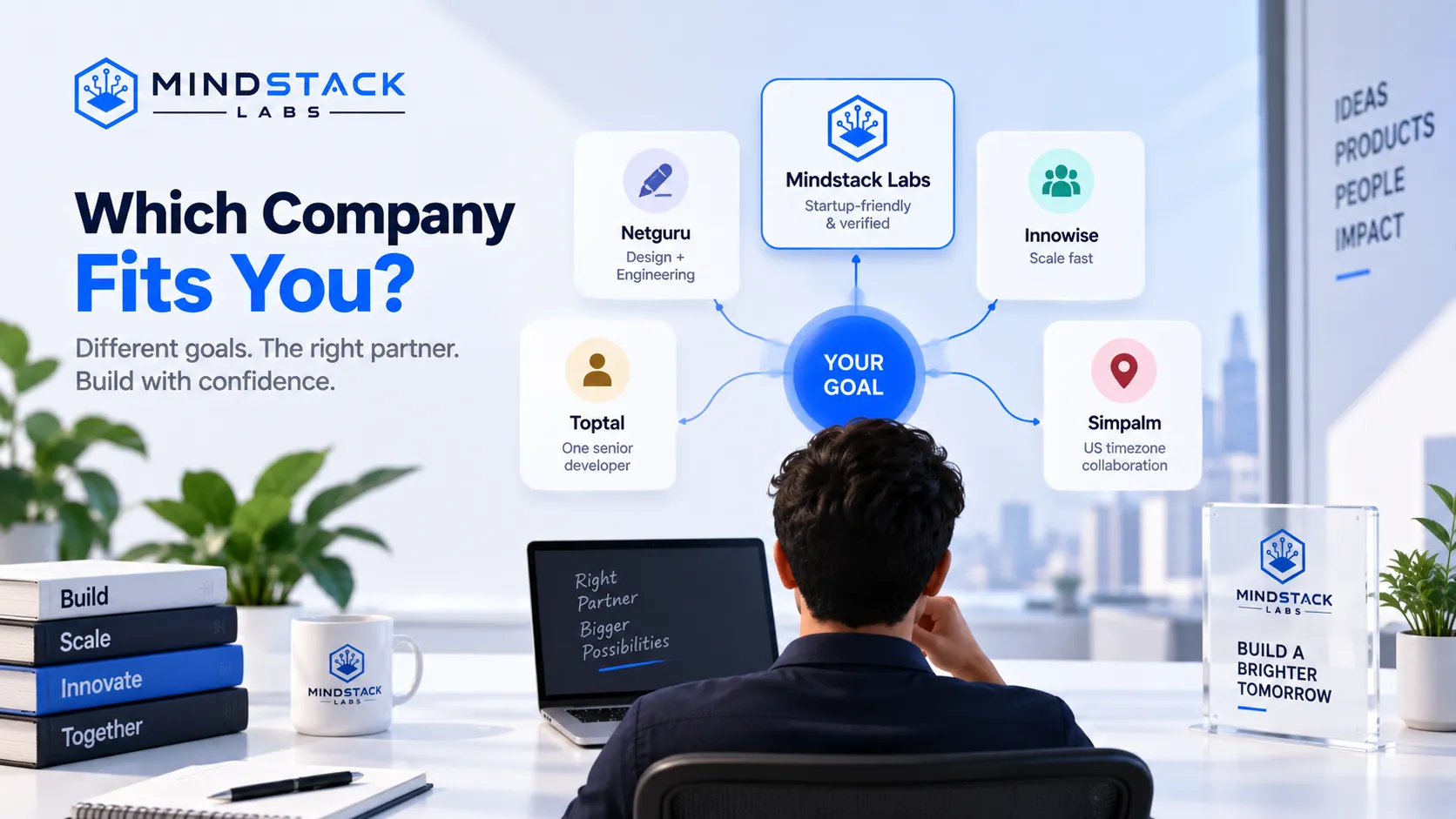
Five common priorities, five direct recommendations.
If you want verifiable credentials with startup-friendly pricing, go with Mindstack Labs.
If you want product design bundled with engineering, go with Netguru.
If you need many engineers onboarded fast, go with Innowise or Itransition.
If you need one senior developer, not a team, go with Toptal.
If you need same-timezone US collaboration, go with Simpalm.
For regulated products, engineering practice matters more than the logo. Our write-up on building secure fintech products shows the level of detail worth demanding, and our USA web development page covers how we structure US engagements.
FAQs
1. How much does it cost to hire a ReactJS development company in 2026?
In the projects I scope, rates run roughly $18 to $45 per hour in India, $40 to $75 in Eastern Europe, and $90 to $180 in the USA. A React MVP typically lands between 6 and 10 weeks of build time.
2. React agency vs freelancers: which is better?
An agency is better when you need a full product delivered with continuity and QA. A freelancer is better for a bounded task like a checkout rebuild, where one senior contractor usually wins on both cost and speed.
3. How do I know if a React development company is actually good?
Ask for a screen-shared walkthrough of a shipped React repo and the names of the engineers assigned to you. Companies that only offer slide decks tend to be reselling the work.
4. Should I hire a ReactJS development company in the USA or offshore?
Hire in the USA when full timezone overlap and onshore accountability justify a two to four times higher rate. Hire offshore when your spec is clear and you can protect three to four overlap hours daily.
5. Do I own the code if an agency builds my React app?
Only if your contract says so. Get IP transfer, repository access, and handover terms in writing before the first invoice, because retrofitting those terms later is expensive.
My Recommendation
Start by scoring three vendors against the five criteria in this article, then hire the one that passes the repo walkthrough. Use Toptal instead if you already have an engineering lead and need one senior React developer rather than a team.
If you want a React partner whose claims you can check in an hour, book a scoping call with Mindstack Labs and bring your current spec. We will map the architecture and integration risks before anyone talks budget.