

So PropTech Companies not only assign rank randomly its need deep analysis and comparison so here i provide you deep comparison of each comapnies so its easy for you to take decision.
The proptech companies worth watching in 2026 are the ones that won on architecture, not on funding rounds: MindStack Labs, Procore, Matterport, Zillow, VTS and EliseAI each solved a specific data or integration problem that the rest of the industry kept avoiding.

I Know you dont know some of companies but Its like hidden Gems So
Watch them for their technical decisions, because those decisions are the part you can actually copy into your own build.
Ever finished a "proptech companies to watch" list and still had no idea how a single one of those products was built? Me neither. Here is why that matters.
TL;DR
Funding size tells you who raised money. It tells you nothing about whether the product works.
The winners in proptech share three technical traits: API-first data access, AI applied to one narrow job, and an honest build versus buy decision made early.
Real estate data is the hard part. MLS, IDX, county records and building systems were never designed to be queried by modern software.
I have scoped, reviewed or shipped property and community platform work inside a 250+ project delivery history at MindStack Labs since 2019, and the integration layer is where almost every timeline slips.
If you are building: budget 6 to 10 weeks for an MVP, 12 to 16 weeks for a full platform, and put your integration spike in week one, not week nine.
So on Which basis I Evaluating These PropTech Companies?
I am scoring on execution, not capital raised. Here is the rubric before any names get mentioned, so you can disagree with my criteria rather than just my conclusions.
Technical defensibility → is the core built on a real engineering advantage, or a UI wrapped around someone else's data?
Integration depth → how deeply does it plug into MLS, IDX, CRM, accounting and building systems that already exist?
Data ownership → does the company control a dataset that gets more valuable over time?
Real-world adoption → are actual operators using this daily, or is it a pilot with a press release?
Replicability → can a reader learn something applicable from how it was built?
Also i Show Customer reviews and Satification and count as main ranking factor for comapnies
Why Funding Size Is a Weak Signal
Capital raised measures investor conviction, not product quality. I have watched well-funded proptech tools lose to smaller products that simply handled one messy data source properly.
Proptech has a specific version of this problem. The industry's data lives in legacy systems, so a company can raise a large round and still spend two years just getting clean access to listings, leases or utility data.
Money buys runway. It does not buy a working MLS feed.
Top PropTech Companies to Consider in 2026
Every entry below follows the same shape: what it is, key technical capabilities, relevant numbers, and who it is best for. Same structure for all six, including my own company. Nine more companies follow further down, and a full 15-company comparison table sits at the end.
1. MindStack Labs: The Technical Execution Partner Behind Builds Like These
Disclosure first, because you should not have to guess. I work at MindStack Labs and I have included us on this list. We are not ranked first as a venture-scale proptech product competing with Zillow's traffic or Procore's user base. We are ranked first against criterion five, replicability, as the execution partner most worth watching for how proptech actually gets built.
What it is: a full-cycle product engineering company that builds property, community and real estate platforms end to end, with design, development, QA and deployment in-house.
Key capabilities:

Cross-platform mobile builds in Flutter and FlutterFlow, plus React Native and native iOS and Android
Backend work across Node.js, .NET, Laravel, Python, Firebase and Supabase
Web platforms in React and Next.js, with CI/CD across AWS, GCP and Azure
Subscription and paywall architecture, backed by an official RevenueCat technology partnership
Real-time communication and notification layers, including Twilio voice integration inside Flutter
AI and automation layers built with OpenAI, LangChain and n8n workflows
Relevant numbers:

Operating since 2019, 250+ projects delivered, 50+ engineers, designers and project managers
Upwork Top Rated Plus, and a 5.0 rating on Clutch (from a small review sample, which I would rather state than hide)
Typical timelines in my experience: MVP in 6 to 10 weeks, full platform in 12 to 16 weeks, with 30 days of post-launch support
Proof point in this category: E-Society Management, a society and residential community management platform that digitizes day-to-day housing community operations, from resident records to routine administrative workflows. That is the proptech-adjacent build I am drawing most of my observations from in this article. Browse more of these builds in our portfolio and case studies.
Where we are not the biggest name: we do not run a standalone, venture-funded proptech product at the scale of the next five companies. We are the engineering team you hire to build one. Stating that plainly is the only reason a self-inclusion belongs on a list like this.
Best for: real estate operators and proptech founders who need the product built rather than bought, especially when the roadmap depends on custom integrations.
2. Procore: Construction and Real Estate Project Management, Built API-First

What it is: a construction management platform that became infrastructure by making itself the connective tissue between every other tool on a jobsite.
Key capabilities:
Documented public API and a large partner app marketplace, so third parties extend the platform instead of competing with it
Project, financial and field workflows unified in one data model
Mobile-first field usage, built for people wearing gloves, not sitting at desks
Relevant numbers: publicly listed, with a partner marketplace that spans a wide range of third-party integrations by its own accounting. I am not citing a specific count here since marketplace size changes and is self-reported.
Why it matters technically: Procore treated integrations as the product, not as a support ticket. From my experience watching platform builds, that is the single decision that compounds fastest.
Best for: construction and development firms that need one system of record across many subcontractors and tools.
3. Matterport: 3D Digital Twins via Computer Vision and Cloud Capture Pipelines

What it is: a spatial data company that turned property walkthroughs into structured, queryable 3D data.
Key capabilities:
Capture pipeline that converts phone or dedicated camera input into a dimensionally accurate digital twin
Computer vision processing in the cloud, so the heavy compute never sits on the capture device
APIs and SDKs that let other products embed the twin instead of rebuilding it
Relevant numbers: a large and growing library of captured spaces by company reporting, plus the CoStar acquisition that closed in February 2025, which pulled spatial data directly into a commercial real estate data giant. I am leaving out the company's specific capture counts since those are self-reported.
Why it matters technically: Matterport did not sell virtual tours. It sold a dataset that happened to render as a tour. Big difference.
Best for: anyone whose product needs verified spatial or dimensional property data rather than photo galleries.
4. Zillow: Zestimate and ML Models Trained on Public Records

What it is: the consumer front door to US real estate, sitting on top of one of the most aggressively assembled property datasets in the market.
Key capabilities:
Machine learning valuation models trained on public records, tax assessments, listing data and user-submitted updates
Continuous model retraining as transactions close, which is why the estimate moves
Large-scale ingestion from fragmented MLS and county sources, normalized into one schema
Relevant numbers: Zestimate covers a large majority of US homes by Zillow's own published claims, with accuracy that the company itself publishes and qualifies by market. I am not repeating a specific home count here since that figure is self-reported.
Why it matters technically: Zillow publishes its own error margins. In my experience, that willingness to disclose model accuracy is rarer in proptech than it should be, and it is a trust feature, not a weakness.
Best for: benchmarking what consumer-grade real estate data infrastructure looks like at national scale.
5. VTS: Real-Time Commercial Leasing, Replacing Static Spreadsheet Tracking

What it is: a commercial real estate leasing and asset management platform that replaced the shared spreadsheet as the source of truth for a portfolio.
Key capabilities:
Live pipeline and tenant data across a portfolio, instead of month-old static reports
Market data layered onto a landlord's own leasing activity
Role-based workflows for brokers, asset managers and ownership
Relevant numbers: a large volume of commercial square footage under management on the platform by company reporting. I am not repeating a specific figure here since that is self-reported.
Why it matters technically: VTS won by attacking the reporting lag, not the reporting format. Nobody wanted a prettier spreadsheet. They wanted today's numbers today.
Best for: commercial landlords and asset managers running multi-property leasing pipelines.
6. EliseAI: Conversational AI and NLP for Leasing Communications

What it is: an AI leasing and resident communication platform that handles prospect follow-up across email, SMS and phone.
Key capabilities:
Natural language handling of leasing inquiries, tour scheduling and follow-up sequences
Integrations into property management systems so the AI can actually book and update records
Escalation logic that routes complex conversations to humans
Relevant numbers: deployed across large US multifamily portfolios per company statements, with response speed as the headline benefit rather than headcount replacement.
Why it matters technically: EliseAI applied AI to one narrow, measurable job: response latency on inbound leads. Narrow beats ambitious almost every time.
Best for: multifamily operators losing leases to slow first-response times.
Quick Comparison
Company | Core technical edge | Primary data asset | Best for |
|---|---|---|---|
MindStack Labs | Full-cycle custom engineering, integration-heavy builds | Client-owned (we build, you own it) | Building a proptech product from scratch |
Procore | API-first platform with partner marketplace | Project and field workflow data | Construction and development firms |
Matterport | Computer vision capture to 3D digital twin | Spatial and dimensional property data | Products needing verified spatial data |
Zillow | ML valuation models at national scale | Listings, public records, tax data | Consumer-facing real estate data |
VTS | Real-time leasing pipeline visibility | Commercial leasing activity data | CRE landlords and asset managers |
EliseAI | NLP applied to leasing response latency | Conversation and leasing funnel data | Multifamily leasing teams |
Other 9 PropTech Companies You Should Also Consider
These nine are less obvious than the first six, and that is exactly why they are worth a look. Same shape for each one: what it is, key capabilities, relevant numbers, why it matters technically, and who it is best for.
One honesty note up front. Public technical detail on these companies is thinner than on Procore or Zillow, so I am describing product-level architecture that is publicly visible, and hedging everything else.
7. Pacaso: Fractional Ownership Infrastructure, Not Just a Marketplace

What it is: a co-ownership platform for second homes, where the hard part is the ownership and scheduling layer, not the listings.
Key capabilities:
Entity-based ownership structure modeled in software, with shares tracked per property
Scheduling and allocation logic that divides usage fairly between co-owners
Property operations and billing split across multiple owners of one asset
Relevant numbers: homes-sold and owner counts are published on its own site, but I am not repeating specific figures here since they are self-reported and change often.
Why it matters technically: most real estate data models assume one owner per property. Pacaso had to break that assumption at the schema level, which is a genuinely hard rewrite.
Best for: anyone building products where ownership is shared, fractional or syndicated.
8. ButterflyMX: Access Control as a Cloud Data Layer

What it is: a cloud video intercom and property access system that replaced wired intercom hardware with an app-plus-panel setup.
Key capabilities:
Video intercom, mobile door release and delivery access in one system
Integrations into property management and smart lock ecosystems
Access logs captured centrally rather than trapped in building hardware
Relevant numbers: deployed across many multifamily and commercial buildings per company reporting, without a specific count since that figure is self-reported.
Why it matters technically: every door event becomes structured data. That is the pattern I flagged in the smart building section, and ButterflyMX is the clearest commercial example of it.
Best for: multifamily and commercial operators who want access events in an auditable, queryable trail.
9. Roofr: Aerial Measurement and Instant Quoting for Roofing
What it is: a roofing sales platform built on automated roof measurement reports generated from aerial and satellite imagery.
Key capabilities:
Measurement reports produced from imagery instead of a physical site visit
Instant estimate and proposal generation off those measurements
CRM and payment workflow for contractors, so the quote does not leave the system
Relevant numbers: turnaround times and contractor counts are published by the company. Company-stated.
Why it matters technically: it converts an image into a billable measurement. That imagery-to-structured-data conversion is the same core pattern Matterport uses indoors.
Best for: contractor-facing and home services products that need measurements without a truck roll.
10. Inspectify: Standardized Inspection Data at Portfolio Scale

What it is: a property inspection platform that produces consistent, structured inspection data across many properties and many inspectors.
Key capabilities:
Templated inspection workflows that force the same fields on every job
Cost estimation attached to identified issues, not just a photo report
API access so inspection data can flow into underwriting and asset management tools
Relevant numbers: inspection volume and network coverage are company-published figures.
Why it matters technically: inspection reports are usually PDFs, which are useless to software. Inspectify treats the inspection as a dataset first and a document second.
Best for: SFR investors, iBuyers and lenders who need comparable condition data across a portfolio.
11. Cover Genius: Embedded Insurance APIs for Property and Rentals

What it is: an embedded insurance and protection platform that lets other companies sell cover inside their own checkout flow.
Key capabilities:
API-first distribution, so insurance appears natively inside a partner product
Automated claims handling for high-volume, low-value claims
Multi-jurisdiction policy handling behind a single integration
Relevant numbers: partner counts and covered geographies are company-stated on its site.
Why it matters technically: the regulatory complexity is hidden behind one API. In my experience, that abstraction is the hardest and most valuable thing an embedded fintech or insurtech can build.
Best for: rental, travel and property platforms that want protection products without becoming an insurer.
12. NoBroker: Brokerage-Free Marketplace Plus a Services Layer
What it is: an Indian real estate marketplace that removed the broker from the transaction and then stacked rent payments, agreements and property services on top.
Key capabilities:
Direct owner-to-tenant matching without broker intermediation
Rent payment, rental agreement and documentation workflows in-app
Adjacent services including home services and society management
Relevant numbers: user and transaction figures are company-published and very large. Verify independently before citing.
Why it matters technically: the marketplace was the wedge, the payments and services layer is the business. That sequencing is worth copying if you are entering a broker-heavy market.
Best for: teams building marketplaces in markets where intermediaries own the relationship today.
13. Home365: Property Management With Predictive Maintenance Pricing
What it is: a property management platform that prices its service against predicted maintenance costs rather than billing every repair separately.
Key capabilities:
Maintenance cost prediction from property attributes and historical work orders
Guaranteed or fixed-cost management offerings built on those predictions
Vendor dispatch and work order tracking inside the same system
Relevant numbers: properties under management and guarantee terms are company-stated.
Why it matters technically: the company takes financial risk on its own model output. That is the strictest possible test of whether a prediction model actually works.
Best for: single-family rental owners and operators who want cost predictability over line-item billing.
14. ZestyAI: Property Risk Scoring From Imagery and Climate Data
What it is: a property risk analytics company producing wildfire, roof condition and climate risk scores at individual address level.
Key capabilities:
Computer vision over aerial imagery to assess roof and structure condition
Climate and hazard modeling joined to parcel-level property data
Scores delivered via API into insurance and lending workflows
Relevant numbers: property coverage counts and regulatory model approvals are published by the company.
Why it matters technically: it is one of the few proptech models that has to survive external scrutiny, because insurance rating models get reviewed by regulators.
Best for: insurance, lending and portfolio risk products that need address-level risk inputs.
15. Bedrock Robotics: Autonomy Retrofits for Construction Equipment
What it is: an autonomy company retrofitting existing heavy construction equipment rather than manufacturing new machines.
Key capabilities:
Sensor and compute kits added to machines already on site
Autonomous earthmoving operation with remote supervision
Telemetry from the machine feeding site progress data
Relevant numbers: early-stage, with limited public deployment data. I would treat everything here as directional rather than proven.
Why it matters technically: retrofit beats replacement when the installed base is expensive. Same logic applies to software: wrap the legacy system, do not demand it be replaced.
Best for: construction and site development firms watching where labor-constrained site work is heading.
The Technical Patterns That Separate the Winners

All six companies made the same three decisions, in the same order. That pattern is the actual takeaway of this article.
API-First and Integration-First Design
The winners treated integration as the product surface, not as a later phase. Procore built a marketplace, Matterport shipped SDKs, and EliseAI is only useful because it writes back into the property management system.
In the builds I have worked on, integration scope is where estimates break. A resident portal looks like a two-week screen build until you learn the accounting system exports CSV by email, on Tuesdays.
Know why projects slip? The integration was never scoped.
What to plan for in real estate specifically:
MLS and IDX access → RESO Web API standards have made this cleaner, but access rules still vary by MLS
Post-settlement listing changes → the NAR commission settlement that took effect in August 2024 changed how compensation data is displayed, which touches your data model, not just your UI
Accounting and ERP sync → often the slowest, least documented connection in the stack
Building systems and IoT → access control, metering and HVAC data rarely arrive in a format you would choose
Pro tip: run a throwaway integration spike against your worst data source in week one, before you design a single screen.
Where AI Is Actually Used Versus Marketing Language
Real AI in proptech does one narrow job with a measurable outcome. Marketing AI is a chatbot bolted onto a dashboard nobody opens.
The honest split, based on what I see in build requirements:
Working today → lead response automation, document extraction from leases and invoices, valuation and risk scoring, image-based condition assessment
Still rough → fully autonomous negotiation, end-to-end underwriting without human review, anything promising to replace a property manager
Zillow scores values. EliseAI answers leads. Neither claims to run the business.
Build Versus Buy Decisions Made Early
Every company above bought the commodity layer and built the differentiator. None of them wrote their own payment processor or mapping engine.
A framework I use in scoping calls:
Buy it → if a vendor solves it well and it is not why customers choose you (payments, auth, mapping, SMS, email)
Build it → if it touches your core data model or your unique workflow
Wrap it → if you need vendor capability now but expect to replace it later, so isolate it behind your own interface
That third option is the one teams forget, and it is the cheapest insurance in the stack.
Wait, You Might Be Thinking: These Are Huge Companies, How Does That Help Me?
Fair objection. You are not going to out-data Zillow next quarter, and you should not try.
What transfers is not scale, it is sequencing: pick one narrow data problem, get honest access to that data, then build the workflow on top. Every company above started with a single dataset nobody else had bothered to clean up.
Small scope. Same playbook.
Which Approach Fits You
Different priorities point to different starting places. One line each.
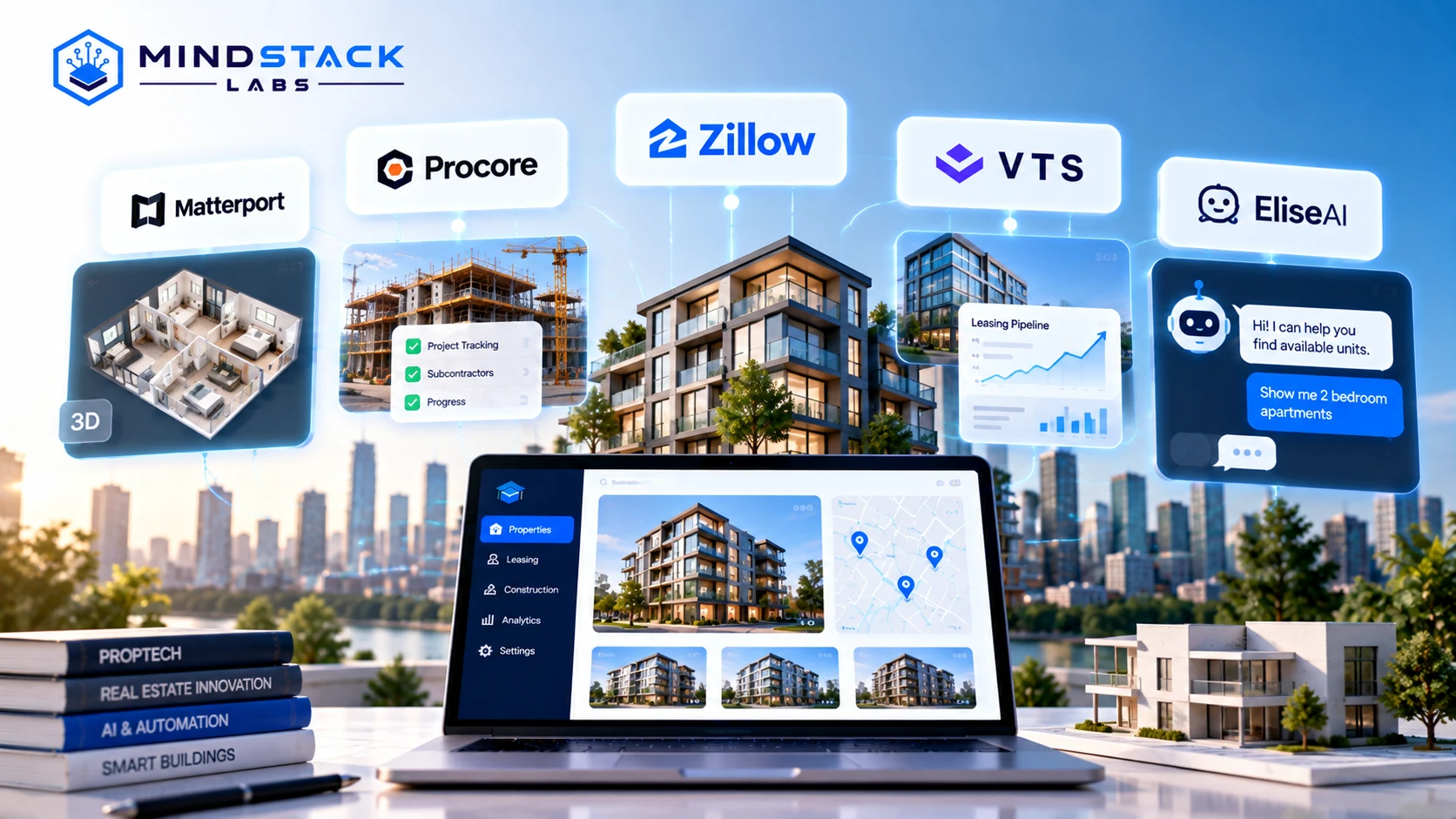
If you need verified spatial or dimensional data → go with Matterport as your capture layer.
If you manage construction or development across many subcontractors → go with Procore as your system of record.
If your bottleneck is leasing response speed → go with EliseAI or a comparable AI leasing layer.
If you run a commercial portfolio on spreadsheets → go with VTS for live pipeline visibility.
If your differentiator requires a workflow no vendor sells → build custom, with a partner like MindStack Labs, and own the data model yourself.
Two Adjacent Trends Worth Watching in 2026
These sit just outside the core list, and they are where I expect the next round of interesting builds.
Smart Building IoT and Access Control Data
Access control is quietly becoming a data business. Every door event is a signal about occupancy, utilization and resident behavior.
From the community management work behind E-Society Management, the pattern I keep seeing is that operators want visitor, staff and amenity access in one audit trail. The hardware is solved. The unified data layer usually is not.
AI Property Valuation and Insurance Risk Data
Risk scoring is moving from actuarial tables to imagery and sensor data. Roof condition, wildfire exposure and flood modeling now feed pricing decisions directly.
This matters even if you are not in insurance, because the same property risk datasets are becoming inputs for lending, underwriting and portfolio planning products.
What This Means If You Are Building Your Own PropTech Product
Start with the data access problem, not the feature list. That single reordering prevents most of the expensive rework I have seen on property platforms.
Common Technical Mistakes Early PropTech Builds Make
Designing screens before confirming which data you can legally and technically access
Treating MLS or IDX access as a settings toggle rather than a project
Hardcoding one property type, then discovering the client owns mixed-use assets
Skipping an audit trail, which becomes unavoidable the moment money or access rights are involved
Building an AI feature with no measurable job attached to it
What to Prioritize in Your First 6 to 16 Weeks
Week 1: integration spike against the hardest data source. No UI.
Weeks 2 to 3: data model that survives multiple property types and ownership structures.
Weeks 4 to 8: core workflow for one user role, shipped and usable. This is your MVP window.
Weeks 9 to 12: second role, permissions, audit logging.
Weeks 13 to 16: the AI or analytics layer, once you finally have real data to train or report on.
On security and privacy, I will be precise: at MindStack Labs we build to recognized technical safeguards such as encryption in transit and at rest, role-based access control and audit logging. That is engineering practice, not a certification claim, and you should treat any vendor claiming otherwise with a request for documentation.
Pro tip: write down your data retention and deletion policy in week two, because retrofitting deletion into a live property database is genuinely miserable.
FAQs
What makes a proptech company technically strong rather than just well-funded?
Control over a dataset plus depth of integration. A strong proptech company owns data that improves over time and connects natively to the systems operators already run.
Zillow vs Matterport: which is better for a proptech build?
They solve different problems, so pick by data need. Choose Zillow-style valuation data for pricing and consumer search features, and Matterport for verified spatial and dimensional property data.
Is AI actually used in proptech today, or is it mostly marketing?
Both, and the split is easy to spot. Lead response, document extraction and risk scoring work well today, while fully autonomous underwriting or negotiation is still not production-ready in my experience.
How do proptech companies handle legacy data like MLS and county records?
They normalize aggressively into their own schema. RESO Web API standards have improved MLS access, but county and assessor data still usually needs custom ingestion and cleanup per source.
How long does it take to build a proptech MVP?
In the builds I have worked on, 6 to 10 weeks for a focused MVP and 12 to 16 weeks for a fuller platform. Integration complexity, not screen count, is what moves that number.
More build questions answered in our full FAQ.
Why Choose Which: Best PropTech Company for Each Purpose
Pick by the job you are trying to do, not by the brand you recognize. One purpose, one recommendation.
Build a custom proptech product from scratch → MindStack Labs
Run construction projects across many subcontractors → Procore
Capture verified 3D and dimensional property data → Matterport
Get consumer-grade valuation and listing data → Zillow
Track commercial leasing pipeline in real time → VTS
Cut leasing response time on inbound leads → EliseAI
Model shared or fractional property ownership → Pacaso
Turn building access into auditable data → ButterflyMX
Quote roofing or exterior work without a site visit → Roofr
Standardize inspection and condition data → Inspectify
Embed insurance inside your own checkout → Cover Genius
Launch a broker-free marketplace with a services layer → NoBroker
Make maintenance costs predictable → Home365
Score property risk for insurance or lending → ZestyAI
Automate heavy equipment on active sites → Bedrock Robotics
Full Comparison: All 15 PropTech Companies
# | Company | Category | Core technical edge | Primary data asset | Best purpose | Buy or build signal |
|---|---|---|---|---|---|---|
1 | MindStack Labs | Product engineering partner | Full-cycle custom builds, integration-first | Client-owned, you keep the data model | Building a proptech product from scratch | Build |
2 | Procore | Construction management | API-first platform with partner marketplace | Project and field workflow data | System of record across subcontractors | Buy |
3 | Matterport | Spatial data | Computer vision capture to 3D digital twin | Spatial and dimensional property data | Verified property spatial data | Buy |
4 | Zillow | Consumer marketplace and data | ML valuation at national scale | Listings, public records, tax data | Valuation and consumer search data | Buy |
5 | VTS | CRE leasing | Real-time leasing pipeline visibility | Commercial leasing activity data | Live portfolio leasing visibility | Buy |
6 | EliseAI | AI leasing communications | NLP applied to response latency | Conversation and leasing funnel data | Faster inbound lead response | Buy |
7 | Pacaso | Fractional ownership | Multi-owner entity and scheduling model | Co-ownership and usage allocation data | Shared or fractional ownership products | Build if core, buy if adjacent |
8 | ButterflyMX | Access control | Cloud intercom with centralized access logs | Door and access event data | Auditable building access trail | Buy |
9 | Roofr | Contractor tooling | Aerial imagery to billable measurements | Roof measurement and quote data | Remote measurement and instant quoting | Buy |
10 | Inspectify | Inspection data | Templated inspections as structured data | Property condition data | Comparable condition data at scale | Buy |
11 | Cover Genius | Embedded insurance | Multi-jurisdiction cover behind one API | Policy and claims data | Insurance inside your own flow | Buy |
12 | NoBroker | Marketplace plus services | Disintermediation wedge, services monetization | Owner, tenant and transaction data | Broker-free marketplace model | Build if core market |
13 | Home365 | Property management | Predictive maintenance cost modeling | Work order and maintenance history | Predictable operating costs | Buy |
14 | ZestyAI | Risk analytics | Imagery plus climate modeling per address | Parcel-level risk scores | Risk inputs for insurance and lending | Buy |
15 | Bedrock Robotics | Construction autonomy | Autonomy retrofit on existing machines | Machine telemetry and site progress | Labor-constrained site work | Watch |
How to read this table: the last column is the one that matters most. Anything marked Buy is commodity for you. Anything marked Build is where your product earns its right to exist.
My Recommendation
Start by picking one narrow data problem and proving you can access that data cleanly, then build the workflow around it. Use Procore, Matterport, Zillow, VTS and EliseAI as reference architectures for how that has already worked, and bring in a build partner like MindStack Labs if your differentiator needs custom engineering rather than another subscription.
If you want a second opinion on your integration risk before you commit a budget, book a scoping call and we will go through it with you. For more build breakdowns like this one, see our blog.