

A Node.js app development company usually helps a business start faster when it does not already have an experienced internal team. An in-house team can become more efficient over time, while a hybrid model combines internal product ownership with external Node.js expertise.
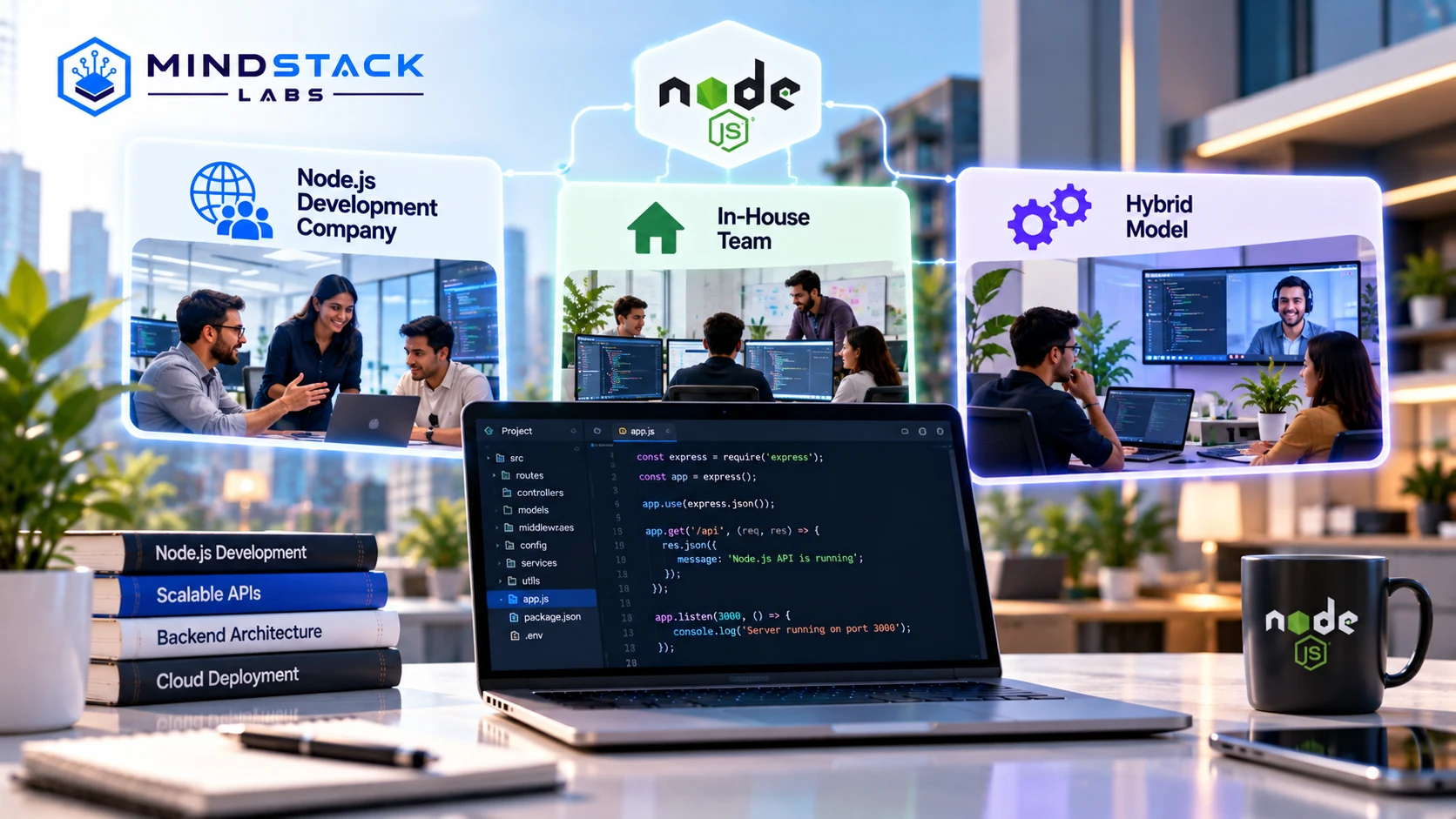
The right choice depends on your launch deadline, product complexity, technical leadership, hiring capacity, and long-term roadmap.
TL;DR: Node.js Company vs In-House Team
Choose a Node.js development company when you need to start quickly, access specialist skills, or launch an MVP before building a permanent team.
Choose an in-house team when Node.js is a long-term business capability and you can support recruitment, leadership, QA, and retention.
Choose a hybrid model when your internal team understands the product but needs external backend capacity.
Compare total delivery cost, not only developer rates. Recruitment, management, delays, rework, tools, and support also affect the final cost.
The best Node.js app development company should provide clear ownership, documentation, testing, communication, and handover terms.
What Does “Shipping Faster” Mean for a Node.js Product?
Shipping faster means reaching a usable, tested release with less delivery friction. It does not simply mean writing code quickly.
A company can hire developers quickly and still lose time through unclear requirements, poor architecture, missing QA, slow feedback, or delayed decisions.
Time to assemble the development team
An in-house team usually requires several steps before productive development begins:
Define the required roles.
Write job descriptions.
Source candidates.
Conduct technical interviews.
Negotiate offers.
Wait through notice periods.
Complete onboarding.
Set up repositories, tools, and environments.
Transfer product knowledge.
An experienced Node.js app development company may already have developers, project managers, QA specialists, and technical leadership available.
That does not remove onboarding. The team still needs to understand your product, users, integrations, and business rules. However, it can reduce the time required to form the delivery team.

Time to reach a usable MVP
The first meaningful milestone is not the first code commit. It is a usable release that can be tested with real users or internal stakeholders.
A Node.js MVP may require:
Product requirements.
A realistic feature scope.
Backend architecture.
Database design.
API development.
Authentication and authorisation.
Third-party integrations.
Error handling.
QA and testing.
Deployment.
Monitoring.
Post-launch fixes.
A clearly scoped MVP can move quickly under either model. A vague product brief can slow down both.
Long-term development velocity
A fast first release does not guarantee fast long-term development.
Velocity can decline because of:
Technical debt.
Poor documentation.
Repeated rework.
Unclear ownership.
Slow decision-making.
Weak testing.
Poor deployment practices.
Overloaded developers.
Difficult team expansion.
When I compare delivery models, I evaluate two timelines:
How quickly can the first release ship?
How effectively can the product evolve after launch?
Fast hiring → does not always equal → fast product delivery
What Does a Node.js App Development Company Provide?
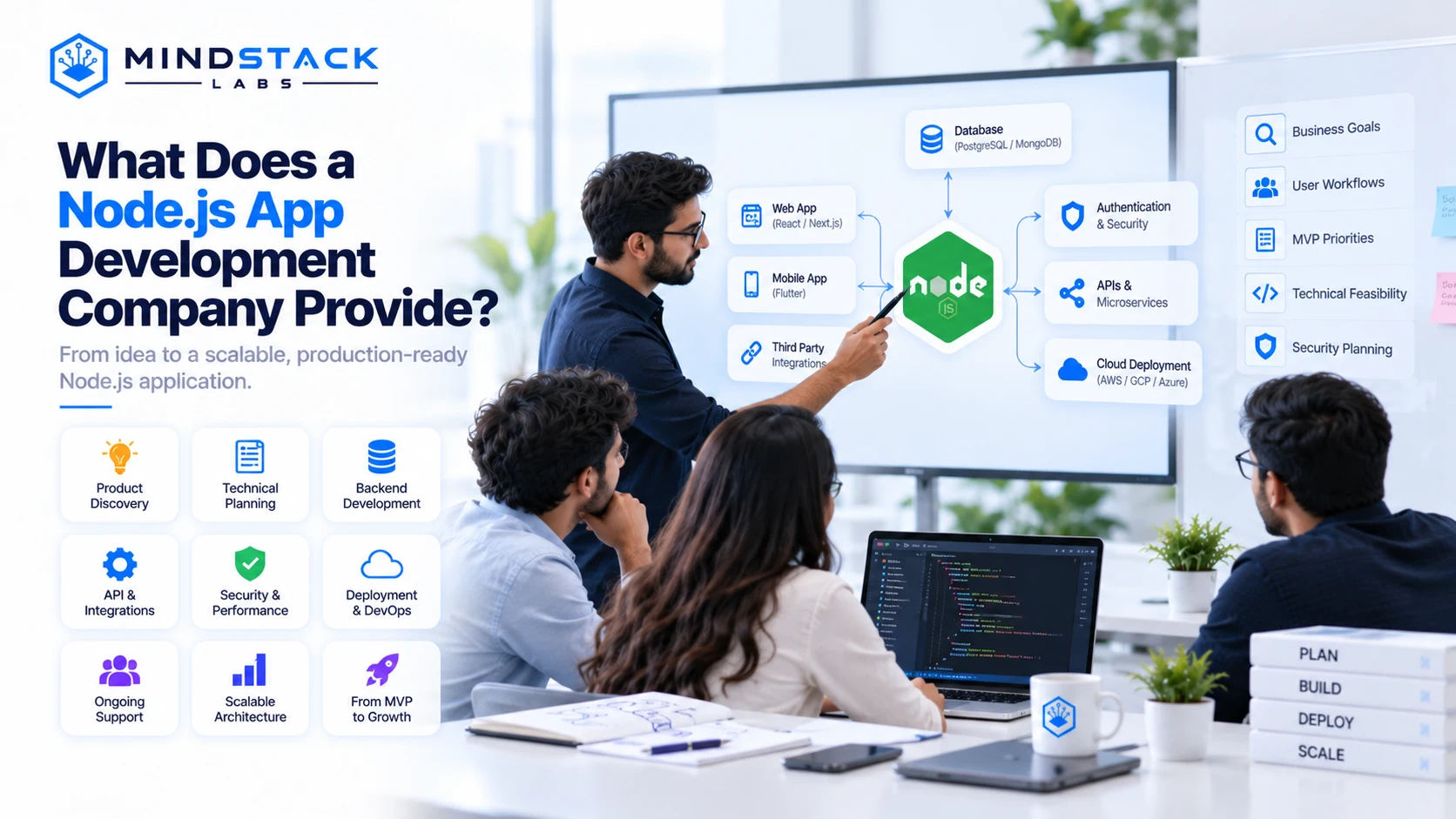
A Node.js app development company provides more than individual developers. Its value usually comes from combining technical capability, delivery process, project coordination, and product experience.
Product discovery and technical planning
A strong engagement should begin by clarifying what needs to be built and why.
Discovery may cover:
Business objectives.
User roles and workflows.
MVP priorities.
Technical feasibility.
Node.js backend architecture.
API requirements.
Database needs.
External integrations.
Security considerations.
Release planning.
This stage prevents a common problem: starting development before the team understands the product boundaries.
The TransportPro case study shows why operational products should be evaluated as complete workflows rather than isolated features.
Node.js backend development
Node.js backend development can support the server-side systems that power web and mobile products.
Depending on the project, the work may include:
REST or GraphQL API development.
Authentication and authorisation.
Database integration.
Third-party service integration.
Real-time features.
Background jobs.
File and media handling.
Backend performance work.
Cloud deployment.
Maintenance and support.
The exact scope should be confirmed during discovery. A Node.js Backend Development company should not treat every product as a collection of reusable modules.
Architecture should reflect:
Expected traffic.
Data relationships.
Integration requirements.
User permissions.
Security needs.
Product growth.
Reporting requirements.
Operational workflows.
You may also need supporting capabilities such as database solutions, depending on the product’s data model and reporting requirements.
QA, deployment, and post-launch support
A product is not ready when development ends. It also needs testing, deployment, monitoring, bug fixes, and future improvements.
Ask whether the provider handles:
Functional testing.
API testing.
Regression testing.
Deployment.
Technical documentation.
Monitoring.
Maintenance.
Handover.
Some businesses also need frontend or mobile coordination. In that case, a partner with wider application development services may reduce handoffs between disconnected suppliers.
Project and technical management
A development company may also support:
Technical planning.
Delivery scheduling.
Scope tracking.
Progress updates.
QA coordination.
Risk identification.
Stakeholder communication.
Release planning.
This matters when a founder or product manager does not want to coordinate backend, frontend, QA, and deployment resources independently.
The cheapest option can become the slowest option when nobody owns the delivery process.
What Does an In-House Node.js Team Provide?
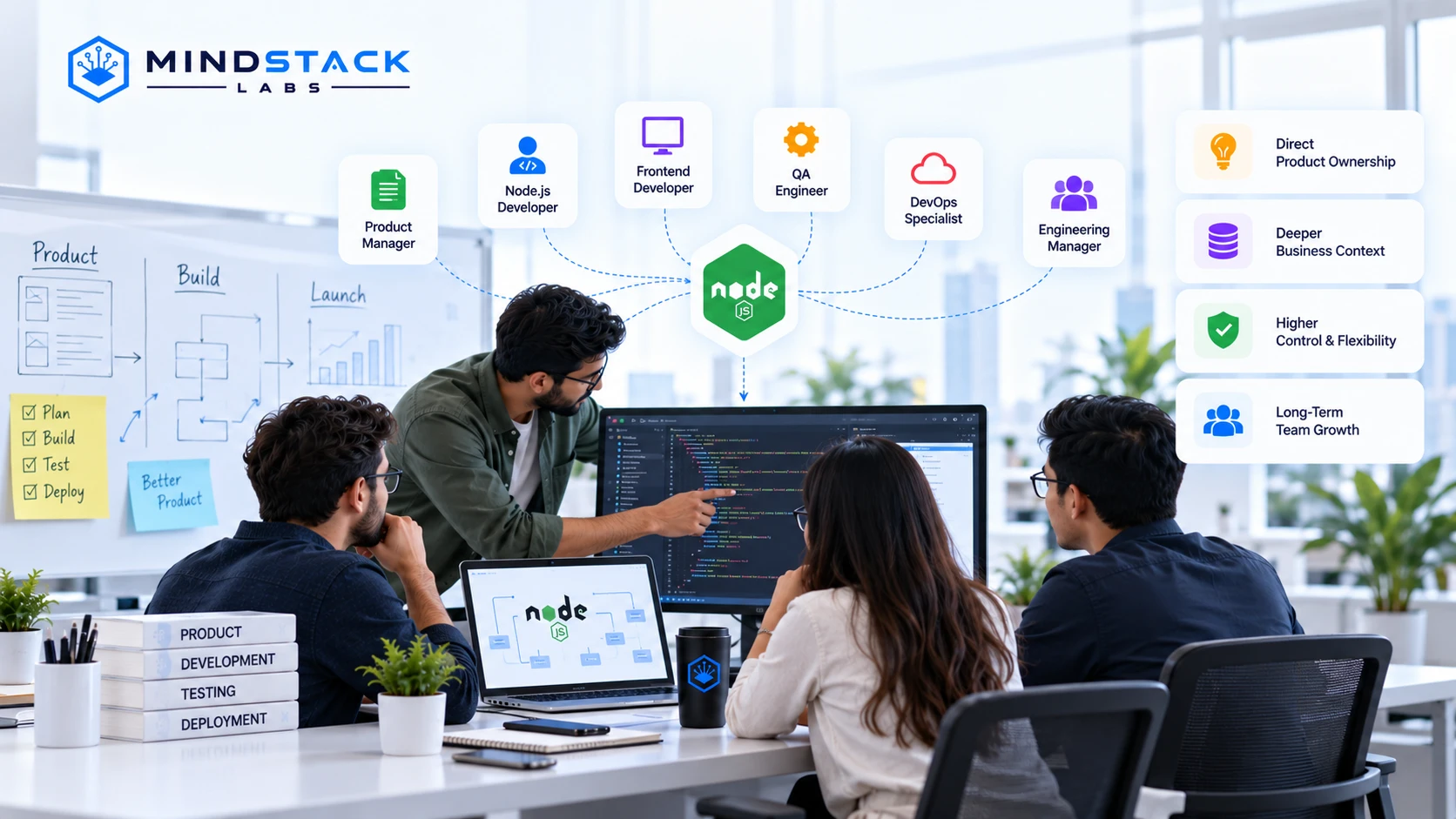
An in-house team provides direct product ownership, internal context, and long-term control. These benefits become more valuable when Node.js development is a permanent part of the company’s operating model.
Product ownership and internal context
An internal team usually works closely with:
Product managers.
Business stakeholders.
Customer-facing teams.
Internal systems.
Company leadership.
That closeness can improve decisions because developers receive product context directly.
An in-house team may be especially valuable when the product depends on:
Proprietary workflows.
Confidential processes.
Sensitive internal systems.
Complex domain knowledge.
Frequent business decisions.
Internal developers can also build deeper knowledge of customer behaviour and operational constraints over time.
Hiring and onboarding requirements
Building an internal Node.js team requires more than hiring one developer.
A company may need to:
Define the required roles.
Write job descriptions.
Source candidates.
Conduct technical interviews.
Complete offers and notice periods.
Set up tools and environments.
Transfer product context.
Establish engineering and QA processes.
The required roles may include:
Node.js developers.
Technical leadership.
Frontend or mobile developers.
QA engineers.
DevOps specialists.
Product managers.
Engineering managers.
Not every project needs all these roles internally. However, someone must own each responsibility.
Hidden operating costs
The cost of an in-house software development team includes more than compensation.
Consider:
Recruitment and agency fees.
Salaries and benefits.
Management time.
Developer tools.
Cloud infrastructure.
Training.
Onboarding.
Employee turnover.
Replacement hiring.
Team expansion.
Time spent between projects.
Technical leadership.
In my experience, management capacity is often overlooked. A founder or product leader may spend significant time recruiting, coordinating, reviewing, and unblocking a team before it reaches a stable rhythm.
That does not make internal hiring a bad choice. It means the full operating cost should be understood first.
Node.js App Development Company vs In-House Team: Comparison
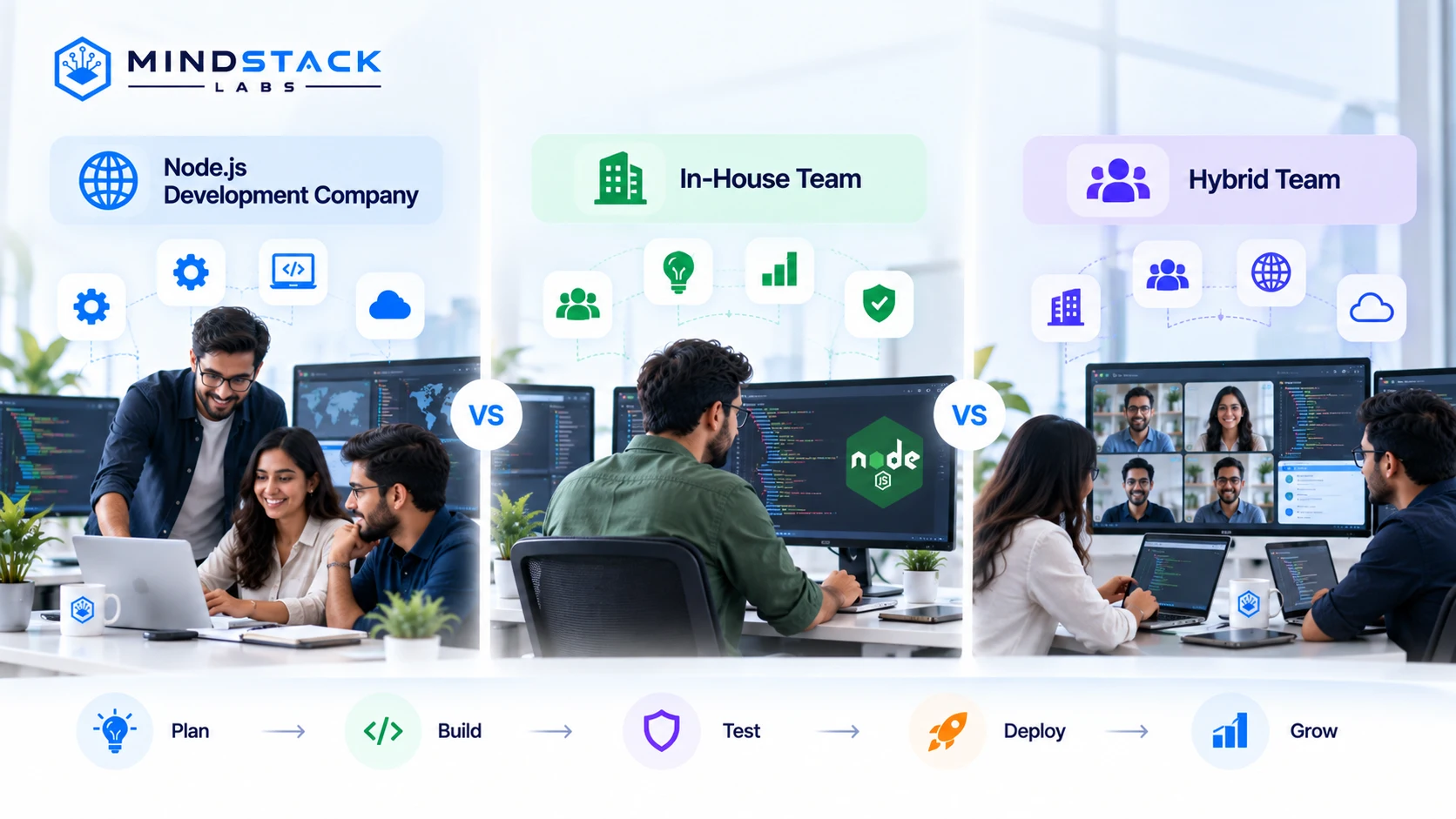
Neither model wins in every situation. The right option depends on product stage, urgency, internal capability, and ownership requirements.
Decision factor | Node.js development company | In-house team | Hybrid team |
|---|---|---|---|
Time to start | Usually faster if a suitable team is available | Depends on recruitment and onboarding | Often fast when internal staff already exists |
Hiring effort | Lower for the client | Higher | Moderate |
Time to MVP | Can be faster with clear scope and relevant experience | Depends on team readiness | Combines internal context with external capacity |
Cost structure | Project, retainer, or engagement-based | Salaries, benefits, tools, and management | Combination of internal and external costs |
Expertise | Access to multiple specialists | Depends on who the company hires | Extends existing internal capability |
Product knowledge | Built through discovery and collaboration | Builds internally over time | Internal team provides context |
Technical control | Requires clear processes and communication | Direct day-to-day control | Shared responsibilities must be documented |
Code ownership | Must be defined contractually | Usually remains internal | Must be agreed between parties |
QA and testing | May be included in the engagement | Must be staffed internally | Can be shared |
Deployment and DevOps | May be included or separately scoped | Requires internal ownership | Can be divided by responsibility |
Scalability | Easier to adjust capacity | Requires additional hiring | Flexible when roles are clear |
Post-launch support | Available if included in the agreement | Remains internal | Shared or phased handover |
Best fit | MVPs, deadlines, specialist work, flexible capacity | Permanent products with strong leadership | Speed plus internal ownership |
Cost and financial flexibility
A development company may use a project, retainer, or engagement-based model. An internal team creates ongoing costs through recruitment, compensation, management, tools, infrastructure, and retention.
A small backend project with a defined scope has a different cost structure from a multi-platform product with payments, real-time data, complex permissions, and ongoing maintenance.
Compare total delivery cost rather than hourly rates:
Total delivery cost = people + management + tools + delays + rework + support
Before comparing proposals, ask what each quote includes:
Discovery.
Technical planning.
Development.
Testing.
Deployment.
Documentation.
Project management.
Post-launch support.
A lower hourly rate does not automatically produce a lower project cost.
Pro tip: Ask every provider to separate discovery, development, QA, deployment, documentation, and post-launch support in the proposal.
When Should You Hire a Node.js App Development Company?

Hire a Node.js app development company when speed, specialist access, or flexible capacity matters more than building a permanent internal team immediately.
You need to launch an MVP quickly
An existing team can reduce the delay between product definition and implementation.
This is most useful when:
The MVP scope is clear.
The deadline matters.
The company has limited engineering capacity.
The team wants to validate demand before hiring permanently.
The agency should still challenge unrealistic scope. A fast team cannot turn an oversized MVP into a small one by itself.
Your internal team lacks Node.js expertise
A Node.js Backend Development agency can provide focused support when the internal team lacks experience in:
API architecture.
Real-time functionality.
Backend performance.
Database design.
Cloud deployment.
Third-party integrations.
The external team should work with technical leadership rather than operate as an opaque code supplier.
You need flexible delivery capacity
Product workload often changes across:
Discovery.
MVP delivery.
Launch.
Post-launch improvement.
Scaling.
Migration.
Maintenance.
External capacity can be useful when the company needs to increase or reduce support across these phases.
Mind Stack Labs can be evaluated as a practical option when you need Node.js backend development, external implementation capacity, or support alongside an internal team. Review the Node.js backend development service against your requirements, ownership expectations, documentation needs, and support model.
Why Mind Stack Labs Is a Practical Node.js Partner
Mind Stack Labs should be evaluated as a product delivery partner, not only as a source of Node.js developers.
Full-cycle product delivery
A Node.js product may require:
Product planning.
UX and interface coordination.
Frontend or mobile integration.
Backend architecture.
QA.
Deployment.
Post-launch improvements.
A full-cycle partner can help reduce handoffs between disconnected suppliers. The exact delivery scope should still be confirmed during discovery.
You can explore the wider Mind Stack Labs services to understand how Node.js backend work may connect with other product requirements.
Experience with operational products
A provider’s portfolio should be evaluated against the type of product you are building.
Relevant examples include:
These projects do not automatically prove that every product uses the same Node.js architecture. They do show why product scope, workflow complexity, and operational requirements should be discussed before selecting a development partner.
What to discuss before starting
A useful project conversation should cover:
Product stage.
Launch target.
Existing team.
Backend requirements.
Integrations.
QA expectations.
Deployment responsibility.
Code ownership.
Documentation.
Post-launch support.
That is how a vendor comparison becomes a delivery decision.
When Does In-House or Hybrid Delivery Make More Sense?
In-house delivery suits permanent internal capability, while hybrid delivery suits companies that need speed without giving up product ownership.
Build in-house for permanent capability
Build an internal Node.js team when:
Node.js is central to the long-term roadmap.
The company has technical leadership.
Product knowledge is highly proprietary.
The company can support recruitment and retention.
There is enough work beyond the initial launch.
An internal team may provide stronger long-term product context, but it also requires continuous investment in engineering management, QA, DevOps, and team development.
Use hybrid delivery for speed plus ownership
A hybrid model may include:
An internal product manager plus an external Node.js backend team.
An internal CTO plus an external delivery team.
An internal frontend team plus external backend specialists.
An external MVP team followed by internal hiring and handover.
This approach works when the company owns product strategy but lacks immediate implementation capacity.
Prevent hybrid delivery problems
Hybrid delivery can fail when responsibilities remain unclear.
Set up:
One source of truth for requirements.
Clear technical ownership.
Shared repository access.
Technical documentation.
Defined code review responsibilities.
Agreed security controls.
Handover milestones.
A regular communication schedule.
A clear scope-change process.
Internal product ownership + external delivery capacity = flexible execution
Ownership must be written down.
How to Choose the Best Node.js App Development Company
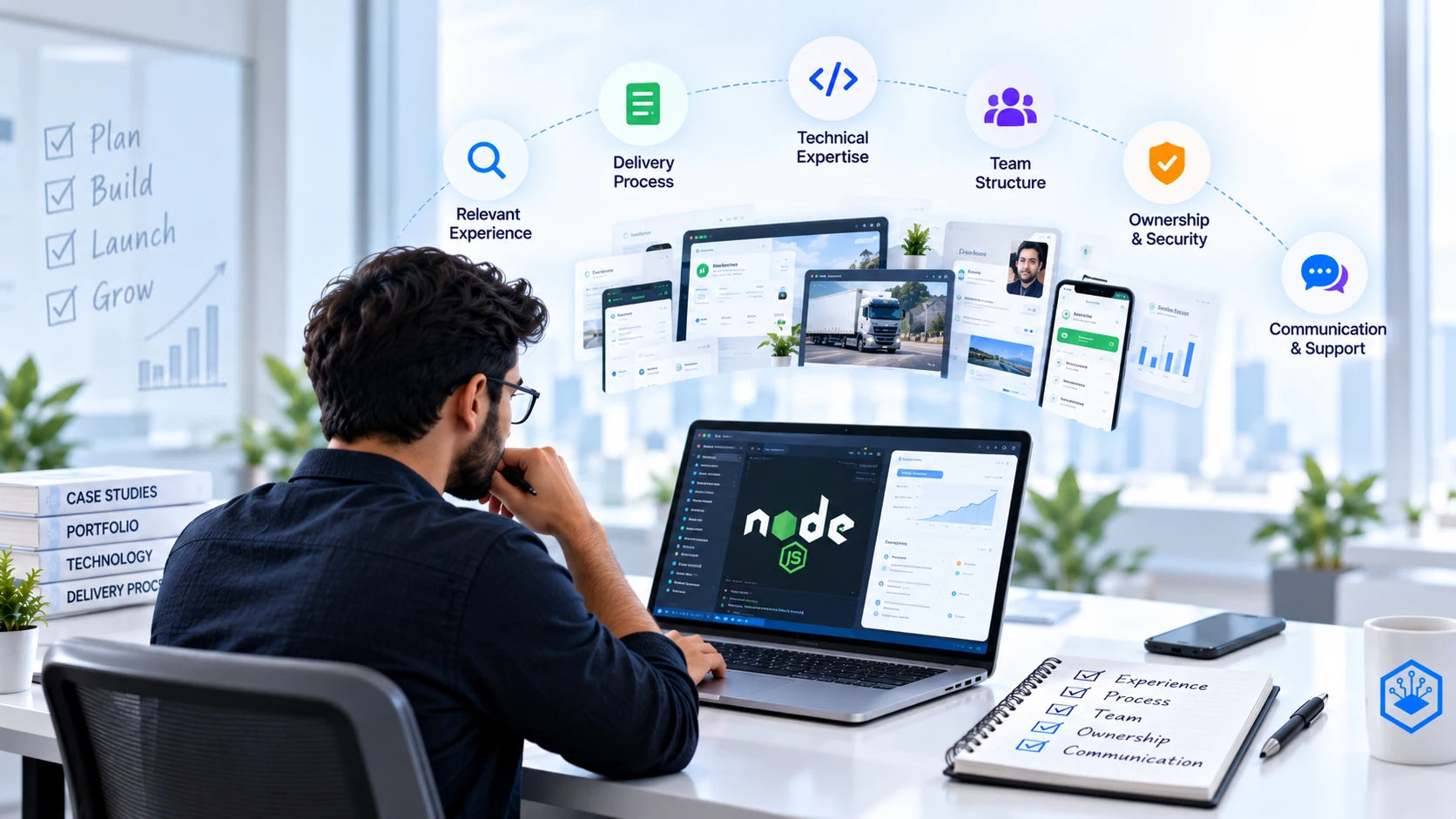
The best Node.js app development company is not simply the provider with the lowest quote or the longest technology list. It is the company that fits your product, delivery model, risk profile, and internal capability.
Review relevant project experience
Look for evidence of experience with:
Similar product complexity.
Node.js backend architecture.
API integrations.
Real-time functionality.
Security-sensitive workflows.
Database systems.
Deployment and maintenance.
Products at a similar delivery stage.
A provider does not need to have built the exact same application. It should explain how its experience transfers to your product.
Start with the Mind Stack Labs portfolio and case studies, then ask how relevant examples relate to your requirements.
Understand the delivery process
Ask how the company handles:
Discovery.
Scope definition.
Technical planning.
Project management.
Development.
Code review.
QA.
Deployment.
Post-launch support.
A vague process creates risk even when developers are technically capable.
Check ownership and documentation
Ask:
Who owns the source code?
Where is the repository hosted?
What documentation is delivered?
Who owns cloud accounts?
How are credentials managed?
What happens if the engagement ends?
Is a technical handover included?
How are third-party dependencies recorded?
Evaluate communication and team structure
Clarify:
Who is the project contact?
Who makes technical decisions?
Who performs QA?
How often are updates shared?
How are scope changes handled?
Who will actually work on the product?
Which responsibilities remain with your internal team?
Do not assume the person in a sales call will be part of the delivery team.
Pro tip: Ask for the proposed team structure, delivery milestones, and ownership terms before comparing agency rates.
Frequently Asked Questions
Node.js app development company vs in-house team: which is better?
A Node.js development company is usually better for fast launches, specialist support, and flexible capacity. An in-house team is often better for permanent product ownership and a stable long-term roadmap.
Is it faster to hire a Node.js development company or build an in-house team?
A development company can usually start faster when it already has an available team. Building internally requires recruitment, onboarding, and process setup before the team reaches full productivity.
Is a Node.js development company cheaper than an in-house team?
Neither option is always cheaper. Compare project scope, management, recruitment, tools, delays, rework, support, and long-term team costs instead of comparing hourly rates alone.
Can a Node.js development company work with an existing team?
Yes. An external team can provide backend development, specialist architecture, QA, or temporary capacity. Responsibilities, repository access, communication, documentation, and code ownership should be agreed in advance.
What should I ask a Node.js backend development company before hiring?
Ask about similar projects, team structure, delivery process, testing, security, source-code ownership, documentation, scope changes, and post-launch support.
Final Verdict: Which One Ships Faster?
A Node.js app development company usually ships faster when the business has a clear product scope, a fixed launch target, and no experienced internal team ready to begin.
An in-house team may become faster over the long term when Node.js is a permanent capability, product knowledge is highly specialised, and the company can support engineering leadership and retention.
A hybrid team is often the practical middle path when the business wants internal product ownership but needs external Node.js capacity immediately.
From my perspective, start with an experienced Node.js development company when speed is the immediate constraint. Build internal capability later when the product has proven demand and a stable long-term roadmap.