For years, the difference between a junior and a senior developer was often measured by experience.
A junior developer might know how to write code, use frameworks, and follow existing patterns. A senior developer was expected to understand why the code should be written a certain way, make architectural decisions, debug difficult problems, and anticipate issues before they reached production.
AI is changing this equation.
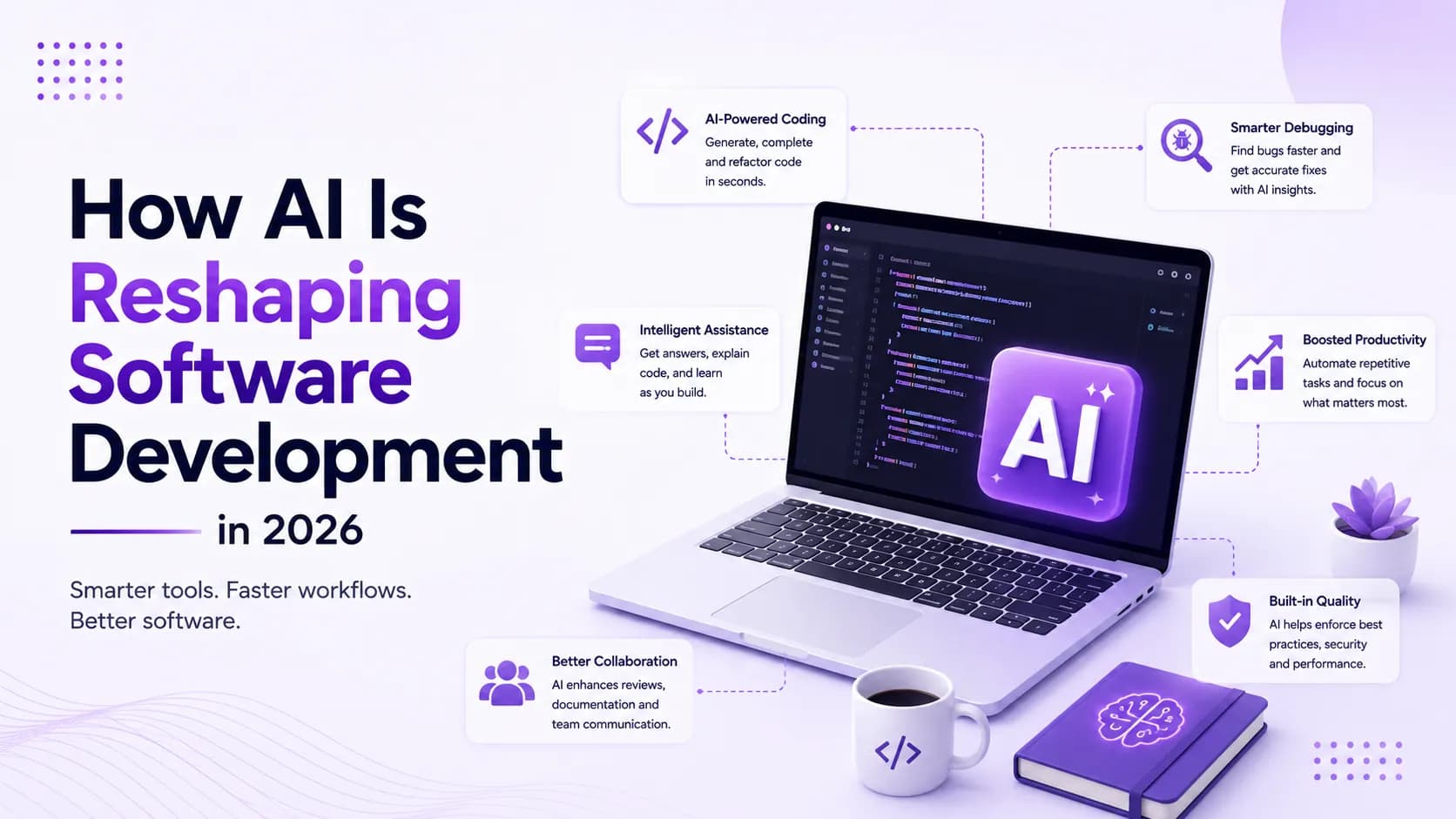
Tools such as AI coding assistants can generate code, explain unfamiliar APIs, write tests, refactor functions, and help developers troubleshoot errors in seconds. This means some tasks that previously required years of experience can now be completed by developers much earlier in their careers.
But this does not mean the gap between junior and senior developers has disappeared.
Instead, the nature of the gap is changing.
The Old Developer Skill Gap
Before AI became a common part of software development, a developer often spent significant time building a mental library of technical knowledge.
A junior developer might spend hours trying to understand:
How a framework feature works
Why an API request is failing
How to structure a database query
How to fix a build error
How to implement a particular UI component
How to configure a development environment
A senior developer could often solve these problems faster because they had encountered similar situations before.
Experience created speed.
Over time, developers accumulated patterns:
I’ve seen this error before.
This architecture will probably cause problems later.
This approach works, but there’s a simpler way.
This database query will become expensive at scale.
That accumulated experience remains valuable.
However, AI is now able to provide part of that knowledge on demand.
AI Is Compressing the Learning Curve
One of the biggest changes AI brings to software development is the reduction in the time required to move from problem → understanding → implementation.
A junior developer can now ask:
“Explain this error and show me three possible causes.”
Then:
Here’s my code. Which part could be causing the problem?
Then:
Refactor this implementation and explain why your approach is better.
The developer still needs to understand the answer, but AI can dramatically reduce the time spent searching documentation, browsing forums, and experimenting with multiple approaches.
This effectively compresses part of the traditional learning curve.
A developer who might previously have needed several hours to investigate a problem can sometimes reach a working solution much faster.
But there is an important distinction:
Getting an answer is not the same as understanding the problem.
The New Risk: Fast Code Without Deep Understanding
AI can make inexperienced developers extremely productive.
It can also make them confidently wrong.
A developer may ask an AI tool to implement authentication, database access, payment processing, caching, or background services and receive code that appears completely reasonable.
The code may even work.
But questions remain:
Is the implementation secure?
What happens under high traffic?
What happens when the API fails?
Is sensitive data being exposed?
Are database queries optimized?
Are transactions handled correctly?
What happens when two requests execute simultaneously?
Is the architecture maintainable?
Does the implementation follow the project’s existing conventions?
These questions are where experience becomes important.
AI can generate an implementation.
Someone still needs to take responsibility for that implementation.
Senior Developers Are Moving Up the Abstraction Level
AI changes the role of senior developers in an interesting way.
Instead of spending most of their time writing every line manually, senior developers can increasingly focus on:
Architecture
System design
Technical trade-offs
Security
Performance
Reliability
Code review
Product requirements
Debugging complex production issues
Mentoring
Technical strategy
For example, instead of manually writing a complete API integration, a senior developer might define:
The API contract
The data model
Error-handling requirements
Authentication strategy
Caching requirements
Observability requirements
Testing strategy
AI can then help implement parts of that system.
The senior developer’s value shifts from writing every line toward deciding what should be built and validating that it is built correctly.
Juniors Can Become Productive Much Faster
This is one of the most positive effects of AI.
A junior developer no longer needs to know everything before becoming productive.
Suppose a developer is working with a technology they have never used before.
Instead of spending an entire day understanding the basics, they can ask AI to explain:
I’m familiar with Flutter but new to Supabase. Explain how authentication, database queries, storage, and Row Level Security fit together.
Then they can progressively ask more specific questions while building the feature.
This creates something close to an on-demand technical mentor.
The developer can learn while working instead of learning everything first and applying it later.
That can significantly accelerate career development when AI is used as a learning tool rather than simply as a code generator.
But Senior Developers Get AI Advantages Too
It would be a mistake to think AI only benefits juniors.
Experienced developers can often get even more value from AI because they know what to ask.
Consider a developer investigating a production performance issue.
A junior developer might ask:
Why is my application slow?
A senior developer might provide:
Relevant logs
Database query plans
Request timings
Architecture details
Recent deployments
Traffic patterns
Known bottlenecks
And ask AI to compare several possible causes.
The difference isn’t necessarily the AI tool.
The difference is the quality of the problem definition.
Experience helps developers provide better context, recognize bad suggestions, and identify which details actually matter.
AI Doesn’t Remove the Importance of Debugging
Coding is only one part of software development.
Real-world development often involves problems that are difficult to reproduce:
It works on Android but fails on one iPhone model.
The subscription is active in one system but not another.
The API works locally but fails in production.
The database works with 100 records but becomes slow with millions.
The application crashes only under a particular sequence of events.
These problems rarely have a single obvious answer.
AI can help generate hypotheses and suggest debugging steps, but developers still need to gather evidence, reproduce the issue, test assumptions, and determine the actual root cause.
This is one reason debugging remains an important differentiator between levels of engineering experience.
The Skill That Matters More: Verification
As AI-generated code becomes more common, one skill becomes increasingly important:
Verification.
Developers need to ask:
How do I know this is correct?
That means understanding:
Testing
Logging
Monitoring
Security principles
Documentation
Performance profiling
Error handling
Code review
System behavior
An AI-generated solution that passes one happy-path test isn’t necessarily production-ready.
The developer’s job increasingly becomes:
Generate → Inspect → Test → Validate → Improve
rather than simply:
Write → Run
The Definition of “Senior” Is Changing
Traditionally, seniority was strongly associated with how much technical knowledge someone had accumulated.
AI makes access to technical knowledge much easier.
As a result, some traditional indicators of experience become less meaningful.
Knowing the exact syntax of a framework feature is less valuable when an AI assistant can generate it instantly.
Knowing how to search documentation is still useful, but AI can now accelerate that process.
Memorizing boilerplate code is increasingly unnecessary.
Instead, senior-level skills are becoming more about judgment.
A senior developer needs to understand questions such as:
Should we build this ourselves?
Should we use an existing service?
Is this abstraction necessary?
What happens if this dependency disappears?
Where should this logic live?
What are the security implications?
What will happen when the system grows?
Is this solution solving the real problem?
AI can help answer these questions, but it cannot take responsibility for the decisions.
The Gap May Become Smaller in Some Areas — and Larger in Others
AI is likely to reduce the gap between junior and senior developers for certain tasks.
For example:
Area | Impact of AI |
Boilerplate code | Gap can shrink significantly |
Syntax and API usage | Gap can shrink |
Basic debugging | Gap can shrink |
Documentation lookup | Gap can shrink |
Code generation | Gap can shrink significantly |
Architecture | Experience remains important |
System design | Experience remains important |
Security decisions | Experience remains important |
Production debugging | Experience remains important |
Technical trade-offs | Experience remains important |
Product understanding | Human judgment remains important |
So the future isn’t necessarily:
Junior = Senior
Instead, it is closer to:
AI raises the baseline, while experience continues to influence the ceiling.
The Best Developers May Be the Best AI Collaborators
The developer of the future may not be the person who writes the most code.
It may be the person who can effectively combine:
Domain knowledge + engineering fundamentals + AI + judgment
A strong developer might use AI to:
Explore solutions
Generate boilerplate
Explain unfamiliar technologies
Write tests
Review code
Refactor implementations
Generate documentation
Investigate errors
Automate repetitive tasks
But they remain responsible for the final result.
This changes the developer’s workflow from manually producing everything to orchestrating and validating technical work.
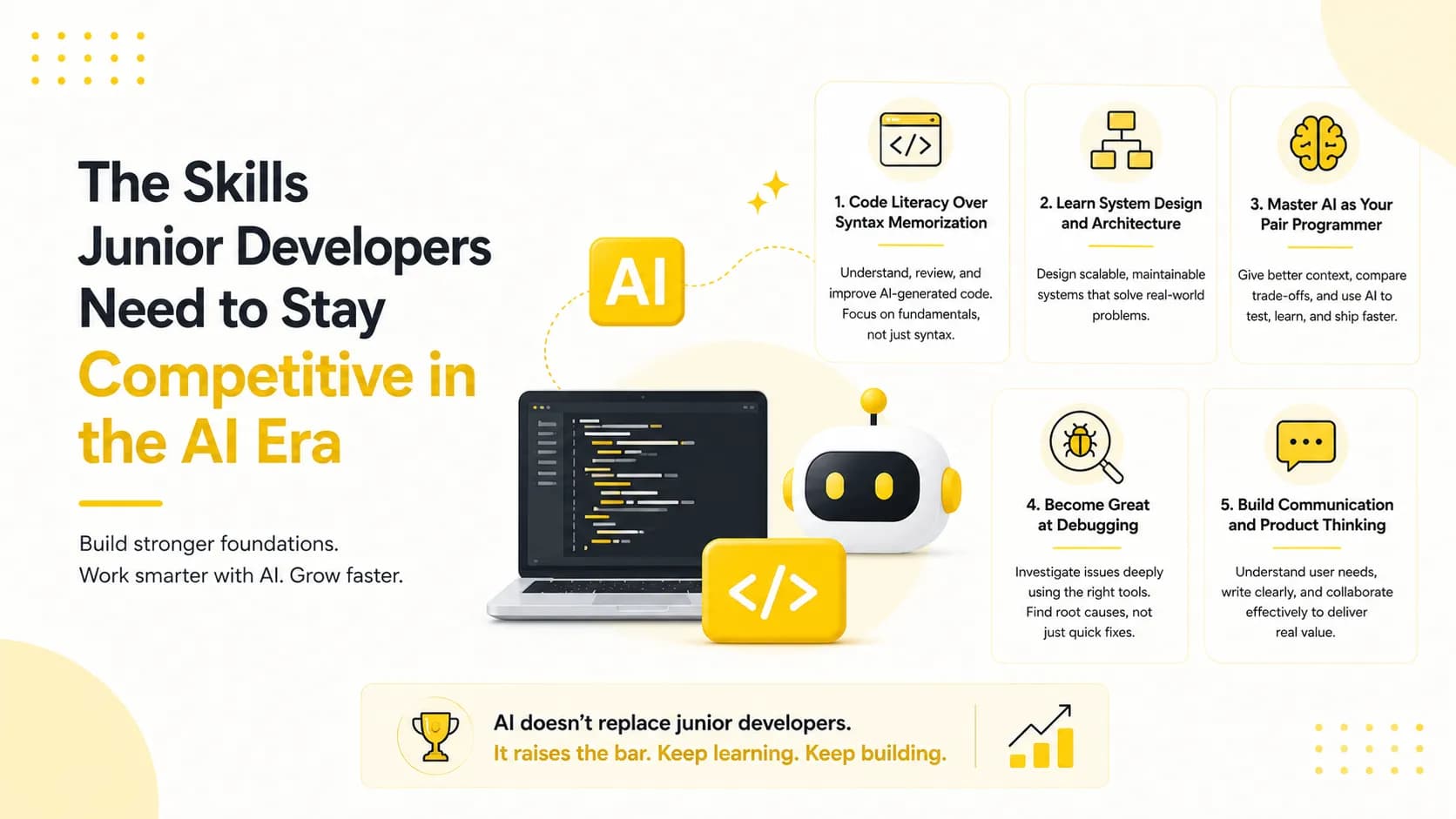
What Junior Developers Should Focus On
If you’re a junior developer today, AI shouldn’t be viewed as competition.
It can be one of the fastest ways to accelerate your learning.
If you’re a junior developer today, AI shouldn’t be viewed as competition. It can be one of the fastest ways to accelerate your learning. But avoid the trap of accepting every generated solution without understanding it.
AI also means you don’t have to memorize every programming syntax detail. You can ask AI for the correct syntax instantly. What matters more is understanding what the code does and knowing how to verify it.
Instead of asking:
Give me the code.
Try asking:
Explain the approach first.
Then:
Show me the implementation.
Then:
What are the potential problems with this approach?
And finally:
How can I test it?
This turns AI from a code-generation tool into a learning and reasoning tool.
Build strong fundamentals in:
Data structures
APIs
Databases
Networking
Authentication
Testing
Git
Debugging
Security
Software architecture
AI becomes much more useful when you understand the concepts behind the code it generates.
What Senior Developers Should Focus On
For experienced developers, the opportunity is different.
AI can eliminate a large amount of repetitive implementation work.
That creates more time for higher-value activities:
Designing systems
Improving architecture
Reviewing critical code
Understanding business requirements
Improving reliability
Reducing technical debt
Mentoring developers
Automating engineering workflows
The senior developer who refuses to adapt to AI may spend significant time doing work that could be automated.
But the senior developer who blindly trusts AI also introduces new risks.
The valuable position is between the two:
Use AI aggressively, but verify carefully.
The Future Isn’t Junior vs Senior
The more useful comparison may eventually become:
Developer without effective AI workflows vs Developer with effective AI workflows.
A junior developer who understands how to use AI responsibly can outperform their previous baseline by a large margin.
A senior developer who combines decades of engineering experience with AI can potentially become even more productive.
The gap doesn’t disappear.
The skills that create the gap evolve.
In the past, knowing how to write code quickly was a major advantage.
Now, knowing how to define problems, evaluate solutions, design systems, and validate AI-generated work is becoming increasingly important.
AI can write the code.
It can explain the code.
It can even suggest the architecture.
But software still needs someone who understands what should be built, why it should be built, and whether the result is actually correct.
And that is where engineering experience continues to matter.
Final Thought
AI is not simply making junior developers more like senior developers. It is changing what developers at every level spend their time doing.
The junior developer gets a faster path to knowledge.
The senior developer gets a powerful productivity multiplier.
And the most important skill for both may be the same:
Don’t just ask AI for answers. Learn how to question the answers.