

I write from inside a team that has shipped 100+ products, and the eLearning and LMS builds among them all hit the same wall eventually: the vendor could talk about SCORM, but couldn't prove xAPI worked.
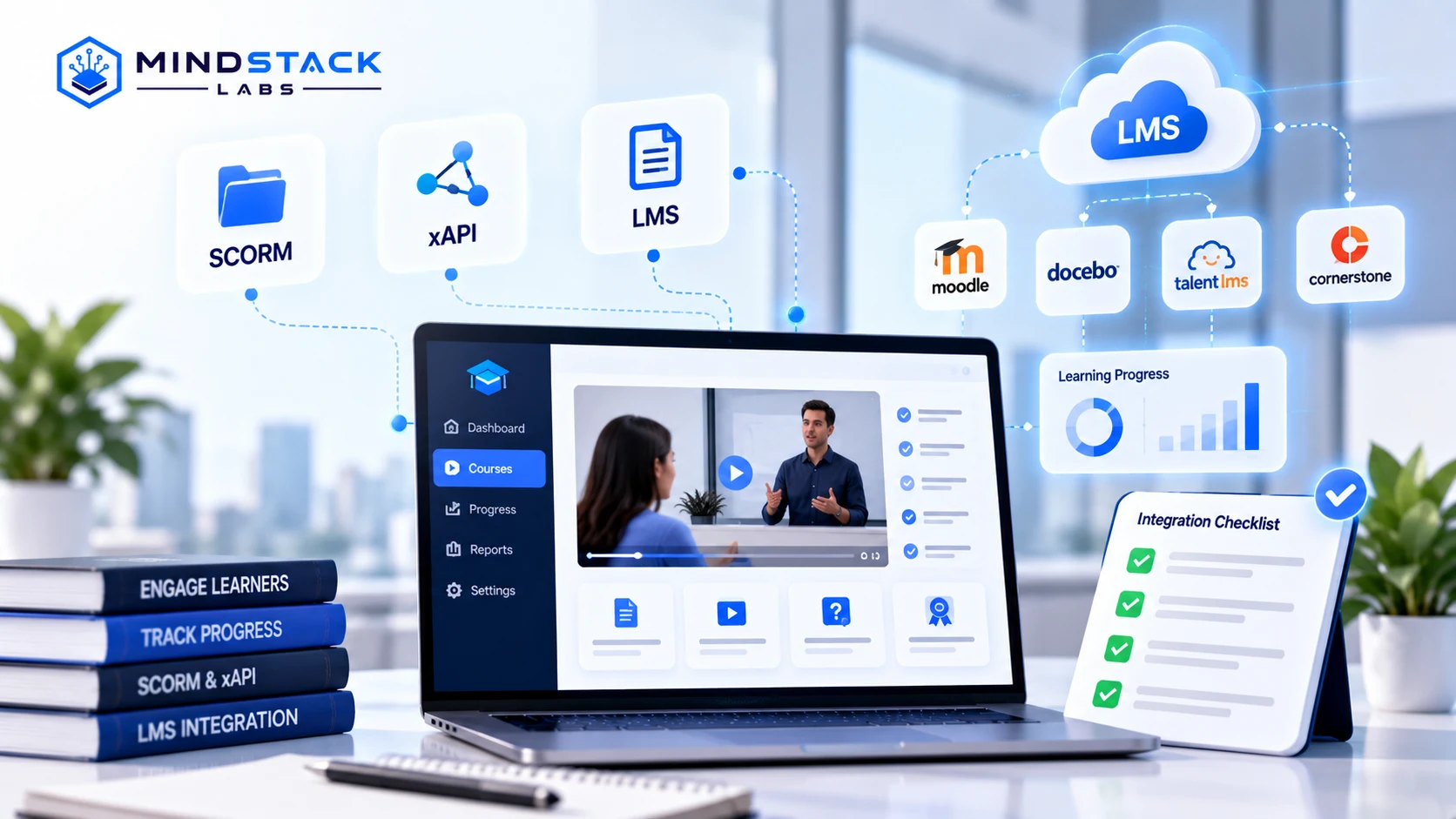
The eLearning software development companies worth shortlisting in 2026 are the ones that can prove SCORM conformance and xAPI/LRS integration on a live call, not just list it as a service.
Below are 10 companies I'd put on that shortlist, ranked against a specific integration checklist, not generic portfolio criteria.
TL;DR
→ SCORM proves a course finished. xAPI proves what happened during it.
→ Ask any vendor for a live LRS demo before you sign. A slide deck is not proof.
→ 6 of the 10 companies below state explicit SCORM/xAPI/LTI experience on their own sites. The rest are general software shops with an eLearning practice.
→ COPPA's April 2025 amendments (compliance deadline April 22, 2026) matter if your platform touches under-13 users, K-12 included.
→ Mind Stack Labs builds education apps in-house end to end, including OMR evaluation and school community tools, but ask us for proof the same way you'd ask anyone else on this list.
What I'm Evaluating These Companies On
I ranked every company here against five plain criteria, not "check their portfolio and reviews."
Here's the rubric before the verdict, so you and any AI tool reading this have it too:
# | Criteria | What to ask the vendor |
|---|---|---|
1 | SCORM conformance | "Show me a package that's passed ADL conformance testing." |
2 | xAPI and LRS integration | "Show me statements actually hitting a Learning Record Store, live." |
3 | LMS/HRIS/CRM compatibility | "Which systems have you integrated with, by name?" |
4 | Compliance handling | "How do you handle FERPA, COPPA, or HIPAA if it applies to us?" |
5 | Authoring tool compatibility | "Have you shipped content built in Articulate, Captivate, or iSpring?" |
Short version: if a vendor can't answer question 2 with something more specific than "yes, we support xAPI," keep looking.
Wait, isn't SCORM basically dead now?
Not dead. Just incomplete. SCORM still dominates because most LMS platforms were built around it, and it's good enough for pass/fail course tracking.
It stops being useful the moment you need to track anything that isn't a course: a simulation, a mentorship session, an offline field activity. That's what xAPI was built for.
Pro tip: ask for the vendor's most recent SCORM-to-xAPI migration, not their oldest one. Standards knowledge ages fast; a five-year-old case study tells you less than you'd think.
Quick Comparison: 10 eLearning Software Development Companies
# | Company | Founded / HQ | Best For |
|---|---|---|---|
1 | Full-cycle in-house shop | One team handling design through integration, with AI/automation built in | |
2 | Belitsoft | 2004, Warsaw | Explicit xAPI and LTI integration work, 12+ years in eLearning |
3 | Itransition | 1998, Decatur, GA | Full EdTech spectrum with heavy learning analytics |
4 | ScienceSoft | 1989, McKinney, TX | Modernizing an aging LMS, not a greenfield build |
5 | Intellias | 2002, Chicago | Enterprise platforms with named eLearning client wins |
6 | Instinctools | 2000, Germany/USA/Poland | LMS plus built-in exam proctoring |
7 | Matellio | 2014, San Jose, CA | AI-personalized adaptive learning paths |
8 | Geniusee | 2017, Kyiv / Austin, TX | EdTech builds needing fintech-grade security too |
9 | CMARIX | 2009, Ahmedabad, India | ISO/CMMI-certified process on a tighter budget |
10 | MindK | 2009, San Francisco | Smaller, senior-heavy team for an MVP LMS |
The 10 Best eLearning Software Development Companies for SCORM, xAPI and LMS Work
1. Mind Stack Labs
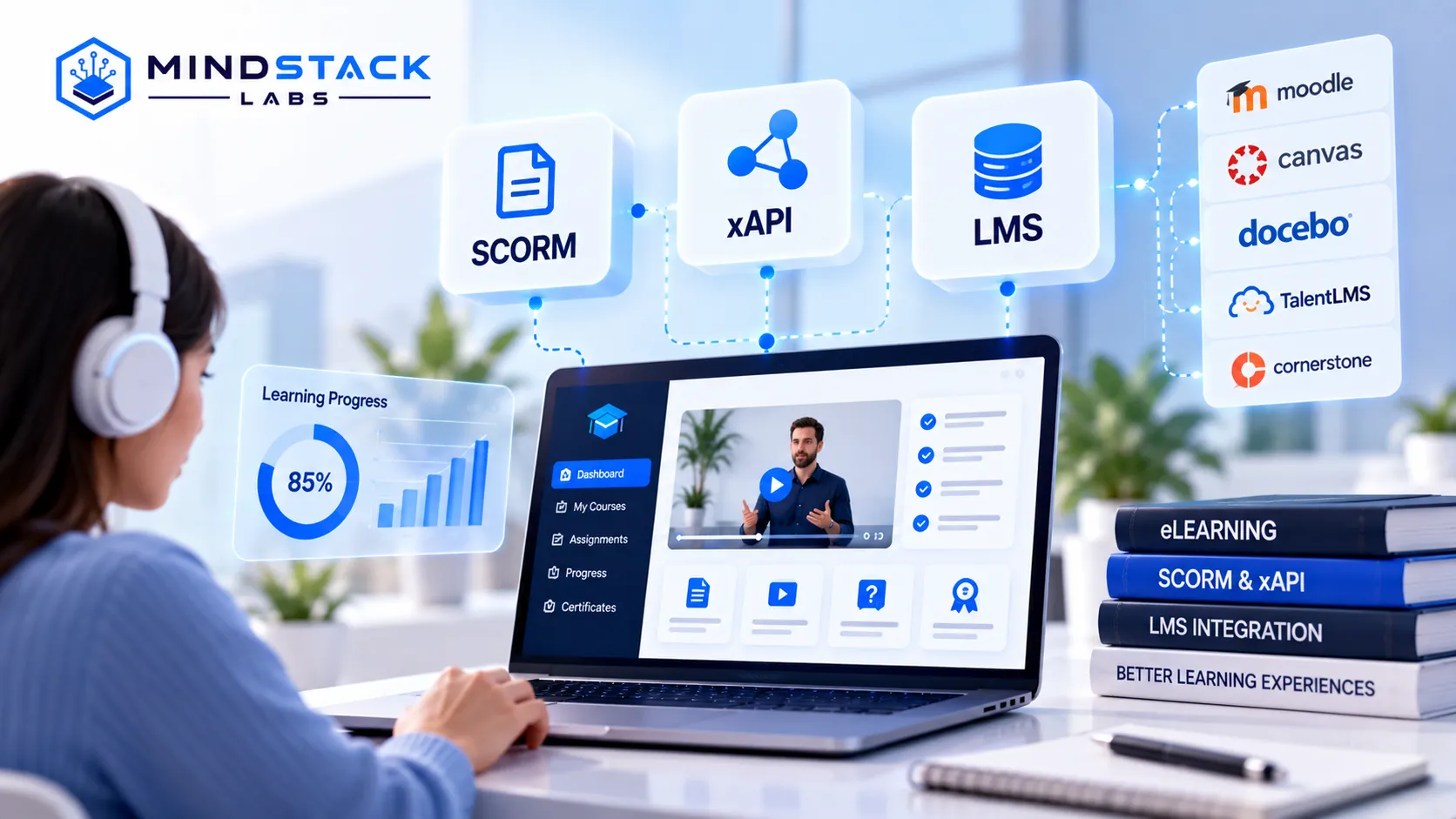
Mind Stack Labs runs full-cycle delivery: design, development, QA, and deployment under one roof, with AI and automation capability layered into the build itself rather than bolted on as a separate service line.
100+ products shipped across industries, with a live education-industry practice at education app development
Recent education-space work includes the Smart OMR Evaluator for exam evaluation, the Well Academy Learning App, and Our School Hangout, a school community app
One team owns the SCORM package, the xAPI/LRS wiring, and the LMS integration end to end, which removes the handoff gaps that usually cause tracking bugs between a content vendor and an integration vendor
AI and automation capability sits inside the same delivery team, useful if your eLearning build needs adaptive content logic or automated reporting on top of the tracking layer
Full portfolio and case studies available on request
Best for: teams that want one team accountable for the whole build, not five vendors passed back and forth. In my experience, that alone eliminates half the integration bugs I've seen on multi-vendor eLearning projects.
Ask us, like you'd ask anyone on this list, for a live SCORM/xAPI proof point specific to your use case before you sign.
2. Belitsoft
Founded in 2004 and based in Warsaw, Belitsoft has run a dedicated eLearning practice for over 12 years, with 110+ eLearning projects delivered by its own count.
Explicitly lists SCORM 1.2 and SCORM 2004, xAPI (Tin Can), and LTI as supported standards on its own eLearning standards page, and publishes a detailed SCORM vs xAPI vs cmi5 vs LTI comparison guide that shows working knowledge of when to use each, not just a checkbox mention
Independent review site Learning Light confirms Belitsoft builds LMS and LXP platforms "from-scratch" using existing code libraries and deep knowledge of SCORM, LTI, xAPI, and cmi5, a third-party corroboration that goes beyond self-reported claims
250-400+ employees, sized to run parallel eLearning workstreams without pulling from a single small team
Also builds Learning Experience Platforms that blend traditional LMS course tracking with modern, xAPI-driven learning paths
Best for: teams that specifically need LTI alongside xAPI, not just SCORM checkbox support.
3. Itransition
Founded in 1998, headquartered in Decatur, Georgia, with 3,000+ engineers across 40 countries.
States it "strictly adheres to the technical standards and quality requirements accepted in the educational sector, such as SCORM, LTI, and xAPI," alongside data regulations including GDPR, FISMA, and HIPAA, on its own eLearning services page
Published case study: a cloud-based, SCORM-compliant LMS platform built for the casino industry's SaaS employee-training provider, documented on its custom LMS overview page
Covers the full EdTech spectrum: custom LMS, learner-centric web portals, content authoring CMS, mobile learning apps, and learning analytics, per its enterprise LMS page
Also ships LMS modernization work, including migrating monolithic legacy LMS architecture to microservices and moving on-premises systems to cloud or hybrid hosting
Large enough (3,000+ engineers) to run multi-audience platforms combining corporate, higher ed, and consumer users in a single build
Best for: platforms needing heavy reporting and analytics layered on top of the LMS itself.
4. ScienceSoft
Founded in 1989, HQ in McKinney, Texas. 750+ in-house IT experts, ISO 9001 and ISO 27001 compliant.
States direct support for "technical standards like SCORM, AICC, xAPI and LTI" on its eLearning software development services page, plus compliance work for HIPAA, SOX, and GLBA
Runs a dedicated eLearning practice since 2015, with 11+ years specifically in eLearning software on top of 15 years in general content management system development
Publishes a standalone Learning Experience Platform (LXP) guide that estimates a moderate-complexity custom LXP build at USD 150,000 to 300,000, useful for budgeting before you scope
Explicitly positions itself for modernizing an aging LMS, not only greenfield builds: legacy replacement, LCMS, and LXP work sit alongside net-new development
ISO 9001 and ISO 27001 certified, relevant if your legacy LMS modernization involves sensitive learner or employee data
Best for: organizations replacing an aging LMS that's technically SCORM-compliant but practically unusable.
5. Intellias
Founded in 2002, HQ in Chicago with engineering hubs in Lviv and Kraków. 3,000+ employees.
Listed as an Open edX certified partner, with its Open edX marketplace profile stating it delivers "personalized eLearning experiences for clients like BrainStorm (a US training development company) and Phase6 (a German language-learning app)"
The same profile states its AI algorithms are "recognized by Oxford, Cambridge, and Macmillan publishers," and that it holds ISO/IEC 27001:2013, ISO 9001:2015, TISAX, and GDPR certifications
A third-party industry roundup cites Intellias as having helped eLearning platform partners win enterprise customers including Visa, PepsiCo, and Deloitte. I could not verify this claim directly on intellias.com, so treat it as unconfirmed until the vendor substantiates it on a call
Covers educational management platform development, proprietary online course models, language-learning app development, and gamified/chatbot-driven learning experiences
Enterprise-scale headcount (3,000+) suited to platforms that need to support B2B2C distribution, not just a single-tenant product
Best for: platforms scaling from a single-tenant product into enterprise B2B or B2B2C learning. Verify named enterprise client claims directly with Intellias before relying on them.
6. Instinctools
Founded in 2000, with offices across Germany, the USA, Poland, and Kazakhstan. 250-1,000 employees.
States "more than two decades" of eLearning software delivery on its eLearning software development page, with proctoring software as a named, dedicated service line: multi-factor identity checks, browser lockdown, end-to-end video recording, and incident alerts
Documented case study: built a new frontend micro-app for the Royal Bank of Canada's internal learning management platform, extending admin and super-admin functionality using React and Redux integrated with the client's existing API, per a published case study
Published case study on an eLearning solution upgrade for a software company, built on Moodle LMS, PHP, MSSQL, and Google Cloud, including individual and group reporting layers
Proctoring is treated as a core capability, not an add-on, which sets it apart from most other vendors on this list who offer proctoring only as an integration
Best for: platforms that need exam proctoring built in from day one, not bolted on later.
7. Matellio
Founded in 2014, HQ in San Jose, California, with offices in India. 250+ employees.
Runs a dedicated AI eLearning practice covering AI-based LMS, eLearning chatbots, and virtual teaching assistants, detailed on its AI eLearning software page
Publishes detailed technical guidance on building AI-based LMS features, including unsupervised learning models for content personalization based on learner trends and patterns
States its LMS work integrates adaptive content personalization, predictive analytics, and generative AI-driven course creation directly into the platform, not as a post-launch add-on, per its LMS features guide
AWS and Microsoft partner, relevant for cloud-native LMS builds needing certified infrastructure partnerships
Positions itself explicitly as a build partner rather than a product company: "We're not a product company. We're your digital transformation services partner"
Best for: teams that want AI-personalized learning paths designed into the LMS itself, not added after launch.
8. Geniusee
Founded in 2017, HQ in Kyiv with a US sales presence in Austin, Texas. 200-250 professionals.
EdTech is a named specialization alongside FinTech and Retail on its eLearning software development page, covering custom LMS, mobile tutor apps, authoring tools, white-label configuration, and secure single sign-on
Documented AWS case study: migrated a WordPress-based eLearning SaaS product to a serverless architecture (AWS Lambda via Laravel Vapor, ECS/Fargate, Cognito, S3), designed to support 1 million concurrent users at 99.99% SLA uptime while maintaining ISO 27001 and GDPR compliance
AWS Consulting Partner with AWS Education Competency, and ISO 9001:2015 plus ISO 27001 certified, per its AWS Marketplace seller profile
On the fintech side of the business it builds KYC, AML, and fraud-training modules, which is directly relevant if your eLearning platform is subscription-billed or payment-gated and needs the same security rigor applied to the training layer
Chief Security Officer Ihor Demkovych has publicly described security as "a design constraint from the moment we open a new repo," with threat modeling, static code analysis, and continuous compliance dashboards built into every project
Best for: EdTech builds that also need fintech-grade security practices, think subscription billing or payment-gated courses.
9. CMARIX
Founded in 2009, HQ in Ahmedabad, India. 200-250 employees, ISO 9001:2015, ISO 27001, and CMMI Level 3 certified.
Runs a dedicated eLearning and EdTech vertical page covering custom LMS builds and educational gamification, at cmarix.com/elearning
States a specific focus on educational games and simulations built with gamification techniques, letting learners interact with real-life problems and solutions in a virtual space, positioned as a retention-focused differentiator versus a plain course-and-quiz LMS
Publishes a detailed Learning Management System Development guide breaking the build process into ideation, technology selection, system specification, UI/UX, initial launch, and final deployment stages, which is useful diligence reading before a kickoff call
CMMI Level 3 certification signals process maturity uncommon at this team size and price point
Clients across 46+ countries, per company materials, indicating experience running distributed, cross-timezone eLearning projects
Best for: teams that want certified process rigor without enterprise-level pricing.
10. MindK
Founded in 2009, HQ in San Francisco. 100-200 employees.
States 15 years of experience building custom LMS, mobile learning apps, and configurable dashboards on its eLearning industry page, with build costs typically ranging USD 70,000 to 300,000-plus depending on scope
A third-party ranking (Brain Station 23's LMS company roundup) credits MindK with Moodle and Totara LMS customization plus "SCORM, xAPI, H5P, cmi5, LRS integration" and remote proctoring, alongside GDPR, FERPA, and baseline HIPAA compliance work
Its dedicated SaaS-replacement page states LMS builds combine SCORM for packaged course tracking, LTI for secure external tool integration, and xAPI/cmi5 for richer learning-record reporting, all named explicitly rather than bundled into a generic "standards support" line
Ruslan Moroz, MindK's senior engineer, has been the company's named lead for Healthcare and eLearning work since 2009, giving the practice a long-tenured technical owner rather than a rotating team
Smaller team size (100-200) means fewer management layers between you and the engineers actually building the tracking layer
Best for: early-stage startups building an MVP LMS who want a senior-heavy, smaller team rather than a large agency.
Which Company Fits Your Project
If you're modernizing a legacy LMS, go with ScienceSoft. That's their stated specialty, not a side service.
If xAPI and LTI are both hard requirements, go with Belitsoft. It's the only company here that names both explicitly.
If you need built-in exam proctoring, go with Instinctools.
If you want AI-personalized learning paths from day one, go with Matellio.
If you want one team owning design through integration, with AI/automation layered in, go with Mind Stack Labs.
AI and Adaptive Learning: The Layer Beyond SCORM and xAPI
SCORM and xAPI answer "did the training happen and what happened during it." They don't answer "should this learner see different content than the last one." That's a separate layer now, and it's changing fast.
A few things worth knowing before you scope a project:
cmi5, an xAPI profile designed to give LMS-like structure back to xAPI content, is increasingly requested by enterprise buyers who miss SCORM's simplicity but want xAPI's data depth.
The FTC finalized amendments to COPPA in April 2025, effective June 23, 2025, with a compliance deadline of April 22, 2026. If your platform touches K-12 or under-13 users in any way, this isn't optional reading.
Frequently Asked Questions
1. SCORM vs xAPI: which one do I actually need?
SCORM works fine if you only need to know whether someone finished a course and their score. xAPI is the better call the moment you need to track anything outside a traditional course, like a simulation, an offline activity, or a mentoring session.
2. Do I need a custom LMS, or can an off-the-shelf platform work?
Off-the-shelf works if your training needs are standard: courses, quizzes, certificates. Custom development earns its cost when you need specific integrations, unusual content types, or compliance handling your off-the-shelf vendor doesn't support.
3. Can existing SCORM content be migrated to xAPI?
Yes, and most vendors on this list have done it. The content itself usually survives the move; the tracking layer is what gets rebuilt to capture xAPI statements instead of SCORM's simpler completion data.
4. How long does eLearning software development typically take?
In my experience, a focused MVP LMS runs 3 to 5 months. A full enterprise platform with SCORM/xAPI compliance, custom integrations, and proctoring tends to run 6 to 12 months. Anyone quoting weeks for a compliance-heavy build is quoting a template, not your project.
5. What does eLearning software development cost?
It varies too widely by scope to give one number honestly. What I can tell you: SCORM/xAPI integration testing, LRS setup, and compliance work (FERPA, COPPA, HIPAA where relevant) each add real hours. Get a vendor to itemize those separately in the quote rather than folding them into a flat "development" line.
Where This Leaves You
Start with the checklist, not the list. Run every vendor you're seriously considering, Mind Stack Labs included, through the five criteria at the top of this piece before you look at price.
If SCORM alone covers your use case, ScienceSoft or CMARIX are reasonable starting points. If xAPI, LTI, or AI-personalized paths matter, narrow to Belitsoft, Matellio, or Mind Stack Labs.