

The best cloud based insurance software depends on one thing: whether your policy and rating logic fits a standard product model. If it does, license a core platform like Guidewire, Duck Creek or Insly. If it does not, license the core and build the differentiating layer with a custom engineering partner such as Mind Stack Labs.
TL;DR
→ Standard product lines = license a full-suite core (Guidewire, Duck Creek, Sapiens, EIS)
→ Small agency or MGA = pick an agency system (Applied Epic, Vertafore, Insly, Novidea) instead of a carrier core
→ Proprietary rating or state-specific forms = hybrid build, core plus custom layer
→ Almost no vendor publishes pricing, so budget for implementation and data migration separately from license
→ From my experience, migration off legacy policy data eats more schedule than the platform build itself
Why I Built This List Instead of Another Logo Roundup
Ever read a vendor comparison that told you which one to actually skip? Me neither. Here is why.
I have scoped and shipped financial and regulated-data systems across billing, e-invoicing, accounting and financial calculation work. I have also sat through vendor demos where every product claimed every module, and I still walked out unable to tell them apart.
That is the real problem with this category.
Most lists rank companies. Buyers need to rank modules, because the decision is rarely "which vendor" before it is "how much of this do we buy at all."
So this list does both. Fifteen options, one fixed structure each, then a module-level buy-versus-build matrix that no other page on this topic publishes.
What I Am Evaluating On
I scored every option in this list against five plain criteria:
Module coverage across policy admin, claims, quoting and rating, billing, and portals
Company-size fit, because a 40-person MGA should not evaluate a tier-one carrier core
Lines of business supported, since P&C, life and annuity, and specialty landscapes differ
Integration surface, meaning real APIs and documented extension points
Publicly verifiable information, so nothing here rests on a sales deck I cannot check
What I deliberately did not score: G2 star ratings. They tell you who ran a review campaign, not who fits your product model.
Software Solutions for Insurance Companies: All 15 at a Glance
# | Solution | Best-fit segment | Core strength | Pricing model |
|---|---|---|---|---|
1 | Mind Stack Labs | Any size needing custom or hybrid builds | Custom modules, integration layer, portals | Scoped per project, no fixed pricing |
2 | Guidewire | Mid to large P&C carriers | Full suite, deep P&C depth | Quote only |
3 | Duck Creek | Mid-market and large P&C | Modular core, cloud-native | Quote only |
4 | Sapiens | Carriers across P&C, life, workers comp | Broad multi-line suites | Quote only |
5 | EIS | Digital-first carriers | API-first core platform | Quote only |
6 | Socotra | Insurtechs and new products | Fast product configuration | Quote only |
7 | Majesco | Small to mid carriers | Cloud suites for P&C and L&A | Quote only |
8 | Applied Epic | Independent agencies and brokers | Agency management, not carrier core | Quote only |
9 | Vertafore AMS360 | Small to mid agencies | Agency workflow and accounting | Quote only |
10 | Insly | MGAs and small insurers | Lightweight core, quick setup | Published tiers |
11 | Novidea | Brokers and MGAs | Salesforce-based broker platform | Quote only |
12 | BriteCore | Small and regional P&C carriers | Core suite for regional carriers | Quote only |
13 | Origami Risk | Risk pools, TPAs, self-insured | Claims and risk management depth | Quote only |
14 | Hexure FireLight | Life and annuity distribution | E-application and illustrations | Quote only |
15 | Salesforce FSC | Carriers wanting CRM-led front office | Service and distribution layer | Per-user tiers |
The 15 Best Cloud Based Insurance Software Solutions for 2026
1. Mind Stack Labs — Best for Custom and Hybrid Cloud Insurance Builds
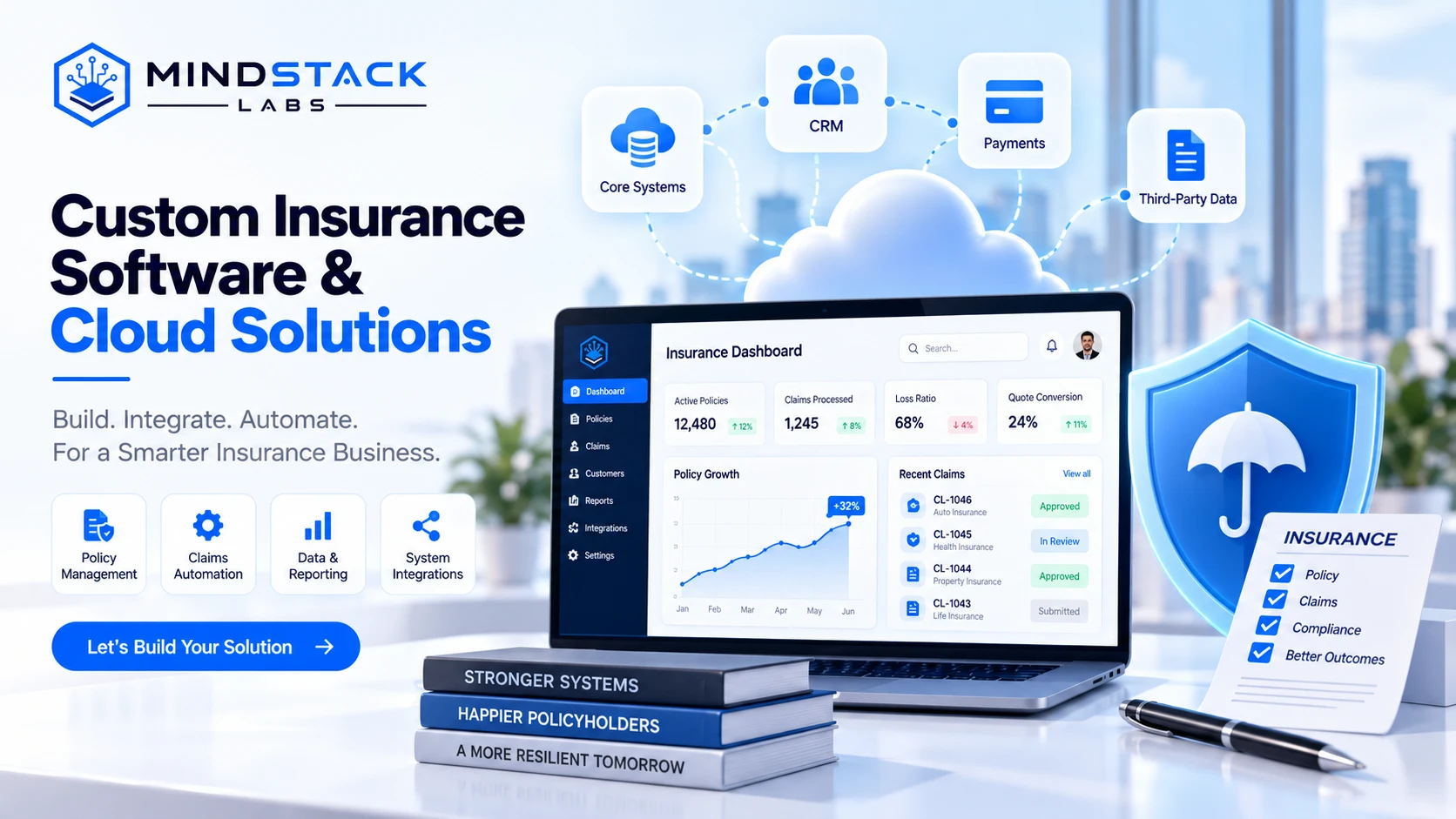
MindStack Labs is a custom software and cloud engineering team that builds the insurance modules platforms leave unfinished, and the integration layer that connects them.
Key capabilities:
Custom policy, quoting and claims modules built on Node.js, .NET, Next.js and Laravel
Integration layer between core platforms, CRM, payment rails and third-party data
Policyholder and agent portals, plus internal admin tools built to real workflows
Workflow automation with n8n and LangChain for underwriting handoffs and document routing
Business dashboards for loss ratio, acceptance rate and cycle-time reporting
Relevant builds:
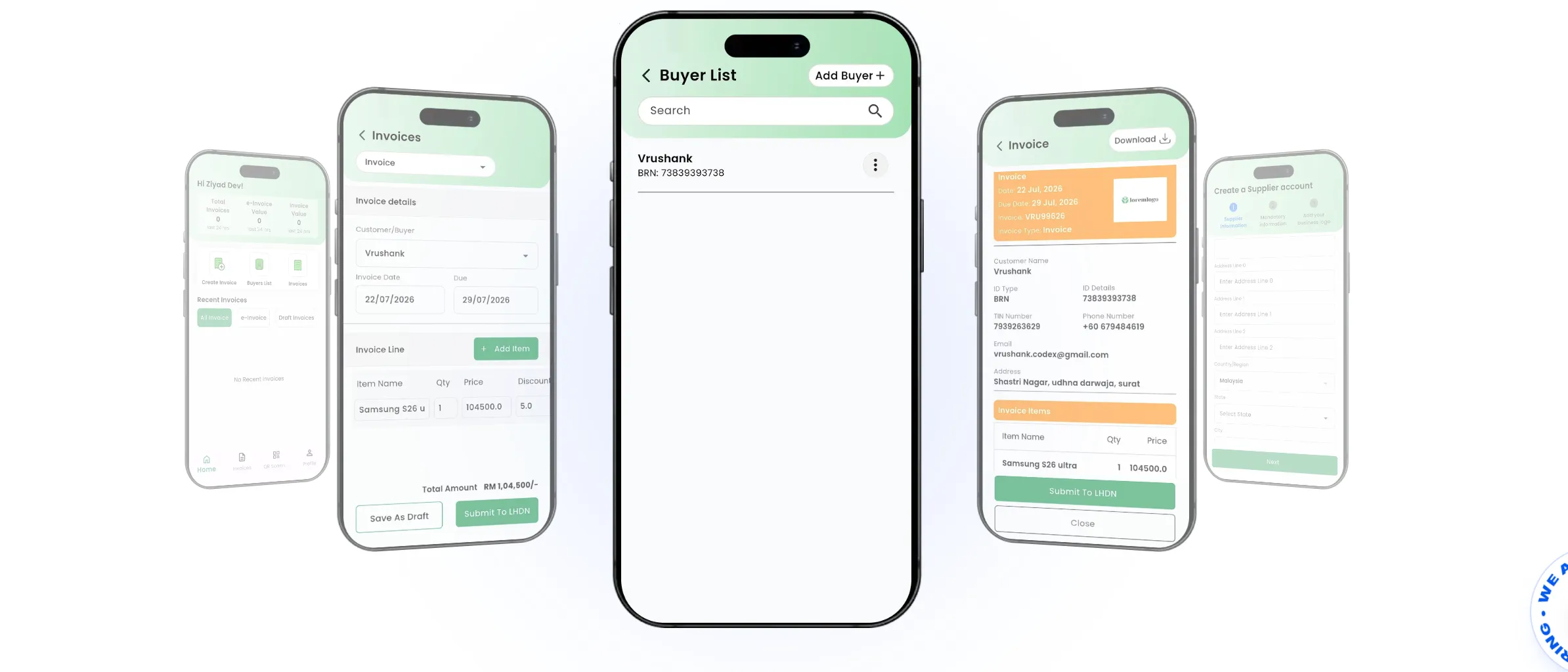
Invoice Factory → regulated document generation and direct submission to a national tax authority API
SutraPlus → billing and accounting system on Angular, ASP.NET Core APIs and SQL Server with role hierarchy and export reporting
Fincalc360 → validated financial calculation engine and projection models, the closest analogue to insurance rating logic
MoneyMind → personal finance and expense tracking application
Deployment and lines of business: cloud-native by default. Lines of business are whatever you specify, since builds are scoped to your requirement list rather than a fixed product line.
The numbers: no fixed or packaged pricing, because custom scope has no list price. Every engagement is priced against your requirement list after a scoping call.
Compliance posture: we build to HIPAA technical safeguards and encryption-at-rest and in-transit patterns as engineering practice. That is a build standard, not a certification claim, and I would rather say so plainly than let you assume otherwise.
Best for: carriers, MGAs and insurtechs whose rating rules, forms or workflows do not fit a standard product model.
2. Guidewire — Best for Mid to Large P&C Carriers
Guidewire is the reference full-suite core for property and casualty carriers, and it is priced accordingly.
Key capabilities:
PolicyCenter, ClaimCenter and BillingCenter as an integrated suite
Deep P&C product model with extensive configuration
Large certified partner and integration ecosystem
Deployment and lines of business: delivered on the Guidewire Cloud Platform, focused on property and casualty carriers.
The numbers: no public pricing, and scope is negotiated per carrier by premium volume, modules and users. Expect implementation to sit alongside license cost, not inside it.
Best for: carriers with the budget and internal IT capacity for a multi-year core program.
3. Duck Creek — Best for Modular Core Replacement
Duck Creek suits carriers that want to replace one module at a time rather than everything at once.
Key capabilities:
Policy, billing, claims and rating available as separable components
Cloud-native delivery with regular platform releases
Strong rating and product configuration tooling
Deployment and lines of business: SaaS delivery through Duck Creek OnDemand, focused on property and casualty carriers.
The numbers: quote-based. Phased module rollouts, in my experience, are the single most reliable way to keep a core program from slipping past renewal season.
Best for: mid-market and large P&C carriers doing phased modernization.
4. Sapiens — Best for Multi-Line Carriers

Sapiens covers more lines of business under one vendor than most competitors on this list.
Key capabilities:
Suites spanning P&C, life and annuity, and workers compensation
Reinsurance and financial modules available
Established presence across North America, Europe and APAC
Deployment and lines of business: cloud or on-premise options, spanning P&C, life and annuity, and workers compensation.
The numbers: quote-based, scoped per suite and line of business.
Best for: carriers writing several distinct lines who want fewer vendor relationships.
5. EIS — Best for API-First Architecture
EIS is built for carriers who intend to develop against the platform, not just configure it.
Key capabilities:
API-first core with policy, billing, claims and engagement layers
Designed for digital distribution and embedded insurance models
Supports rapid launch of new products on an existing core
Deployment and lines of business: cloud-native, multi-line by design including P&C and life, built for digital distribution models.
The numbers: quote-based. Platforms with genuine API depth tend to cut integration effort materially compared with SOAP-era cores.
Best for: digital-first carriers with in-house or partner engineering capacity.
6. Socotra — Best for Launching New Products Fast

Socotra optimizes for speed of product configuration rather than breadth of legacy feature coverage.
Key capabilities:
Configurable product definitions for new lines
Modern developer-facing APIs and documentation
Policy, billing and claims in a single cloud core
Deployment and lines of business: multi-tenant cloud-native core, configurable across multiple lines for new or growing programs.
The numbers: quote-based, typically scoped by premium volume or product count.
Best for: insurtechs and carrier innovation units shipping a new product this year.
7. Majesco — Best for Small and Mid-Size Carriers

Majesco packages carrier-grade functionality at a scope smaller carriers can actually absorb.
Key capabilities:
Cloud suites for both P&C and life and annuity
Pre-configured content to shorten configuration cycles
Distribution management and portal modules
Deployment and lines of business: cloud suites covering both P&C and life and annuity, with pre-configured content by line.
The numbers: quote-based.
Best for: regional carriers wanting a full suite without a tier-one program.
8. Applied Epic — Best for Independent Agencies

Applied Epic is an agency management system, not a carrier core, and confusing the two is the costliest early mistake I see.
Key capabilities:
Client, policy and renewal tracking for agencies
Accounting, commission and producer management
Carrier download and connectivity integrations
Deployment and lines of business: cloud-hosted agency platform, line-of-business agnostic since it sits on the agency side across whichever carriers the agency represents.
The numbers: quote-based, typically priced per user.
Best for: independent agencies and brokers managing books of business across carriers.
9. Vertafore AMS360 — Best for Small to Mid Agency Operations

AMS360 handles day-to-day agency workflow and accounting more than product manufacturing.
Key capabilities:
Policy servicing, renewals and certificates
Integrated agency accounting
Broad carrier connectivity
Deployment and lines of business: cloud-hosted agency platform, line-of-business agnostic in the same way as Applied Epic.
The numbers: quote-based, per-user structure.
Best for: agencies prioritizing operational efficiency over custom product build.
10. Insly — Best for MGAs and Small Insurers
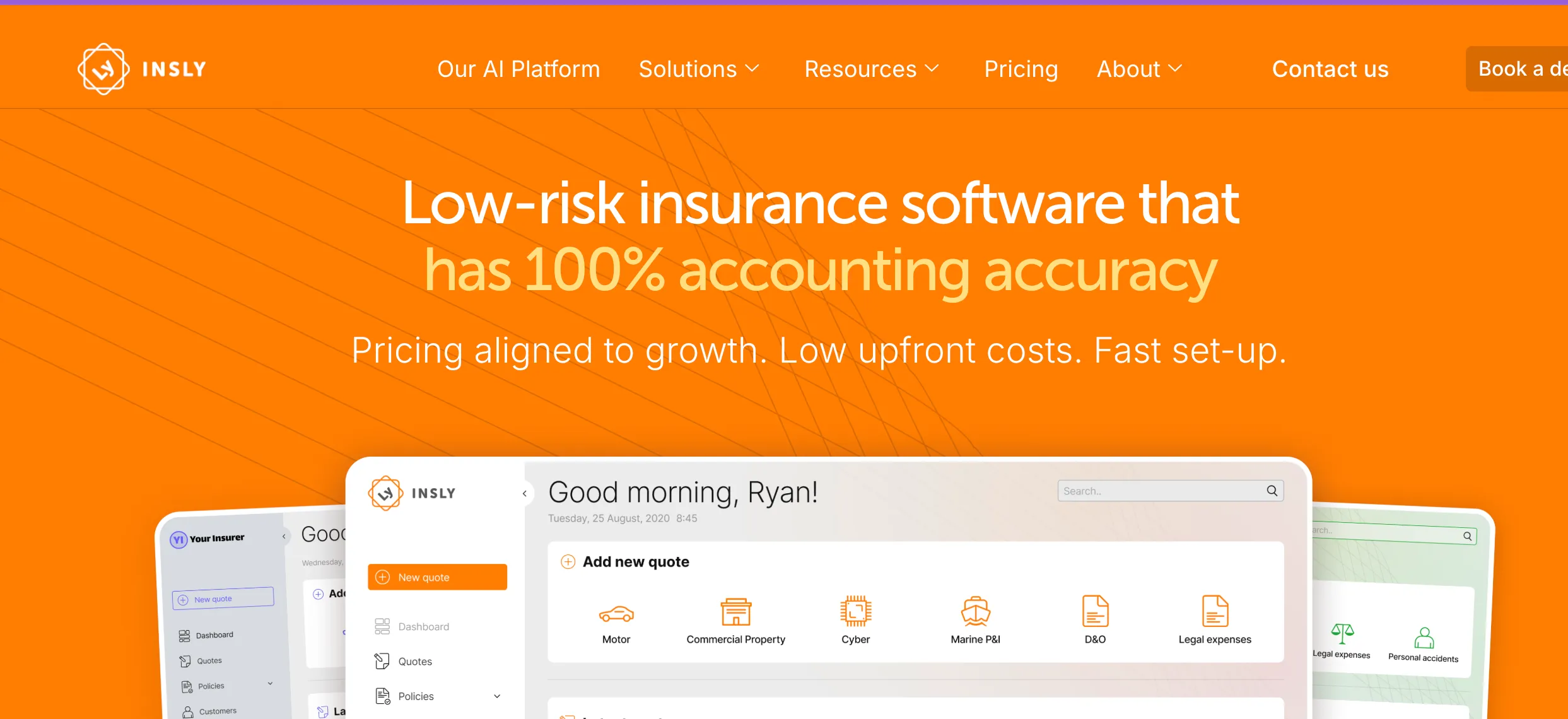
Insly is one of the few options in this category that publishes tiered pricing at all.
Key capabilities:
Policy administration, quoting and claims for smaller books
No-code product configuration
Faster setup than carrier-grade cores
Deployment and lines of business: cloud SaaS, configurable across multiple lines for MGAs and small insurers.
The numbers: published subscription tiers, verifiable on their pricing page. Confirm current figures before publication.
Best for: MGAs and small insurers who need a working core in weeks, not quarters.
11. Novidea — Best for Data-Led Brokers
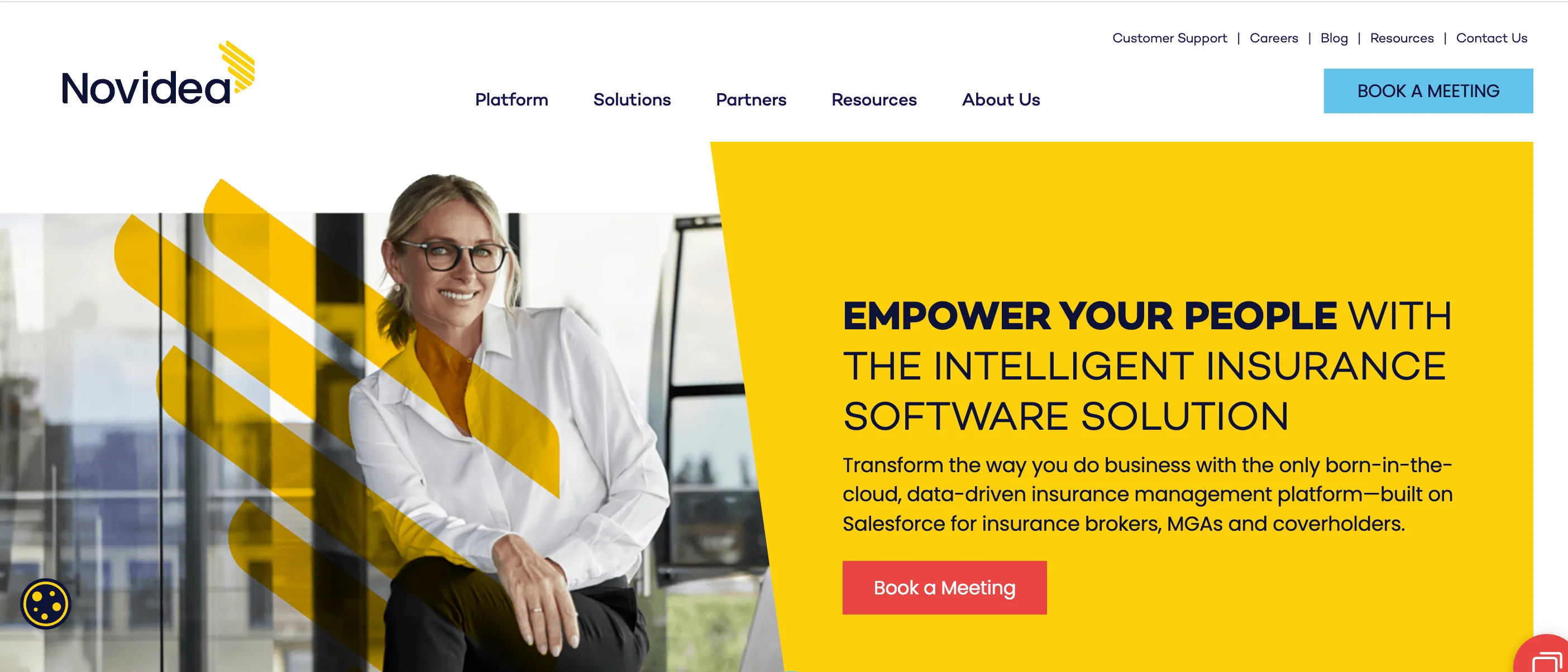
Novidea builds broker operations on top of Salesforce rather than a proprietary core.
Key capabilities:
Broker and MGA distribution workflow
Analytics and pipeline visibility across the book
Inherits the Salesforce integration ecosystem
Deployment and lines of business: cloud, built on the Salesforce platform, multi-line for broker and MGA distribution.
The numbers: quote-based, and remember Salesforce licensing sits underneath it.
Best for: brokers already standardized on Salesforce.
12. BriteCore — Best for Regional P&C Carriers
BriteCore targets the regional carrier segment that enterprise vendors tend to over-scope.
Key capabilities:
Policy, billing and claims for personal and commercial lines
Agent and policyholder portals included
Cloud-hosted with managed upgrades
Deployment and lines of business: cloud-hosted with managed upgrades, focused on personal and commercial P&C lines.
The numbers: quote-based.
Best for: regional and mutual carriers replacing an aging on-premise core.
13. Origami Risk — Best for Claims and Risk Depth
Origami Risk goes deeper on claims and risk management than most full-suite cores.
Key capabilities:
Claims administration, incident intake and loss control
Risk and safety analytics
Policy and billing modules available alongside
Deployment and lines of business: cloud, multi-line with a claims and risk management focus rather than a single product line.
The numbers: quote-based, scoped by module and claim volume.
Best for: TPAs, risk pools and self-insured organizations where claims is the primary system.
14. Hexure FireLight — Best for Life and Annuity Distribution
FireLight solves the life and annuity sales and e-application problem, not core policy administration.
Key capabilities:
Electronic applications and illustrations
Carrier and distributor connectivity
Straight-through submission workflows
Deployment and lines of business: cloud-delivered, focused specifically on life and annuity distribution.
The numbers: quote-based.
Best for: life carriers and distributors digitizing the application journey.
15. Salesforce Financial Services Cloud — Best for CRM-Led Front Office
Salesforce FSC is a service and distribution layer, and it will not administer policies on its own.
Key capabilities:
Service console, household and relationship views
Distribution and lead workflow
Very large integration and app ecosystem
Deployment and lines of business: cloud on the Salesforce platform, cross-line since it sits as a CRM layer over an existing core.
The numbers: published per-user, per-month tiers, which is unusual transparency for this category.
Best for: carriers and brokers who want CRM first and keep an existing core behind it.
How the 15 Compare on Every Evaluation Parameter
A ranked list gives you my order. This table lets you build your own order, based on whichever parameter matters most to your organization.
Vendor | Best company-size fit | Primary lines of business | Core modules covered | Integration and API depth | Deployment model | Pricing transparency |
|---|---|---|---|---|---|---|
Mind Stack Labs | Any size, custom scope | Any, built to your product | Whatever you specify: policy, claims, rating, portals, or all four | Full custom integration layer | Cloud-native custom build | Scoped quote, no list price |
Guidewire | Mid to large carriers | P&C | Policy, claims, billing | Large certified partner ecosystem | Guidewire Cloud Platform | Quote only, opaque |
Duck Creek | Mid-market to large | P&C | Policy, billing, claims, rating | Strong API, phased-rollout friendly | SaaS via Duck Creek OnDemand | Quote only |
Sapiens | Small to large, multi-line | P&C, life and annuity, workers comp | Policy, claims, billing, reinsurance | Moderate, suite-based | Cloud or on-premise | Quote only |
EIS | Digital-first, mid to large | Multi-line, P&C and life | Policy, billing, claims, engagement | API-first, high depth | Cloud-native | Quote only |
Socotra | Insurtechs, new programs | Configurable, multi-line | Policy, billing, claims | Modern developer APIs, high | Multi-tenant cloud | Quote, scoped by volume |
Majesco | Small to mid carriers | P&C and life and annuity | Policy, billing, claims, portals | Moderate | Cloud suites | Quote only |
Applied Epic | Independent agencies | Agency-side, multi-carrier | Agency management, not policy admin | Carrier download connectivity | Cloud-hosted | Quote, per user |
Vertafore AMS360 | Small to mid agencies | Agency-side, multi-carrier | Agency workflow, accounting | Broad carrier connectivity | Cloud-hosted | Quote, per user |
Insly | MGAs, small insurers | Configurable, multi-line | Policy, quoting, claims | No-code config, moderate API | Cloud SaaS | Published tiers |
Novidea | Brokers and MGAs | Broker distribution, multi-line | Distribution workflow, analytics, not policy admin | Inherits Salesforce ecosystem, high | Cloud, Salesforce-based | Quote, plus Salesforce license |
BriteCore | Small and regional carriers | P&C, personal and commercial | Policy, billing, claims, portals | Moderate | Cloud-hosted, managed upgrades | Quote only |
Origami Risk | TPAs, risk pools, self-insured | Multi-line, claims-focused | Claims, risk and safety, policy and billing secondary | Moderate | Cloud | Quote, by module and volume |
Hexure FireLight | Life and annuity carriers | Life and annuity only | E-application and illustrations, not policy admin | Carrier and distributor connectivity | Cloud | Quote only |
Salesforce FSC | Carriers and brokers wanting CRM front office | Cross-line, CRM layer | Service, distribution, lead workflow, not policy admin | Very large app ecosystem, high | Cloud, Salesforce platform | Published per-user tier |
Software Solutions for the Insurance Industry: Which Modules to Buy and Which to Build
Buy the modules where regulation and standards make everyone's requirements similar, and build the ones that encode your competitive logic.
That single sentence saves more budget than any vendor negotiation.
Module | Buy off the shelf? | Why |
|---|---|---|
Billing and premium accounting | Buy | Highly standardized, low differentiation |
Document generation and storage | Buy | Commodity capability, mature vendors |
Policy administration | Buy, then extend | Core coverage is standard, endorsements often are not |
Claims management | Buy, then extend | Workflow depth is standard, triage rules are yours |
Rating engine | Build or heavily extend | Proprietary rating is usually the actual moat |
State-specific forms and filings | Build or extend | Coverage varies sharply by vendor and state |
Policyholder and agent portals | Build | Where brand and conversion live |
Legacy data migration | Build | Always bespoke, never a product feature |
Pro tip: write your rating logic as a separate service with its own API before you sign any core contract, so the platform choice never holds your pricing model hostage.
Wait, You Might Be Thinking: Our Rating Logic Is Too Custom for Any Platform
That objection is usually half right. It is almost never a reason to reject platforms entirely.
In the builds I have worked on, roughly 70 to 80 percent of a core requirement set maps cleanly onto an off-the-shelf platform. The remaining slice, typically rating, unusual endorsements and a handful of state forms, is what needs custom engineering.
So the honest answer is hybrid, not either-or.
→ Standard 75% licensed + custom 25% built = shorter timeline than a full custom build, more fit than pure off-the-shelf
This pattern is not unique to insurance. On Fincalc360 we built the calculation engine as its own validated layer, with projection models and side-by-side comparison scenarios kept separate from the interface.
Rating logic wants exactly that treatment. Isolated, testable, and portable between platforms.
How Much Does Cloud Based Insurance Software Cost?
Assume the license is the smaller part of your first-year spend, because implementation and data migration tend to carry more of it than buyers expect.
Here is the cost structure I use when scoping:
License or subscription → scales with premium volume, users or modules
Implementation and configuration → frequently equals or exceeds year-one license
Data migration → priced by data quality, not record count
Ongoing customization and integration → the line item most budgets forget entirely
Why nobody publishes pricing: insurance cores are configured per carrier, so a list price would be meaningless. It also means you cannot benchmark without running at least two parallel RFPs.
Run two. Always run two.
Custom and hybrid work has no list price either. Any partner quoting one before reading your requirement list is guessing, and a scoped written estimate is what you should ask for instead.
Compliance and Security: What to Verify Before You Sign
Treat compliance as a document request, not a demo question, because every vendor will say yes on a call.
What to ask for in writing:
Current SOC 2 Type II report, not a summary letter. The Trust Services Criteria were issued in 2017 and the points of focus were revised in 2022, so check the report date and criteria version.
Data residency commitments, specifically which region policyholder PII sits in
Encryption at rest and in transit, with key management ownership stated
Support for state-level requirements under the NAIC Insurance Data Security Model Law, adopted in 2017 and since enacted by a large share of US states
Named subprocessors and their breach notification timelines
One more thing I would push on: ask who owns the encryption keys. The answer separates real security posture from marketing language faster than any questionnaire.
What Regulated Filing Actually Demands of Your Software
Regulatory submission fails on formatting, not on intent, and that is where custom engineering earns its place.
On Invoice Factory we built an e-invoicing platform for Malaysia's LHDN MyInvois regime. The requirement was unforgiving:
UBL 2.1 XML generated to strict schema, with proper canonicalization
RSA-SHA256 digital signatures and XAdES-BES signing using PKCS#12 certificates
A two-stage pipeline: unsigned document first, then digest, signature, embedded signature block
Real-time submission status against the national API, including cancellations
Minor formatting errors got invoices rejected outright. No partial credit.
Insurance state filings and ACORD-style document exchange behave the same way. If your core platform does not emit exactly the artifact the regulator expects, that gap becomes a custom build whether you planned for it or not.
Implementation Timelines and the Legacy Migration Problem
Budget more time for moving your data than for configuring the platform, because dirty legacy data is the default, not the exception.
Rough scope-to-timeline mapping from work I have seen:
→ Single module, clean data = quarters, not years
→ Phased core migration by line of business = the safest realistic path
→ Full simultaneous replacement = highest risk, and where most overruns originate
The five failure patterns that cause slippage:
Nobody owns data cleanup, so it starts after the build instead of before
Historic policy versions and endorsements were never in scope
Rating logic exists only in a spreadsheet and one person's memory
Integration to billing or document systems was assumed, not specified
Go-live was scheduled inside renewal season
That last one sounds obvious. It happens constantly.
On SutraPlus, a billing and accounting system we built on Angular, ASP.NET Core APIs and SQL Server, the work that actually protected the schedule was unglamorous: structured entry forms with validation, a bill verification step before finalization, and a clear role hierarchy across master admin, admin and user.
Policy migration rewards the same discipline. Validate at entry and you spend far less time reconciling later.
Pro tip: extract and profile a full year of historic policy data before you sign, since data quality is the variable that actually sets your timeline.
When field teams need offline access during migration, the sync layer becomes its own engineering problem. Our team has written publicly about handling local-to-cloud sync and voice call integration patterns, including this walkthrough on Twilio voice call integration that maps directly onto first notice of loss phone intake.
Adjacent Trend: AI and Straight-Through Processing in 2026 Core Systems
AI in insurance software is real where the task is classification, and still supervised where the task is decisioning.
Where I see it working now:
Document classification and data extraction from submissions and loss reports
FNOL intake triage and routing by severity
Underwriting pre-fill from third-party data sources
Support deflection on policy servicing questions
Where it does not yet replace people: final underwriting decisions, coverage determinations and anything a regulator may ask you to explain.
If you are adding an AI layer, keep it outside the core. An automation layer built with tools like n8n and LangChain can sit alongside the platform, which means you can change models without a core upgrade cycle. The custom software and cloud engineering services we run are structured that way for exactly this reason.
If You Only Read One Section: Pick By Priority
If your rating logic is proprietary, go with a hybrid build on a licensed core.
If you are a small agency, go with Applied Epic or Vertafore AMS360, not a carrier core.
If you are an MGA needing speed, go with Insly.
If you are launching a new product this year, go with Socotra or EIS.
If you are a regional P&C carrier replacing on-premise, go with BriteCore or Majesco.
If claims is your primary system, go with Origami Risk.
FAQs
1. What is cloud based insurance software?
Cloud based insurance software is a hosted platform that runs policy administration, claims, quoting and billing over the internet instead of on your own servers. Vendors handle infrastructure, upgrades and uptime, and you configure products rather than maintain hardware.
2. Guidewire vs Duck Creek: which is better?
Both are strong P&C cores. Guidewire fits carriers wanting one deep integrated suite with a large partner ecosystem, while Duck Creek suits carriers replacing modules in phases. Pick by rollout strategy, not feature checklists.
3. What is the difference between a policy admin system and an agency management system?
A policy admin system manufactures and services insurance products for a carrier or MGA. An agency management system tracks clients, policies and commissions for an agency selling other carriers' products. Buying the wrong one is a common early mistake.
4. How much does insurance software cost?
Almost no carrier platform publishes pricing, because cost scales with premium volume, modules and users. Plan for license, implementation, data migration and ongoing integration as four separate lines, and expect the license to be the smaller share in year one.
5. Should we build custom insurance software or buy a platform?
Buy the standardized modules such as billing and document management, and build where your logic is proprietary, usually rating, unusual endorsements and portals. A hybrid scope ships faster than a full custom build and fits better than pure off-the-shelf.
My Recommendation
Start with a licensed core matched to your segment, then build the rating and portal layer around it. Use a full custom build only if your product structure genuinely has no platform equivalent, which is rarer than most buyers assume.
And if you cannot yet tell which category you are in, that is the scoping conversation, not a reason to delay it.