

In the builds I have worked on, AI chatbot development services land between $8,000 and $25,000 for a focused production pilot and $35,000 to $120,000 for an enterprise bot wired into live systems, delivered in 4 to 6 weeks and 10 to 16 weeks respectively.
Three variables move that number:
how many systems the bot must integrate with
how clean your knowledge base is
how high you set the accuracy bar.
Ever met a buyer who was happy with the first chatbot quote they received? Me neither. Here is why.
I have scoped, audited, and shipped conversational AI systems for support and sales teams since 2019, and the detail I remember most is not the modelling work.
It is the third week of a build where we discovered the client's refund policy existed in four contradictory versions across two Notion pages, a PDF, and one very confident senior agent's memory.
That is the real job. The model is the easy part.
TL;DR
→ Pilot bot (1 channel, 1 use case, light integration) = $8k to $25k, live in 4 to 6 weeks
→ Enterprise bot (multi-channel, CRM and helpdesk writeback, auth) = $35k to $120k, live in 10 to 16 weeks
→ Running costs run 15% to 30% of build cost per year in my experience, and almost nobody puts them in the proposal
→ Cost drivers ranked: integration count → knowledge base quality → accuracy target. Model choice matters far less than buyers expect
→ The project killer is never the AI. It is undefined escalation and unclean source content
What AI Chatbot Development Services Actually Include
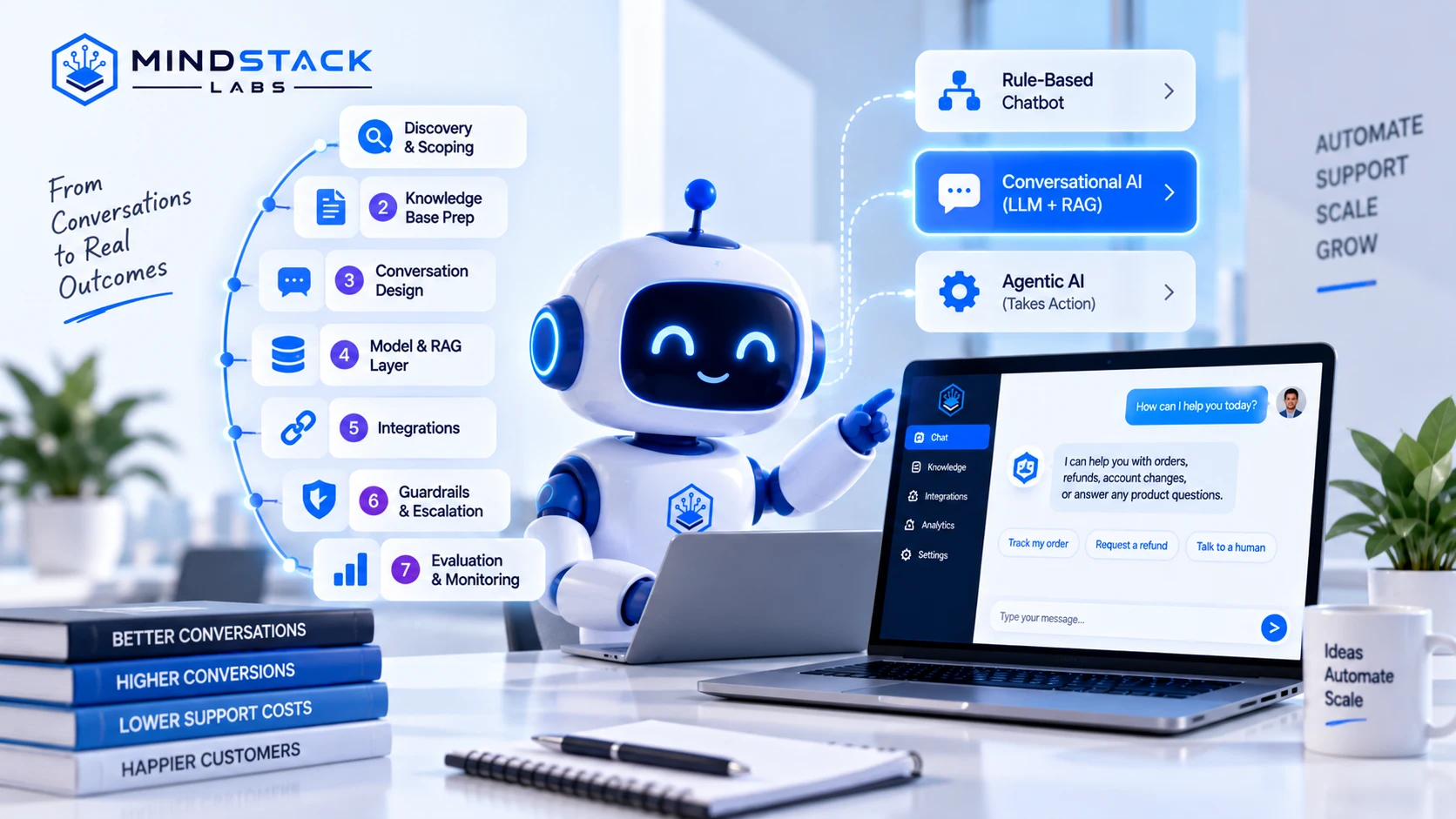
A production chatbot build is seven workstreams, and quotes differ mostly because vendors silently drop three of them.
The Seven Workstreams in a Real Build
# | Workstream | What it covers | Often missing from cheap quotes |
|---|---|---|---|
1 | Discovery and use case scoping | Ticket analysis, intent mapping, success metrics | Sometimes |
2 | Knowledge base preparation | Cleaning, deduplicating, structuring source content | Very often |
3 | Conversation design | Flows, tone, fallbacks, disambiguation | Often |
4 | Retrieval and model layer | RAG pipeline, vector store, prompt architecture | Rarely |
5 | Integrations | CRM, helpdesk, order systems, authentication | Partially scoped |
6 | Guardrails and escalation | Hallucination controls, human handoff, logging | Very often |
7 | Evaluation and monitoring | Test sets, accuracy tracking, retraining loop | Almost always |
Workstreams 2, 6, and 7 are where projects live or die.
Know why? Because those three are invisible in a demo. A bot with no evaluation harness looks identical to a bot with one, right up until it goes live.
Rule-Based vs Conversational AI vs Agentic AI
You are buying one of three different products, and the price gap between them is roughly 4x.
Type | What it does | Typical build cost | Best for |
|---|---|---|---|
Rule-based / decision tree | Follows fixed buttons and keyword paths | $3k to $8k | Simple FAQ deflection, appointment booking |
Conversational AI (LLM + RAG) | Understands natural language, answers from your knowledge base | $10k to $40k | Support deflection, product questions, onboarding |
Agentic AI | Takes actions in live systems: refunds, order changes, ticket updates | $40k to $120k+ | Order operations, account changes, complex service flows |
Most buyers ask for agentic and need conversational. In my experience, roughly 70% of ticket volume in a typical support queue is answerable from good documentation alone, no system actions required.
Pro tip: Scope your first build as conversational with one agentic action, not the reverse.
What Is Never in Scope Unless You Ask
Cleaning your knowledge base (assume you will be asked to do it)
Multilingual coverage beyond the first language
Load testing at peak volume
A written accuracy target you can hold the vendor to
Post-launch retraining after month one
Ask about all five in writing. The answers separate builders from resellers fast.
How to Scope the Build Before You Request a Single Quote
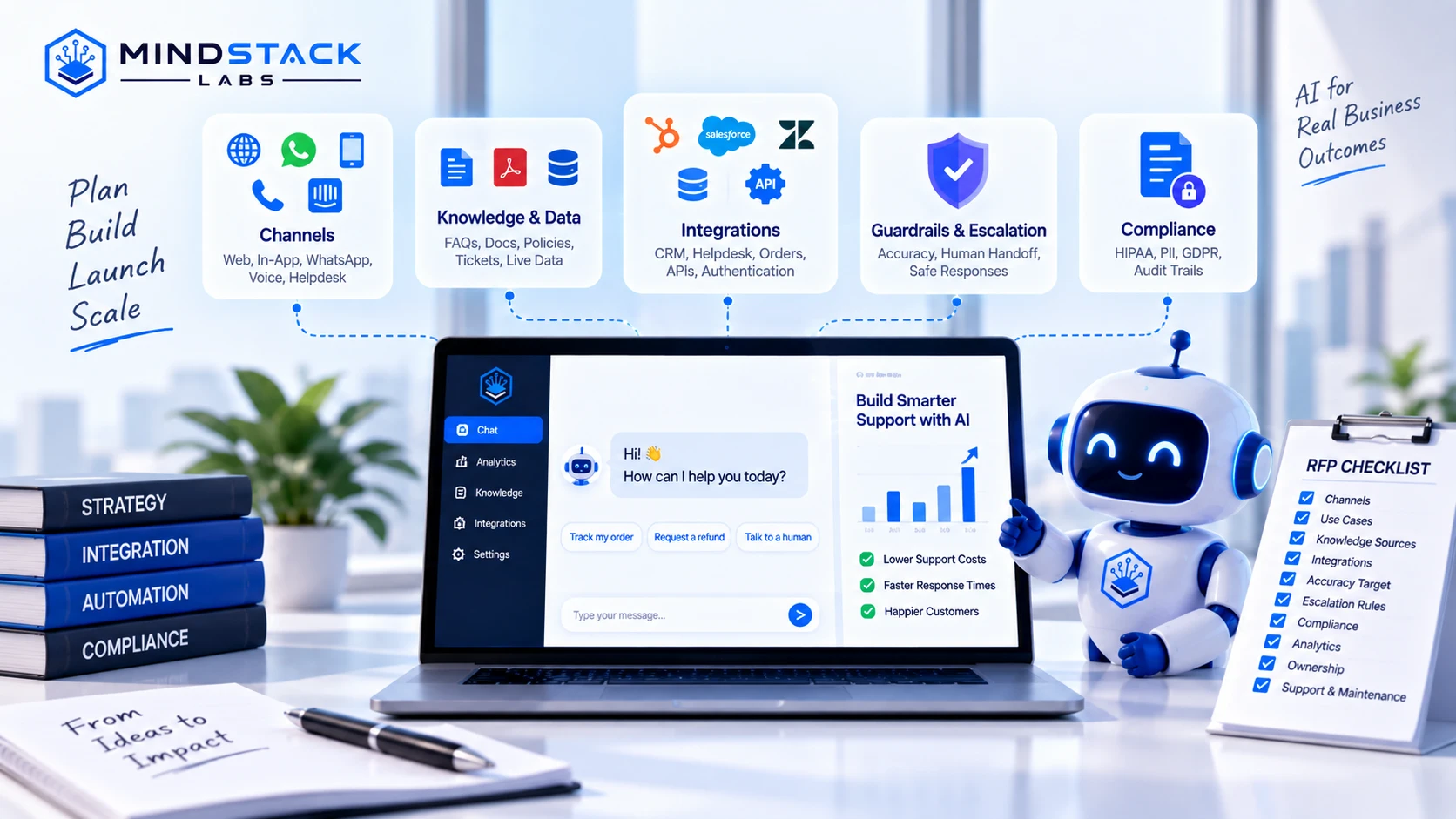
Scope the four dimensions below and your quotes become comparable overnight. Skip them and every vendor prices a different imaginary project.
Channel Scope
Decide where the bot lives before anything else, because each channel adds real engineering.
Website widget → cheapest, fastest, best starting point
In-app → needs auth and session context
WhatsApp → needs official WhatsApp Business API onboarding and template approval
Voice → a genuinely different build, see the Voice AI solutions approach
Helpdesk-native (Intercom, Zendesk) → fastest path if your team already lives there
Data and Knowledge Scope
List every source the bot must answer from, then rate each one honestly.
Help centre articles and FAQs
Product docs and pricing pages
Policy documents (returns, refunds, SLAs)
Historical ticket threads, which are gold for intent discovery
Live data: order status, account state, inventory
Rate each source: current, stale, or contradictory. Contradictory content is the single most reliable predictor of a delayed launch that I have seen.
Integration Scope
Integrations are the biggest cost multiplier, so count them precisely.
Integration | Why it matters | Complexity |
|---|---|---|
Helpdesk read and write | Ticket creation, context passing | Low to medium |
CRM writeback | Conversation logged against the contact | Medium |
Order or billing system | Real-time answers instead of generic ones | Medium to high |
Authentication | Required before the bot shares account data | High |
Internal APIs | Anything custom, anything legacy | High |
One clean helpdesk integration is a week. One legacy ERP with no documentation is a month. Same line item on a proposal.
Guardrails, Escalation, and the Accuracy Target
Contract an accuracy target or you have contracted nothing.
What I ask for in every build:
A test set of 150 to 300 real historical questions with approved answers
A containment target (share of conversations resolved without a human)
Explicit escalation triggers: frustration, VIP status, repeated failure, out-of-scope topic
A refusal behaviour, so the bot says "I will get a human" instead of inventing policy
Full conversation logging for review
Regulated and Industry-Specific Scope
Healthcare, fintech, and insurance builds cost 30% to 60% more, and the reason is not the AI.
It is data handling. Expect extra work on data residency, PII redaction in logs, retention rules, consent language, and audit trails. For healthcare chatbots we build to HIPAA technical safeguards as an engineering practice, and we scope PII handling before any model work starts.
One more dated signal worth planning around: EU AI Act transparency obligations for systems that interact with people start applying in August 2026. If you serve EU users, budget for disclosure language and logging now rather than retrofitting.
Copy-Paste Scope Checklist for Your RFP
Channels: which ones, in what order
Use cases: top 10 intents by ticket volume
Knowledge sources: list, with owner and last-updated date
Integrations: system, direction, auth method
Accuracy target and test set size
Escalation rules and human handoff path
Compliance requirements and data residency
Analytics and reporting needs
Ownership: code, prompts, data, documentation
Post-launch support duration and retraining cadence
How Long AI Chatbot Development Actually Takes
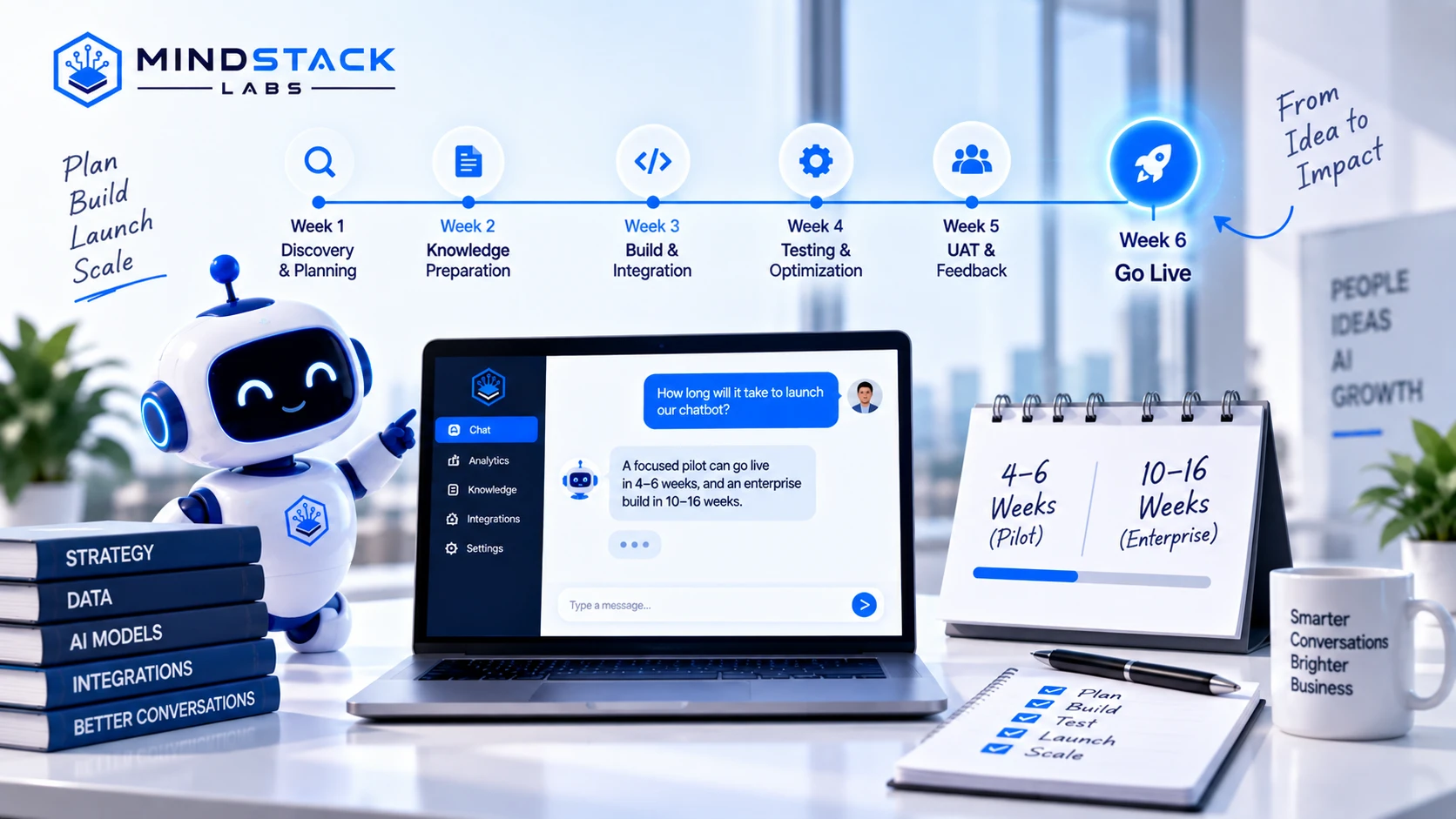
A focused pilot goes live in 4 to 6 weeks and an enterprise build in 10 to 16 weeks, assuming your content is ready. That last clause is doing a lot of work.
Pilot Timeline: 4 to 6 Weeks
Week | Focus | Deliverable |
|---|---|---|
1 | Support audit, intent mapping from ticket history | Prioritised intent list, success metrics |
2 | Knowledge base structuring | AI-readable content set |
3 | Build: retrieval layer, prompts, conversation flows | Working bot in staging |
4 | Testing against the real question set, escalation wiring | Accuracy report, tuned guardrails |
5 | UAT with your support team, fixes | Sign-off |
6 | Staged launch (10% traffic), monitoring | Live bot, dashboard |
Enterprise Timeline: 10 to 16 Weeks
Phase | Weeks | What happens |
|---|---|---|
Discovery and architecture | 1 to 3 | Multi-team workshops, system mapping, security review |
Knowledge and data engineering | 3 to 6 | Multiple sources, PII handling, residency decisions |
Build and integrations | 5 to 11 | Channels, CRM and helpdesk, auth, agentic actions |
Evaluation and hardening | 10 to 13 | Accuracy runs, load testing, red teaming |
Staged rollout | 13 to 16 | Traffic ramp by segment, monitoring, tuning |
The Five Things That Delay Chatbot Projects
Knowledge base cleanup nobody owned → adds 2 to 4 weeks
Integration credentials and security review → adds 1 to 3 weeks
No single decision-maker on tone and escalation policy → adds 1 to 2 weeks
Scope creep from "can it also do voice" mid-build → adds 3 weeks or more
No test set, so nobody can agree the bot is finished → indefinite
Four of those five are on the client side. Not a criticism, just a planning reality.
The Real Cost of a Production AI Chatbot
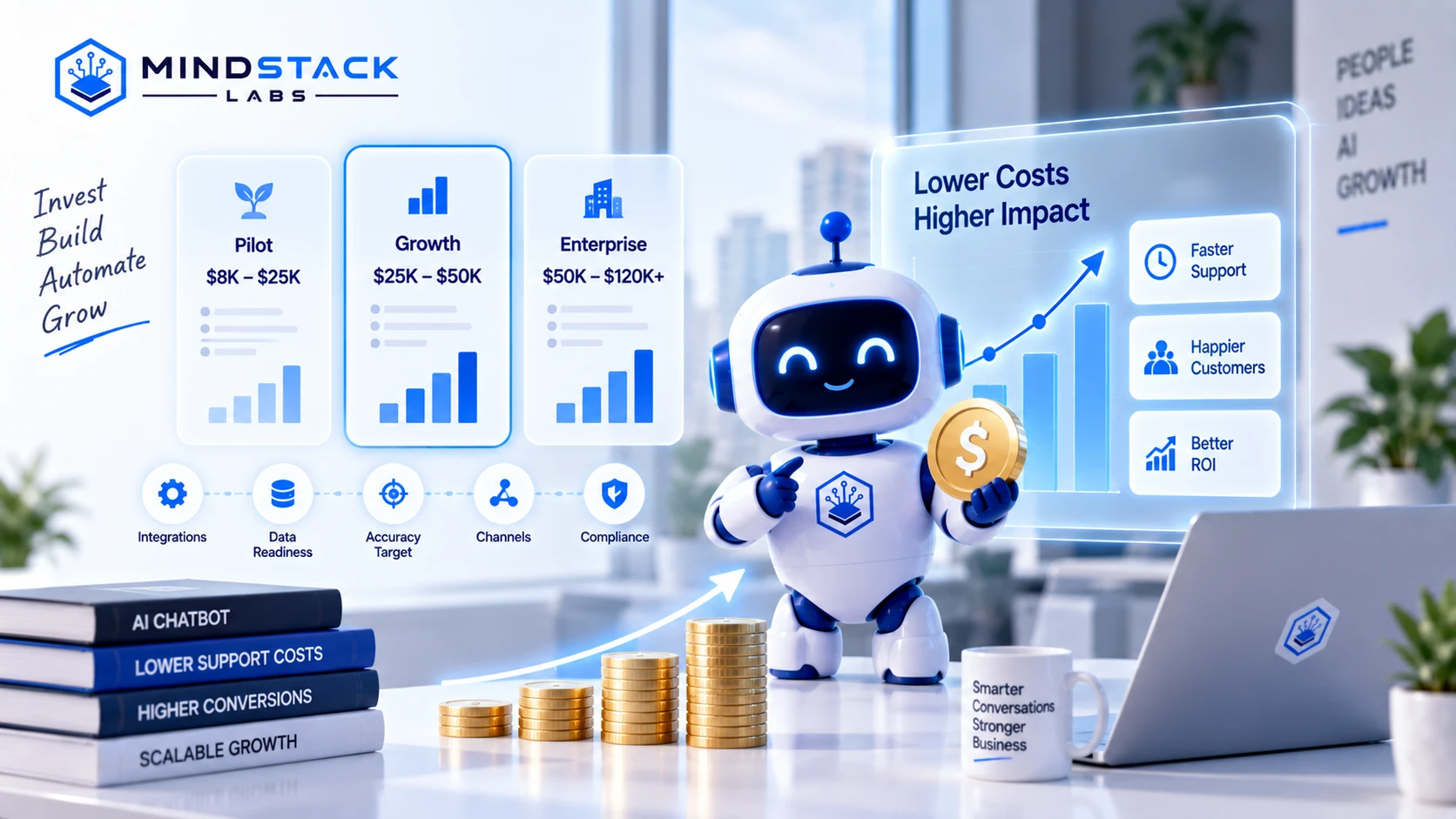
Budget the build and the first year of running it, because the second number surprises people more than the first.
Build Cost by Tier
Tier | Scope | Typical range | Timeline |
|---|---|---|---|
Pilot | 1 channel, 10 to 20 intents, 1 light integration | $8k to $25k | 4 to 6 weeks |
Growth | 2 channels, helpdesk and CRM writeback, 30+ intents | $25k to $50k | 8 to 12 weeks |
Enterprise | Multi-channel, auth, agentic actions, compliance work | $50k to $120k+ | 10 to 16 weeks |
These are ranges I have seen across market quotes and delivery, not a price list. Your number depends on the integration count more than anything else.
Cost Drivers, Ranked by Real Impact
→ Integration count and messiness = biggest single driver
→ Knowledge base condition = second biggest, and entirely within your control
→ Accuracy target = raising containment from 60% to 85% can add 30% to the build
→ Channel count = each new channel adds 15% to 25%
→ Compliance scope = 30% to 60% on regulated builds
→ Model choice = usually under 10% of total cost, despite being the thing buyers ask about first
Running Costs Nobody Puts in the Proposal
Cost line | Typical annual range | Notes |
|---|---|---|
LLM tokens and API usage | $600 to $9,000 | Scales with conversation volume and context size |
Hosting and vector database | $500 to $4,000 | Higher with self-hosted or strict residency needs |
Monitoring and logging | $300 to $2,000 | Skip this and you are flying blind |
Maintenance and retraining | $3,000 to $18,000 | Content changes, new intents, prompt versioning |
Helpdesk or platform seats | Varies | Existing spend, but check the AI add-on pricing |
In my experience, total year-one running cost lands at 15% to 30% of the build cost.
Year-One Total Cost of Ownership: Worked Example
A mid-market SaaS company, one website bot plus WhatsApp, Zendesk writeback, around 4,000 conversations a month:
Build: $32,000
Tokens and APIs: $2,400
Hosting and vector store: $1,200
Monitoring: $700
Maintenance retainer: $6,000
→ Year one total = approximately $42,300
Compare that to one additional full-time support hire and the payback maths usually writes itself.
How Cost Differs by Region
Region | Typical blended rate | Same pilot build |
|---|---|---|
USA and Canada | $120 to $220/hr | $40k to $70k |
UK and Western Europe | $90 to $170/hr | $30k to $55k |
Australia and Singapore | $90 to $160/hr | $30k to $50k |
Eastern Europe | $50 to $90/hr | $18k to $32k |
India | $25 to $60/hr | $8k to $22k |
The rate gap is real. The quality gap is not automatic in either direction, which is exactly why the evaluation criteria below matter more than the postcode.
Wait, You Might Be Thinking: Could We Just Use Intercom or Tidio?
Sometimes yes, and any vendor who tells you otherwise is selling, not advising.
If your support volume is under roughly 300 tickets a month, your questions are genuinely generic, and you need nothing from your own systems, an off-the-shelf AI add-on will serve you well for a fraction of the cost. Start there.
Custom becomes the right call when the bot needs your data, your logic, or your compliance posture.
Option | Upfront | Time to launch | Ceiling |
|---|---|---|---|
Platform AI add-on (Intercom, Tidio, Zendesk AI) | Low, per-resolution or per-seat | Days | Low: generic answers, limited system actions |
Custom AI chatbot development services | $8k to $120k | 4 to 16 weeks | High: your data, your actions, your guardrails |
In-house build | Salary cost of 2+ engineers | 3 to 9 months | High, if you retain the people |
What breaks first in-house? Not the prototype. The prototype is a good weekend. It is the evaluation harness, the retrieval tuning, and the on-call rota that quietly consume a senior engineer for two quarters.
Pricing Models and Contract Terms to Insist On
Pick fixed scope for a first build and time and material only once trust exists.
Model | Best when | Watch out for |
|---|---|---|
Fixed scope | Pilot with a locked intent list | Change requests priced painfully |
Time and material | Evolving scope, multiple integrations | Budget drift without weekly caps |
Dedicated team | Ongoing roadmap, multiple bots | Paying for idle capacity |
Non-negotiable contract terms, in my view:
Full IP ownership of code, prompts, and flows on final payment
Source code and documentation handover, not just platform access
NDA signed before discovery
A written accuracy target and the test set it is measured against
Named post-launch support window and what it covers
Pro tip: Ask for the prompt files and evaluation set in the deliverables list, because a vendor who will not hand those over has built you a rental, not an asset.
How to Evaluate an AI Chatbot Development Company
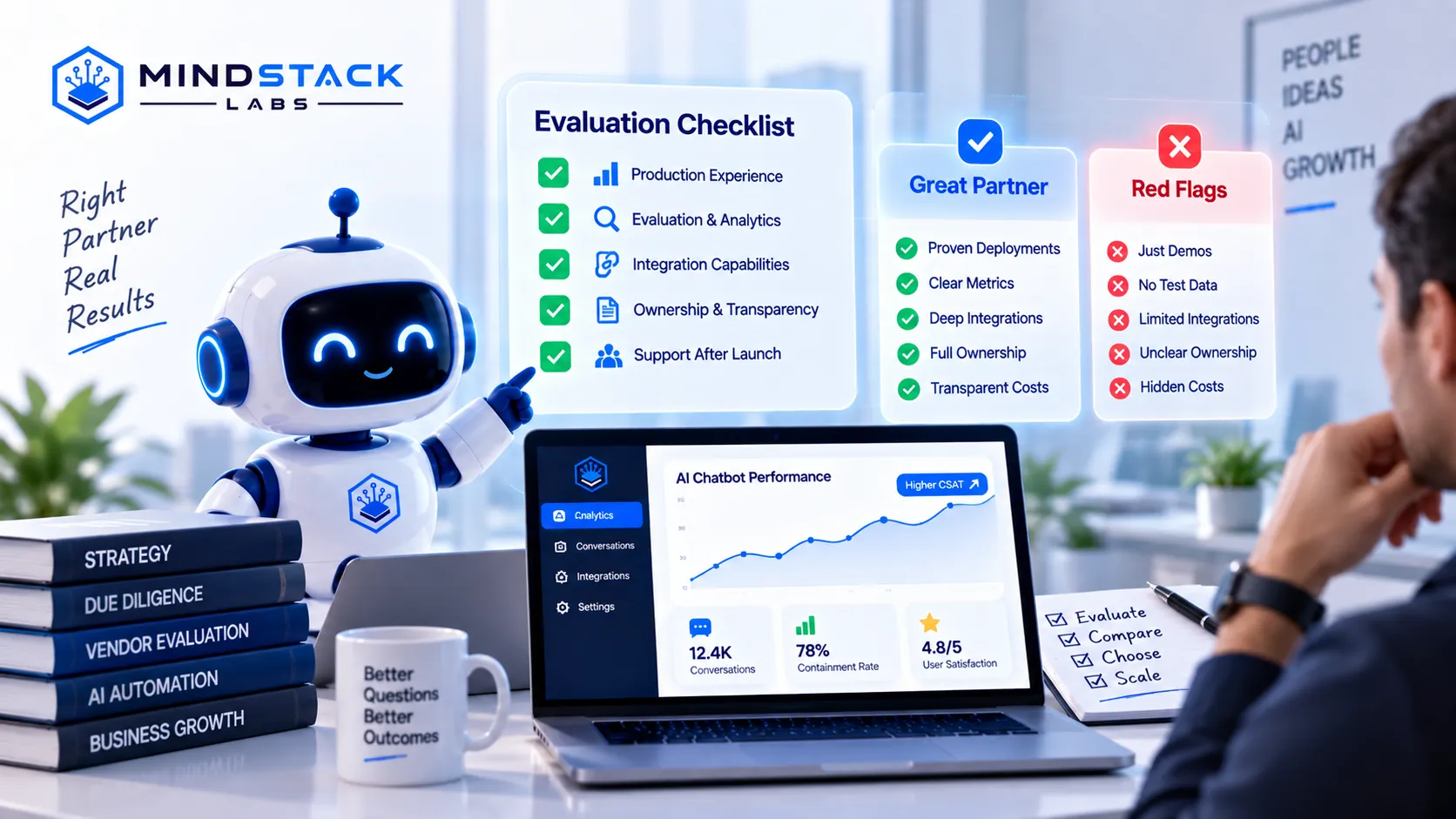
Judge vendors on evidence of production operation, not on demo polish.
Here is what I evaluate on, and it is the same rubric I would use on my own team:
Production evidence: live systems handling real volume, not pilots
Evaluation discipline: can they show how they measure accuracy
Integration depth: have they written to your class of system before
Ownership terms: code, prompts, and data handed over cleanly
Cost transparency: do they volunteer running costs unprompted
Ten Questions That Separate Builders From Resellers
How do you measure accuracy, and what do you report weekly?
What is your containment rate on comparable builds?
Who cleans the knowledge base, and is that in the quote?
What happens when the bot does not know the answer?
Which model do you use, and why that one?
How do you handle PII in logs?
What are my estimated monthly token costs at my volume?
Do I receive the prompts and evaluation set?
What does month two look like after launch?
Show me a conversation log where the bot failed and what you changed.
Question 10 is the one that ends most sales calls early. In a good way.
Red Flags in a Chatbot Proposal
Accuracy promised as a percentage with no test set behind it
No line item for knowledge base work
"Unlimited conversations" with no token cost discussion
No escalation design in the scope
Fixed price quoted before seeing your integration list
When you move from scoping to shortlisting, the criteria above are exactly what to score each vendor against.
How to Choose the Best AI Chatbot Development Services Provider
Choose the provider who shows you their failure logs, their evaluation method, and their running cost estimate before you ask. Everything else is packaging.
By this point you have a scope, a budget band, and a question list. The last decision is which type of partner fits the build you just defined.
What I Score Providers On
Five criteria, weighted in this order, because this is the order in which projects actually fail:
Production operating experience: live bots handling real monthly volume, with logs they will show you
Ownership and handover terms: code, prompts, evaluation set, and documentation transferred to you
Integration track record: proven writeback to your class of helpdesk, CRM, or order system
Accountability on accuracy: a written containment or accuracy target measured against a real test set
Cost honesty: year-one running costs volunteered in the proposal, not discovered in month three
The Four Types of Provider, Scored Honestly
Provider type | Genuine strength | Where it breaks | Best fit |
|---|---|---|---|
Platform vendor (Intercom, Zendesk AI, Tidio) | Live in days, no engineering effort, predictable per-resolution pricing | Generic answers, shallow system actions, no access to your prompts or retrieval layer | Under 300 tickets a month, generic questions |
Freelancer or small studio | Cheapest quote, fast prototype, direct access to the builder | Usually no evaluation harness, single point of failure, thin post-launch cover | Internal experiments, proof of concept |
Large systems integrator | Deep enterprise process, security reviews, multi-team coordination | $120 to $220 blended rates, 10 to 16 week discovery before code, junior delivery teams | Regulated enterprise programmes with committee sign-off |
Specialist AI build partner | Production focus, retrieval and guardrail depth, mid-market pricing | Capacity limits, and quality varies sharply between firms, so verify the criteria above | Pilot to growth-tier builds that must touch live systems |
Notice what decides this: not the logo, and not the hourly rate. It is whether the provider can prove operation, not just delivery.
Why Mind Stack Labs Scores Well Against Those Five Criteria
We sit in the specialist AI build partner row, and here is how we test against the same rubric I would use on anyone else:
Criterion | What we bring |
|---|---|
Production operating experience | Building AI systems and automation since 2019, 250+ automation systems delivered globally across the USA, UK, Europe, Australia, and Asia, with 70%+ of routine tickets auto-resolved on our AI customer support builds |
Ownership and handover | NDA before discovery, full IP ownership guaranteed, clean documented production-ready systems handed to your team |
Integration track record | Native work with Intercom, Zendesk, Freshdesk, and HubSpot Service Hub, built on your existing helpdesk with no migration |
Accountability on accuracy | Scenario test results and escalation rules are phase-three deliverables, then resolution rates and CSAT are monitored and tuned after launch |
Cost honesty | Scope, timeline, and cost tier mapped in the proposal, delivered within 24 hours, with a dedicated project manager and free 30-day post-launch support |
One caveat I will state plainly: if your volume is tiny and your questions are generic, a platform add-on is the better buy and we will tell you so on the call.
The Five-Step Selection Process I Recommend
Shortlist three providers, one from at least two different rows above
Send all three the identical RFP checklist from the scoping section
Ask each for a failed conversation log and the fix that followed
Compare year-one totals, build plus running costs, never build alone
Award the pilot, not the programme, and expand on evidence
→ Same scope + same questions + year-one totals = a comparison you can defend to finance.
Which Option Fits You
Map your top priority to a recommendation and stop comparing everything at once.
If speed matters most, go with a platform AI add-on now and a custom pilot next quarter
If ticket cost reduction matters most, go with a conversational pilot on your highest-volume intents
If the bot must act in your systems, go with a growth-tier custom build and budget for auth work
If you are in a regulated sector, go with a custom build and scope compliance in week one
If budget is the binding constraint, go with one channel, ten intents, and a written expansion plan
The Adjacent Decision Most Buyers Miss: Chat Is Rarely the Only Channel
Budget for the second channel during the first build, because retrofitting costs more than planning.
What I see happen repeatedly: a website bot succeeds, and within a quarter someone asks for WhatsApp, then voice. Each is a different engineering problem.
WhatsApp: official API onboarding, template approval, opt-in compliance. Worth it for order updates and appointment flows
Voice: latency budgets, interruption handling, speech models. A separate build, not a setting
Internal copilots: the same retrieval layer often serves your agents, not just customers
The reusable asset across all three is the retrieval and knowledge layer. Build that properly once and each new channel becomes an integration rather than a project. This is where a broader AI workflow automation view pays off, especially when the bot needs to trigger downstream processes or sync into an AI CRM system.
What ROI Looks Like and How to Prove It Internally
Measure cost per resolved ticket, not conversation count, because volume metrics prove nothing to a CFO.
Metric | What it tells you | Realistic target |
|---|---|---|
Containment rate | Share resolved with no human | 50% to 75% on mature builds |
Deflection rate | Tickets never created | 20% to 40% |
First response time | Customer experience win | Near instant |
Cost per resolved ticket | The CFO metric | 60% to 85% lower than human handling |
CSAT on bot conversations | Guardrail against false savings | Within 5 points of human CSAT |
Simple payback maths you can put in a deck:
Monthly tickets: 4,000
Fully loaded cost per human-handled ticket: $4
Containment at 60% → 2,400 tickets automated → $9,600 saved monthly
Build $32,000 plus $850 monthly running → payback in roughly 4 months
Run that with your own numbers before the first vendor call. It changes how you negotiate.
How We Scope and Deliver Chatbot Builds at Mind Stack Labs
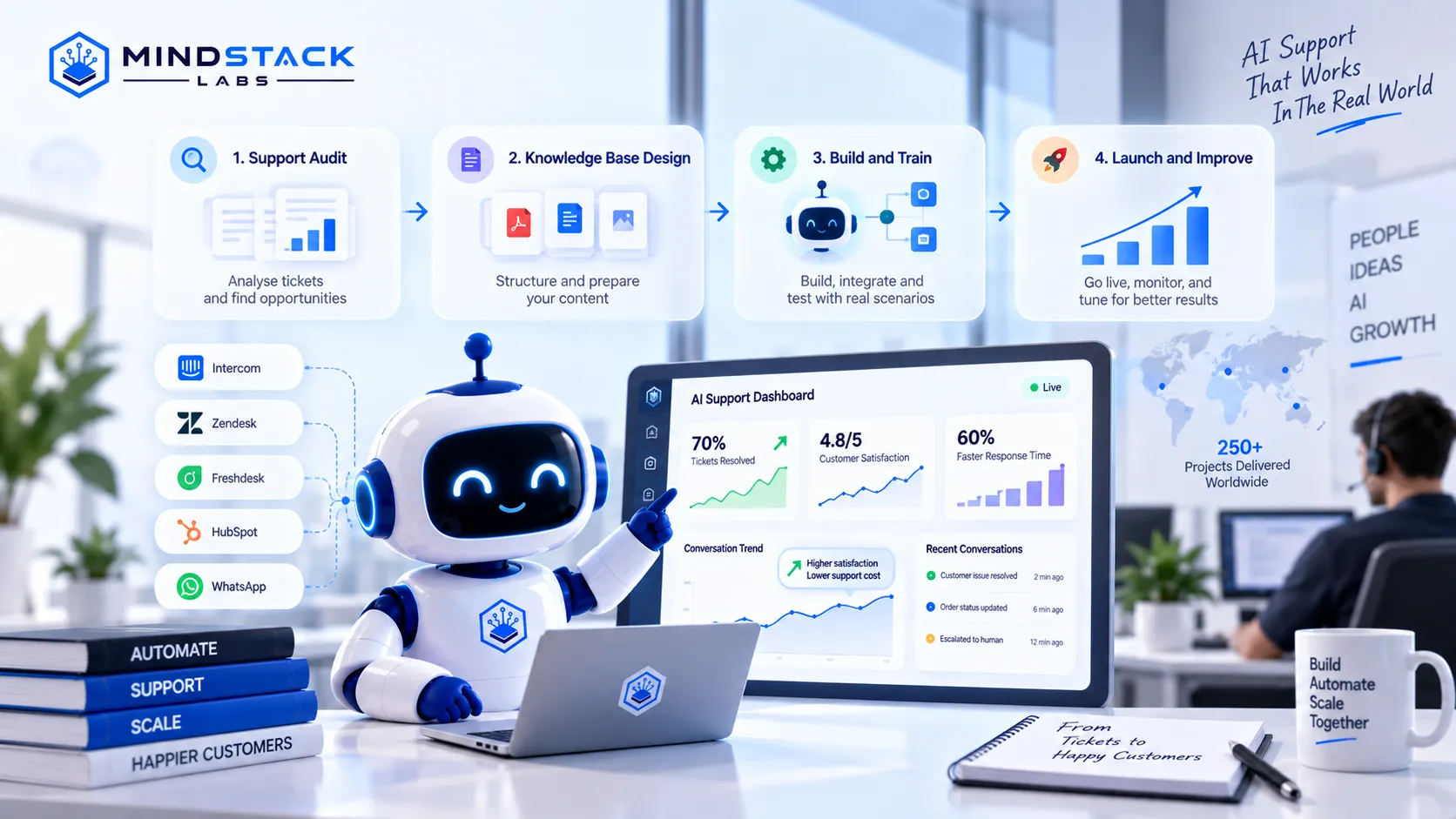
We run a four-phase process built around your ticket data, not a template.
Mind Stack Labs has been building AI systems and automation workflows since 2019, with 250+ automation systems delivered globally for clients across the USA, UK, Europe, Australia, and Asia. Our AI customer support builds resolve 70%+ of routine tickets without human involvement.
Phase | What we do | Output |
|---|---|---|
1. Support audit | Analyse ticket types, bottlenecks, escalation patterns | Category analysis, volume mapping, ROI plan |
2. Knowledge base design | Structure FAQs, policies, product specs into AI-readable form | Knowledge map |
3. Build and train | Build the system, train on your KB, test against real scenarios | Escalation rules, scenario test results |
4. Launch and improve | Go live, monitor resolution rates and CSAT, tune continuously | Live system, reporting dashboard |
What comes as standard:
Stack: GPT-4o, LangChain, n8n, Whisper, official WhatsApp Business API
Helpdesk integration with Intercom, Zendesk, Freshdesk, or HubSpot Service Hub
Smart escalation with full conversation context passed to the agent
Sentiment analysis, VIP detection, and SLA monitoring
Dedicated project manager per engagement
NDA and full IP ownership guaranteed
Free 30-day post-launch support, with longer maintenance plans available
Clean, documented, production-ready systems handed over to your team
We build on your existing helpdesk. No migration required.
My Recommendation
Start with a single-channel conversational pilot on your ten highest-volume intents, and only move to agentic actions once containment holds above 50% for a full month.
Use a platform add-on instead if you are under 300 tickets a month and need nothing from your own systems. Go straight to a growth-tier custom build if the bot must authenticate users or write to your CRM on day one.
Do not start with the model. Start with your ticket data and your test set. Everything else follows from those two things.
Frequently Asked Questions
How much do AI chatbot development services cost?
A production pilot typically runs $8,000 to $25,000, and enterprise builds run $35,000 to $120,000 or more. Integration count and knowledge base condition drive the number far more than model choice does.
How long does it take to build an AI chatbot?
Plan 4 to 6 weeks for a single-channel pilot and 10 to 16 weeks for a multi-system enterprise build. Timelines slip mostly on knowledge base cleanup and integration credentials, not on development.
Custom AI chatbot development vs Intercom AI: which is better?
Intercom-style platform AI wins on speed and cost for generic, low-volume support. Custom development wins when the bot must use your own data, take actions in your systems, or meet compliance requirements.
What are the ongoing costs of running an AI chatbot?
Expect 15% to 30% of build cost annually, covering LLM tokens, hosting, monitoring, and retraining. Ask any vendor for a token cost estimate at your actual conversation volume before signing.
Can an AI chatbot integrate with our CRM and helpdesk?
Yes. We integrate with Intercom, Zendesk, Freshdesk, HubSpot, and any platform with an API, syncing conversations and resolutions back automatically. No migration off your current helpdesk is needed.